 Add to Chrome
 Add to Firefox
 Add to Edge
Controlling Motion Transfer in Diffusion Transformers via Attention Heads
Jul 13, 2026
Diffusion Transformers (DiTs) have advanced video generation with high-quality, temporally coherent results. However, extending them to motion transfer, which requires following reference motion while aligning with a target prompt, remains challenging due to limited understanding of motion and structure representations within DiTs. We analyze video DiTs at the attention-head level and identify distinct heads specialized for motion and spatial structure. Based on this insight, we propose a head-aware controllable motion transfer framework that requires no parameter updates. Our method refines motion cues from motion-specialized heads via semantic correspondence guidance and preserves structure through selective feature injection. This head-level control not only enables accurate motion transfer but also provides an interpretable foundation for controllable video generation with DiTs.

Towards Continuous Sign Language Conversation from Isolated Signs
May 14, 2026Sign language is the primary language for many Deaf and Hard-of-Hearing (DHH) signers, yet most conversational AI systems still mediate interaction through spoken or written language. This spoken-language-centered interface can limit access for signers for whom spoken or written language is not the most accessible medium, motivating direct sign-to-sign conversational modeling. However, sentence-level sign video data are expensive to collect and annotate, leaving existing sign translation and production models with limited vocabulary coverage and weak open-domain generalization. We address this bottleneck by constructing continuous sign conversations from isolated signs: large-scale labeled isolated clips are collected as lexically grounded motion primitives and recomposed into sign-language-ordered utterances derived from existing dialogue corpora. We introduce SignaVox-W, which provides, to our knowledge, the largest labeled isolated-sign vocabulary to date, and SignaVox-U, a continuous 3D sign conversation dataset built from SignaVox-W. To bridge structural mismatch between spoken and signed languages, we use a retrieval-guided spoken-to-gloss translator; to bridge independently collected isolated clips, we propose BRAID, a diffusion Transformer that performs duration alignment and co-articulatory boundary inpainting. With the resulting data, we train SignaVox, a direct sign-to-sign conversational model that generates 3D body, hand, and facial motion responses from prior signing context without spoken-language text or externally provided glosses at inference time. Quantitative and qualitative evaluations show improved isolated-to-continuous motion quality, stronger response-level semantic alignment, and scalable signer-centered interaction that better supports visual-spatial articulation.
ClinicalTrialsHub: Bridging Registries and Literature for Comprehensive Clinical Trial Access
Dec 09, 2025
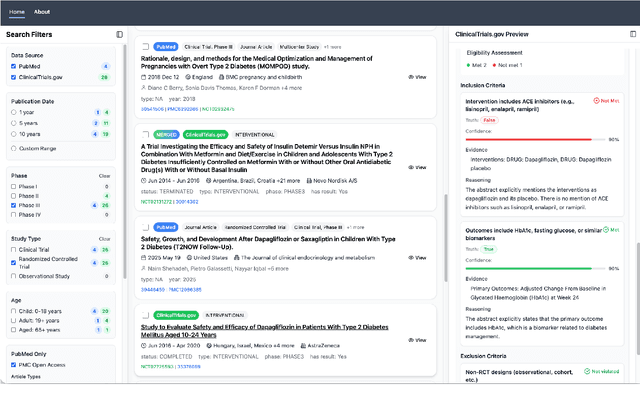
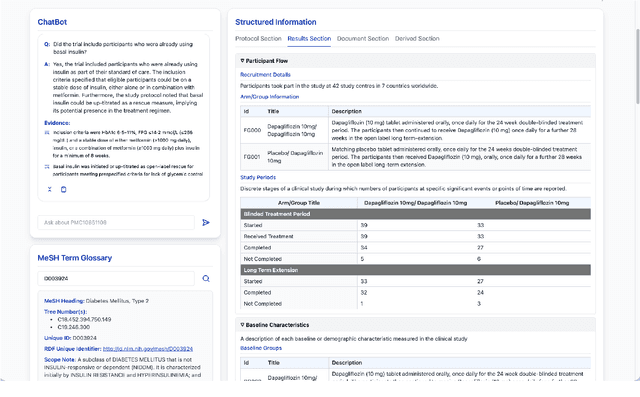
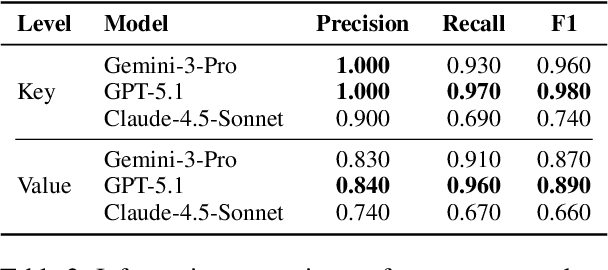
We present ClinicalTrialsHub, an interactive search-focused platform that consolidates all data from ClinicalTrials.gov and augments it by automatically extracting and structuring trial-relevant information from PubMed research articles. Our system effectively increases access to structured clinical trial data by 83.8% compared to relying on ClinicalTrials.gov alone, with potential to make access easier for patients, clinicians, researchers, and policymakers, advancing evidence-based medicine. ClinicalTrialsHub uses large language models such as GPT-5.1 and Gemini-3-Pro to enhance accessibility. The platform automatically parses full-text research articles to extract structured trial information, translates user queries into structured database searches, and provides an attributed question-answering system that generates evidence-grounded answers linked to specific source sentences. We demonstrate its utility through a user study involving clinicians, clinical researchers, and PhD students of pharmaceutical sciences and nursing, and a systematic automatic evaluation of its information extraction and question answering capabilities.
Disentangling Disentangled Representations: Towards Improved Latent Units via Diffusion Models
Oct 31, 2024Disentangled representation learning (DRL) aims to break down observed data into core intrinsic factors for a profound understanding of the data. In real-world scenarios, manually defining and labeling these factors are non-trivial, making unsupervised methods attractive. Recently, there have been limited explorations of utilizing diffusion models (DMs), which are already mainstream in generative modeling, for unsupervised DRL. They implement their own inductive bias to ensure that each latent unit input to the DM expresses only one distinct factor. In this context, we design Dynamic Gaussian Anchoring to enforce attribute-separated latent units for more interpretable DRL. This unconventional inductive bias explicitly delineates the decision boundaries between attributes while also promoting the independence among latent units. Additionally, we also propose Skip Dropout technique, which easily modifies the denoising U-Net to be more DRL-friendly, addressing its uncooperative nature with the disentangling feature extractor. Our methods, which carefully consider the latent unit semantics and the distinct DM structure, enhance the practicality of DM-based disentangled representations, demonstrating state-of-the-art disentanglement performance on both synthetic and real data, as well as advantages in downstream tasks.