 Add to Chrome
 Add to Firefox
 Add to Edge
Reinforcement Learning with Robust Rubric Rewards
May 28, 2026
While Reinforcement Learning with Verifiable Rewards (RLVR) is effective for deterministically checkable tasks, many vision-language tasks are partially verifiable, demanding multi-criteria supervision (e.g., perceptual details, reasoning steps, and constraints). Rubrics provide a natural interface for this fine-grained supervision, but their effectiveness depends on the execution accuracy during online RL. We propose Reinforcement Learning with Robust Rubric Rewards ($\text{RLR}^3$), extending RLVR from task-level verification to criterion-level verification. $\text{RLR}^3$ routes instance-specific rubrics through two execution paths: an LLM-as-an-extractor paired with a deterministic verifier, or an LLM-as-a-Judge for non-verifiable criteria. To ensure faithful scoring, $\text{RLR}^3$ introduce a minimal exposure strategy that masks ground truths from extractors and images from judges. Furthermore, $\text{RLR}^3$ employs hierarchical aggregation to prioritize essential criteria over additional criteria, and mitigates score saturation within rollout groups. Evaluated on Qwen3-VL-30B-A3B across 15 benchmarks, $\text{RLR}^3$ consistently outperforms RLVR, yielding a 4.7-point improvement over the base model and exceeding the official instruct-to-thinking model gap. Controlled audits confirm our deterministic verification and minimal exposure significantly reduce exploitable false positives.

Visual Preference Optimization with Rubric Rewards
Apr 14, 2026The effectiveness of Direct Preference Optimization (DPO) depends on preference data that reflect the quality differences that matter in multimodal tasks. Existing pipelines often rely on off-policy perturbations or coarse outcome-based signals, which are not well suited to fine-grained visual reasoning. We propose rDPO, a preference optimization framework based on instance-specific rubrics. For each image-instruction pair, we create a checklist-style rubric of essential and additional criteria to score responses from any possible policies. The instruction-rubric pool is built offline and reused during the construction of on-policy data. On public reward modeling benchmarks, rubric-based prompting massively improves a 30B-A3B judge and brings it close to GPT-5.4. On public downstream benchmarks, rubric-based filtering raises the macro average to 82.69, whereas outcome-based filtering drops it to 75.82 from 81.14. When evaluating scalability on a comprehensive benchmark, rDPO achieves 61.01, markedly outperforming the style-constrained baseline (52.36) and surpassing the 59.48 base model. Together, these results show that visual preference optimization benefits from combining on-policy data construction with instance-specific criterion-level feedback.
TextHawk: Exploring Efficient Fine-Grained Perception of Multimodal Large Language Models
Apr 14, 2024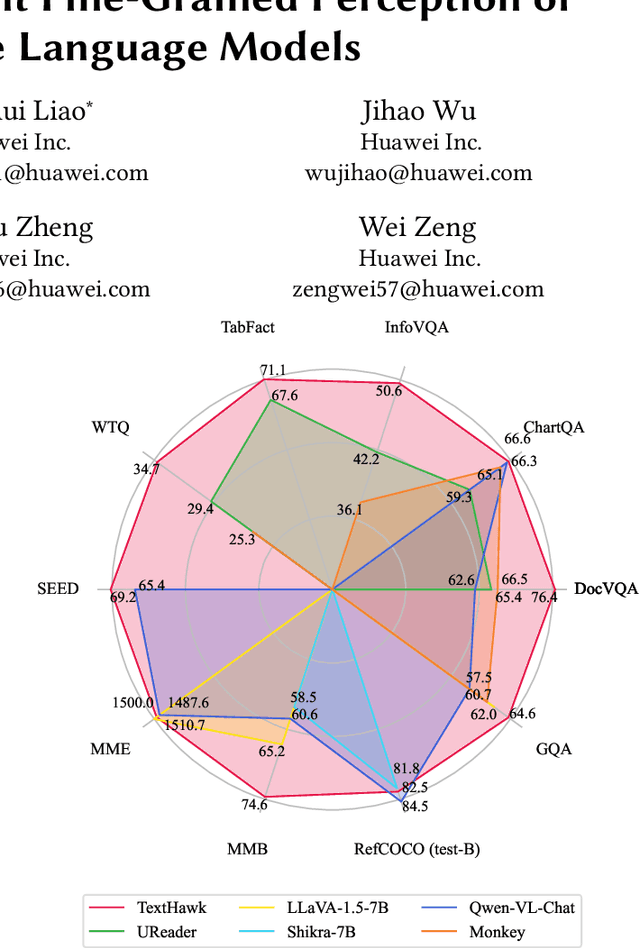
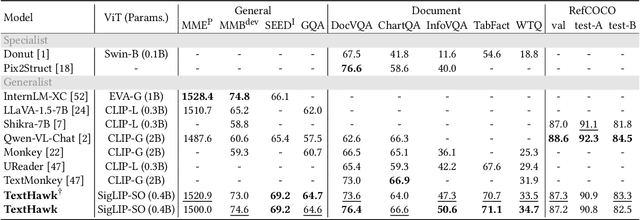
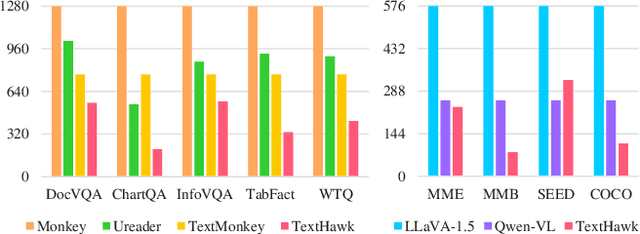

Multimodal Large Language Models (MLLMs) have shown impressive results on various multimodal tasks. However, most existing MLLMs are not well suited for document-oriented tasks, which require fine-grained image perception and information compression. In this paper, we present TextHawk, a MLLM that is specifically designed for document-oriented tasks, while preserving the general capabilities of MLLMs. TextHawk is aimed to explore efficient fine-grained perception by designing four dedicated components. Firstly, a ReSampling and ReArrangement (ReSA) module is proposed to reduce the redundancy in the document texts and lower the computational cost of the MLLM. We explore encoding the positions of each local feature by presenting Scalable Positional Embeddings (SPEs), which can preserve the scalability of various image sizes. A Query Proposal Network (QPN) is then adopted to initialize the queries dynamically among different sub-images. To further enhance the fine-grained visual perceptual ability of the MLLM, we design a Multi-Level Cross-Attention (MLCA) mechanism that captures the hierarchical structure and semantic relations of document images. Furthermore, we create a new instruction-tuning dataset for document-oriented tasks by enriching the multimodal document data with Gemini Pro. We conduct extensive experiments on both general and document-oriented MLLM benchmarks, and show that TextHawk outperforms the state-of-the-art methods, demonstrating its effectiveness and superiority in fine-grained document perception and general abilities.