 Add to Chrome
 Add to Firefox
 Add to Edge
FiSeR: Fine-Grained Source Representations for Cross-Domain AI Image Detection
May 30, 2026
Real-world synthetic image detectors often generalize poorly under domain shift despite strong in-domain performance. Using unsupervised UMAP projections, we find that natural and synthetic features remain partially separable on unseen datasets, yet performance still drops, suggesting that the classification head overfits to training-domain artifacts. Therefore, the key is to learn more transferable representations so that the decision criterion is more stable and robust to domain shifts. Based on the structural fact that synthetic images are produced by diverse generators, we propose a hierarchical contrastive learning framework that improves the separability between natural and synthetic images while preserving generator identity information. It jointly optimizes (i) a coarse contrastive objective between natural and synthetic images and (ii) a fine contrastive objective among synthetic images using generator identities. Trained on WildFake, our method achieves an average AUROC gain of +10.22 on cross-domain evaluation over Chameleon, AIGIBench, Community Forensics, and GenImage under the same settings as the strong baseline DIRE. For few-shot adaptation, we freeze the backbone and fit an SVM head on 10 labeled samples per class, improving AUROC by +10.64 on AIGIBench and +17.41 on Chameleon, averaged over 12 widely used detectors. Our code is publicly available at: https://github.com/heyongxin233/FiSeR.

DeTeCtive: Detecting AI-generated Text via Multi-Level Contrastive Learning
Oct 28, 2024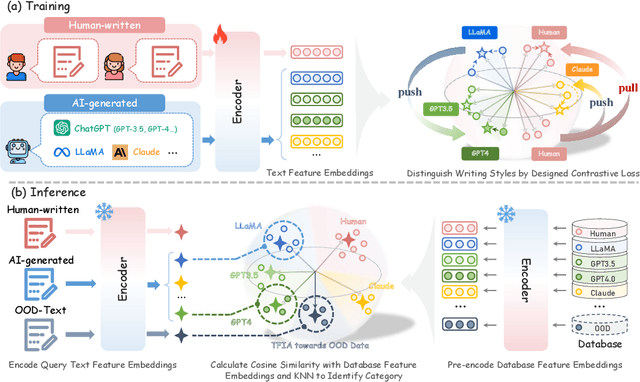
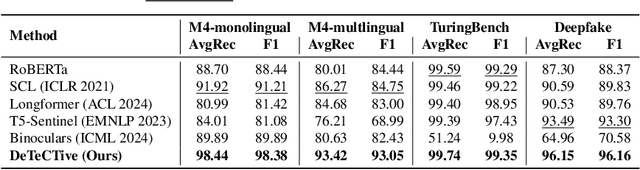


Current techniques for detecting AI-generated text are largely confined to manual feature crafting and supervised binary classification paradigms. These methodologies typically lead to performance bottlenecks and unsatisfactory generalizability. Consequently, these methods are often inapplicable for out-of-distribution (OOD) data and newly emerged large language models (LLMs). In this paper, we revisit the task of AI-generated text detection. We argue that the key to accomplishing this task lies in distinguishing writing styles of different authors, rather than simply classifying the text into human-written or AI-generated text. To this end, we propose DeTeCtive, a multi-task auxiliary, multi-level contrastive learning framework. DeTeCtive is designed to facilitate the learning of distinct writing styles, combined with a dense information retrieval pipeline for AI-generated text detection. Our method is compatible with a range of text encoders. Extensive experiments demonstrate that our method enhances the ability of various text encoders in detecting AI-generated text across multiple benchmarks and achieves state-of-the-art results. Notably, in OOD zero-shot evaluation, our method outperforms existing approaches by a large margin. Moreover, we find our method boasts a Training-Free Incremental Adaptation (TFIA) capability towards OOD data, further enhancing its efficacy in OOD detection scenarios. We will open-source our code and models in hopes that our work will spark new thoughts in the field of AI-generated text detection, ensuring safe application of LLMs and enhancing compliance. Our code is available at https://github.com/heyongxin233/DeTeCtive.