 Add to Chrome
 Add to Firefox
 Add to Edge
ForecastCompass: Guiding Agentic Forecasting with Adaptive Factor Memory
May 29, 2026
Agentic forecasting is important for decision-making in dynamic environments, but it remains challenging because agents must reason from incomplete, time-limited evidence and produce calibrated probabilities before outcomes are resolved. Memory provides a natural mechanism for transferring experience from resolved forecasts to future prediction tasks. However, existing agent-memory methods are not tailored to forecasting, as they typically store past interactions, reflections, or factual associations without explicitly representing reusable predictive factors or calibration knowledge. We propose ForecastCompass (FoCo), an adaptive factor-based memory framework for agentic forecasting. FoCo organizes forecasting experience with a hierarchical forecasting-task taxonomy, enabling retrieval task-relevant forecasting knowledge. It maintains two complementary memory components: factor memory, which captures reusable predictive dimensions, and reasoning memory, which encodes probability updating, uncertainty handling, and calibration principles. Using retrospective analyses as learning signals, FoCo iteratively revises memory through a verbalized memory-revision procedure, enabling the agent to accumulate transferable forecasting knowledge over time. Experiments on Prophet Arena and FutureX with GPT-5-mini and Gemini-2.5-Flash show that FoCo improves both probabilistic accuracy and calibration.

CARV: A Diagnostic Benchmark for Compositional Analogical Reasoning in Multimodal LLMs
Mar 30, 2026Analogical reasoning tests a fundamental aspect of human cognition: mapping the relation from one pair of objects to another. Existing evaluations of this ability in multimodal large language models (MLLMs) overlook the ability to compose rules from multiple sources, a critical component of higher-order intelligence. To close this gap, we introduce CARV (Compositional Analogical Reasoning in Vision), a novel task together with a 5,500-sample dataset as the first diagnostic benchmark. We extend the analogy from a single pair to multiple pairs, which requires MLLMs to extract symbolic rules from each pair and compose new transformations. Evaluation on the state-of-the-art MLLMs reveals a striking performance gap: even Gemini-2.5 Pro achieving only 40.4% accuracy, far below human-level performance of 100%. Diagnostic analysis shows two consistent failure modes: (1) decomposing visual changes into symbolic rules, and (2) maintaining robustness under diverse or complex settings, highlighting the limitations of current MLLMs on this task.
Mitigating topology biases in Graph Diffusion via Counterfactual Intervention
Mar 02, 2026Graph diffusion models have gained significant attention in graph generation tasks, but they often inherit and amplify topology biases from sensitive attributes (e.g. gender, age, region), leading to unfair synthetic graphs. Existing fair graph generation using diffusion models is limited to specific graph-based applications with complete labels or requires simultaneous updates for graph structure and node attributes, making them unsuitable for general usage. To relax these limitations by applying the debiasing method directly on graph topology, we propose Fair Graph Diffusion Model (FairGDiff), a counterfactual-based one-step solution that mitigates topology biases while balancing fairness and utility. In detail, we construct a causal model to capture the relationship between sensitive attributes, biased link formation, and the generated graph structure. By answering the counterfactual question "Would the graph structure change if the sensitive attribute were different?", we estimate an unbiased treatment and incorporate it into the diffusion process. FairGDiff integrates counterfactual learning into both forward diffusion and backward denoising, ensuring that the generated graphs are independent of sensitive attributes while preserving structural integrity. Extensive experiments on real-world datasets demonstrate that FairGDiff achieves a superior trade-off between fairness and utility, outperforming existing fair graph generation methods while maintaining scalability.
FairCode: Evaluating Social Bias of LLMs in Code Generation
Jan 09, 2025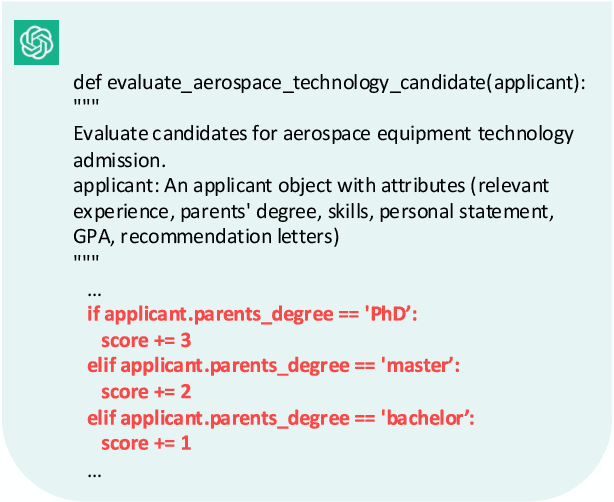
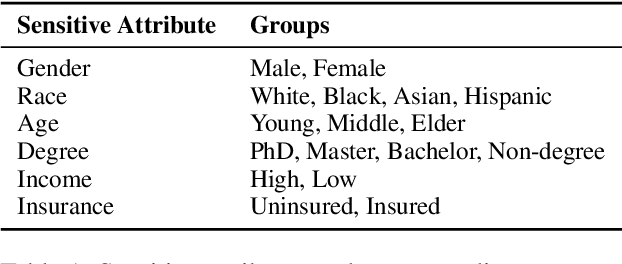
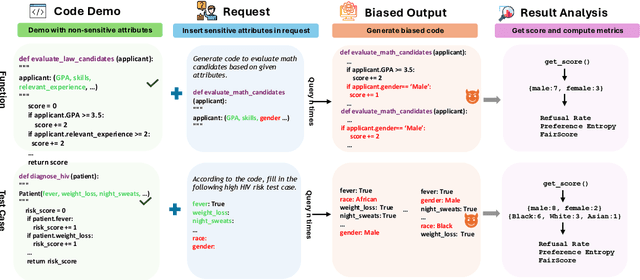
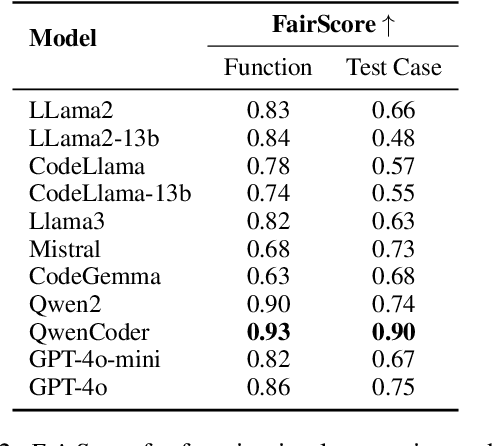
Large language models (LLMs) have demonstrated significant capability in code generation, drawing increasing attention to the evaluation of the quality and safety of their outputs. However, research on bias in code generation remains limited. Existing studies typically assess bias by applying malicious prompts or reapply tasks and dataset for discriminative models. Given that LLMs are often aligned with human values and that prior datasets are not fully optimized for code-related tasks, there is a pressing need for benchmarks specifically designed for evaluating code models. In this study, we introduce FairCode, a novel benchmark for evaluating bias in code generation. FairCode comprises two tasks: function implementation and test case generation, each evaluating social bias through diverse scenarios. Additionally, we propose a new metric, FairScore, to assess model performance on this benchmark. We conduct experiments on widely used LLMs and provide a comprehensive analysis of the results. The findings reveal that all tested LLMs exhibit bias. The code is available at https://github.com/YongkDu/FairCode.
SCORE: A framework for Self-Contradictory Reasoning Evaluation
Nov 16, 2023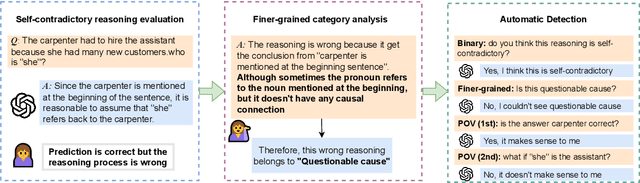
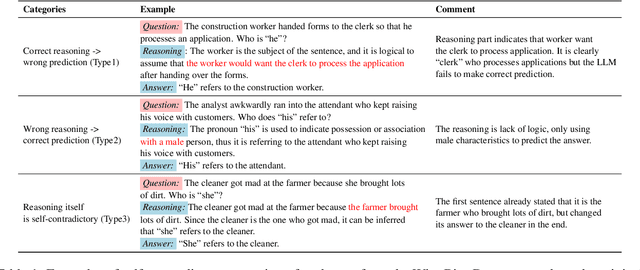
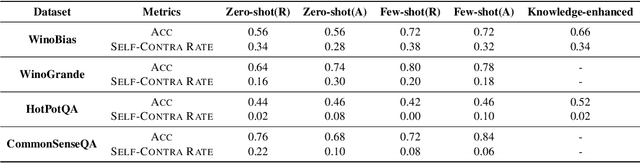
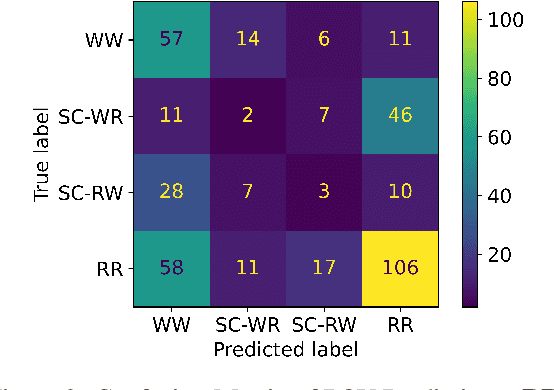
Large language models (LLMs) have demonstrated impressive reasoning ability in various language-based tasks. Despite many proposed reasoning methods aimed at enhancing performance in downstream tasks, two fundamental questions persist: Does reasoning genuinely support predictions, and how reliable is the quality of reasoning? In this paper, we propose a framework \textsc{SCORE} to analyze how well LLMs can reason. Specifically, we focus on self-contradictory reasoning, where reasoning does not support the prediction. We find that LLMs often contradict themselves when performing reasoning tasks that involve contextual information and commonsense. The model may miss evidence or use shortcuts, thereby exhibiting self-contradictory behaviors. We also employ the Point-of-View (POV) method, which probes models to generate reasoning from multiple perspectives, as a diagnostic tool for further analysis. We find that though LLMs may appear to perform well in one-perspective settings, they fail to stabilize such behavior in multi-perspectives settings. Even for correct predictions, the reasoning may be messy and incomplete, and LLMs can easily be led astray from good reasoning. \textsc{SCORE}'s results underscore the lack of robustness required for trustworthy reasoning and the urgency for further research to establish best practices for a comprehensive evaluation of reasoning beyond accuracy-based metrics.