 Add to Chrome
 Add to Firefox
 Add to Edge
Drawing-Recode: Annotation Grounding for Parametric CAD Code Generation from Raster 2D CAD Drawings
Jul 30, 2026
Recovering Parametric CAD sequences from raster-format 2D Computer-Aided Design (CAD) drawings accumulated prior to digital transformation is important for part reproduction and manufacturing process automation. However, existing studies either process only vector drawings or are limited to specific domains, and fail to explicitly connect dimensional annotations to geometric information, limiting their use of dimensional information for 3D Parametric CAD sequences recovery. We propose Drawing-Recode, a framework that generates Parametric CAD sequences as CAD code from raster 2D CAD drawings. Drawing-Recode extracts geometric features via an image encoder and recognizes annotations through a separate text recognition module, then explicitly grounds annotations to geometric information using cross-attention and our proposed Annotation Grounding Loss (AGL). The resulting features are fed into a Large Language Model (LLM) to generate CAD code in the Structured Parametric CAD Code (SPCC) format. Experiments show that Drawing-Recode outperforms existing baselines and remains robust on scanned drawings resembling industrial conditions. We expect Drawing-Recode contributes to digitizing raster 2D CAD drawings in industrial settings and to part reproduction and manufacturing automation.

Efficient Upper Mid-Band Spectrum Sensing with Multiple Signals
Jul 03, 2026Spectrum sensing is a fundamental problem in the upper mid-band, where spectrum resources are shared with incumbent systems. This paper considers frequency-domain occupancy estimation when the number of primary user signals, their bandwidths, and their signal-to-noise ratios are all unknown. We develop a generalized likelihood ratio test and a computationally efficient search procedure that combines binary search with dynamic programming to select the set of intervals maximizing the sum of log-likelihoods. The proposed method is validated through both simulation data and over-the-air experimental data using an upper mid-band software-defined radio (SDR), demonstrating its practical applicability.
PARTREP: Learning What to Repeat for Decoder-only LLMs
Jul 02, 2026While decoder-only LLMs excel at a vast array of natural language tasks, it suffers from an asymmetric information flow induced by causal attention: later tokens are richer in contextual grounding than earlier ones. A simple and effective remedy is prompt repetition -- just appending a second copy of prompt before generation can redistribute grounding across positions and improve reasoning performance. However, full repetition of the original prompt doubles the KV cache footprint and quadruples attention cost during prefill, making it impractical for long-context settings. We propose PartRep, a selective augmentation method that appends only the most informative tokens -- rather than the entire prompt. We use token-wise negative log-likelihood (NLL) as a selection signal, motivated by the hypothesis that less predictable tokens are less recoverable from surrounding context and therefore benefit more from late-position repetition. To avoid the heavy cost of a full forward pass for scoring, we train a lightweight gate that predicts high-NLL tokens from early-layer hidden states, enabling token selection during mid-prefill via early exit. Across eight benchmarks (including MMLU, GSM8K, and RULER) and three model families (Qwen2.5, Llama3.2, Gemma4), PartRep retains most of the gains of full repetition while using only 59.4\% of its KV cache and 79.0\% of its prefill FLOPs.
A Self-Calibrating SDR for High Fidelity Beam- and Null-forming Arrays
Apr 02, 2026Null forming is increasingly essential in modern wireless systems for spectrum-sharing, anti-jamming, and covert communications in contested and congested environments. Achieving deep nulls, however, is far more demanding than conventional beam steering: nulls are intrinsically narrow, and even small phase, timing, or gain mismatches across RF chains can significantly degrade suppression. This work develops and validates a self-calibrating SDR architecture tailored for high-fidelity null forming using a compact reference transmitter directionally coupled to the antenna feeds. We demonstrate the effectiveness of the approach through simulation and experimental measurements on an SDR platform operating from 3.0 to 3.5GHz, a band of growing importance for Department of Defense spectrum-sharing initiatives.
BrepCoder: A Unified Multimodal Large Language Model for Multi-task B-rep Reasoning
Feb 25, 2026Recent advancements in deep learning have actively addressed complex challenges within the Computer-Aided Design (CAD) domain.However, most existing approaches rely on task-specifi c models requiring structural modifi cations for new tasks, and they predominantly focus on point clouds or images rather than the industry-standard Boundary Representation (B-rep) format. To address these limitations, we propose BrepCoder, a unifi ed Multimodal Large Language Model (MLLM) that performs diverse CAD tasks from B-rep inputs. By leveraging the code generation capabilities of Large Language Models (LLMs), we convert CAD modeling sequences into Python-like code and align them with B-rep. We then adopt a two-stage training strategy: First, pre-training on reverse engineering to learn geometric features and design logic. Second, eff ectively extending the model to various downstream tasks such as completion, error correction, and CAD-QA. Consequently, by interpreting B-rep as structural code, BrepCoder achieves superior generalization across diverse tasks, demonstrating its potential as a general-purpose CAD agent.
Hybrid Federated Learning for Noise-Robust Training
Jan 08, 2026Federated learning (FL) and federated distillation (FD) are distributed learning paradigms that train UE models with enhanced privacy, each offering different trade-offs between noise robustness and learning speed. To mitigate their respective weaknesses, we propose a hybrid federated learning (HFL) framework in which each user equipment (UE) transmits either gradients or logits, and the base station (BS) selects the per-round weights of FL and FD updates. We derive convergence of HFL framework and introduce two methods to exploit degrees of freedom (DoF) in HFL, which are (i) adaptive UE clustering via Jenks optimization and (ii) adaptive weight selection via a damped Newton method. Numerical results show that HFL achieves superior test accuracy at low SNR when both DoF are exploited.
ZIP: An Efficient Zeroth-order Prompt Tuning for Black-box Vision-Language Models
Apr 09, 2025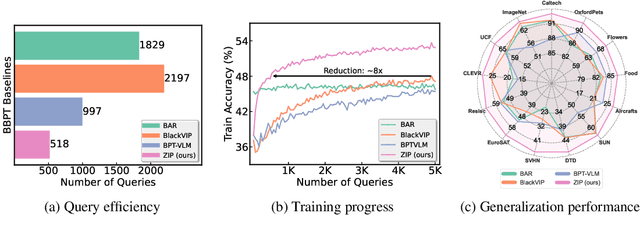
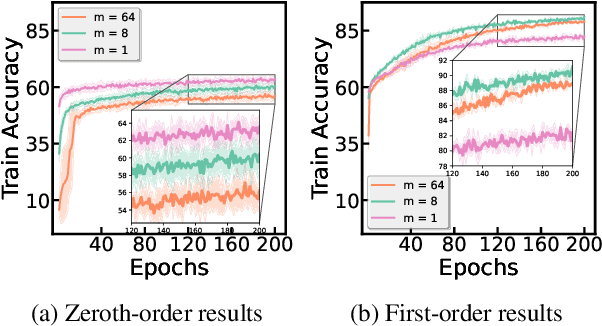
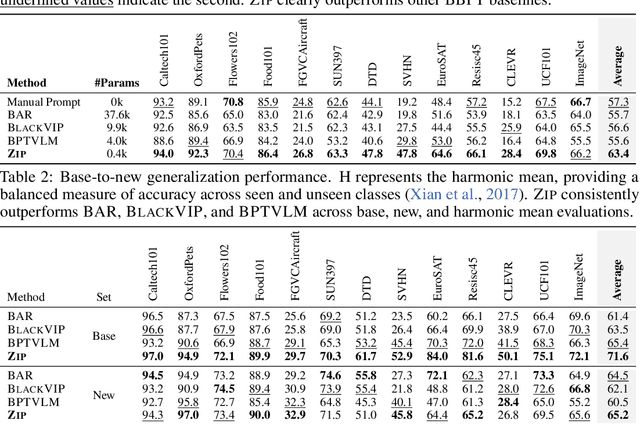
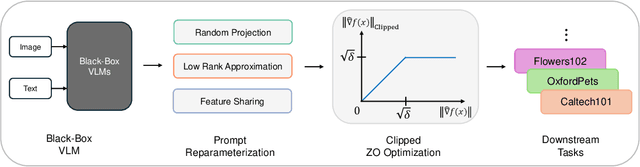
Recent studies have introduced various approaches for prompt-tuning black-box vision-language models, referred to as black-box prompt-tuning (BBPT). While BBPT has demonstrated considerable potential, it is often found that many existing methods require an excessive number of queries (i.e., function evaluations), which poses a significant challenge in real-world scenarios where the number of allowed queries is limited. To tackle this issue, we propose Zeroth-order Intrinsic-dimensional Prompt-tuning (ZIP), a novel approach that enables efficient and robust prompt optimization in a purely black-box setting. The key idea of ZIP is to reduce the problem dimensionality and the variance of zeroth-order gradient estimates, such that the training is done fast with far less queries. We achieve this by re-parameterizing prompts in low-rank representations and designing intrinsic-dimensional clipping of estimated gradients. We evaluate ZIP on 13+ vision-language tasks in standard benchmarks and show that it achieves an average improvement of approximately 6% in few-shot accuracy and 48% in query efficiency compared to the best-performing alternative BBPT methods, establishing a new state of the art. Our ablation analysis further shows that the proposed clipping mechanism is robust and nearly optimal, without the need to manually select the clipping threshold, matching the result of expensive hyperparameter search.
Knowledge Distillation from Language-Oriented to Emergent Communication for Multi-Agent Remote Control
Jan 23, 2024

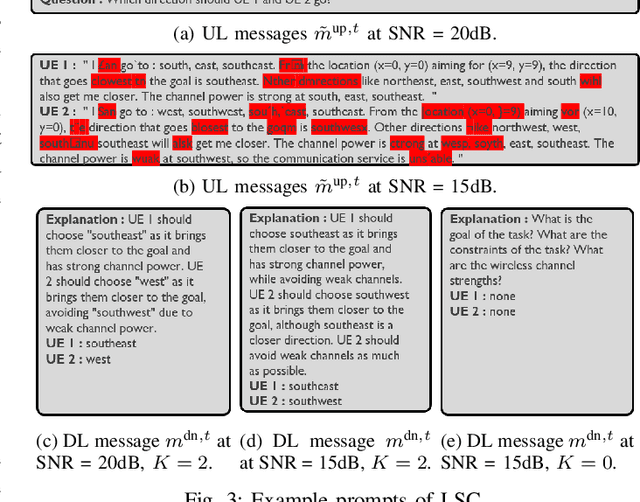

In this work, we compare emergent communication (EC) built upon multi-agent deep reinforcement learning (MADRL) and language-oriented semantic communication (LSC) empowered by a pre-trained large language model (LLM) using human language. In a multi-agent remote navigation task, with multimodal input data comprising location and channel maps, it is shown that EC incurs high training cost and struggles when using multimodal data, whereas LSC yields high inference computing cost due to the LLM's large size. To address their respective bottlenecks, we propose a novel framework of language-guided EC (LEC) by guiding the EC training using LSC via knowledge distillation (KD). Simulations corroborate that LEC achieves faster travel time while avoiding areas with poor channel conditions, as well as speeding up the MADRL training convergence by up to 61.8% compared to EC.