 Add to Chrome
 Add to Firefox
 Add to Edge
A Self-Calibrating SDR for High Fidelity Beam- and Null-forming Arrays
Apr 02, 2026
Null forming is increasingly essential in modern wireless systems for spectrum-sharing, anti-jamming, and covert communications in contested and congested environments. Achieving deep nulls, however, is far more demanding than conventional beam steering: nulls are intrinsically narrow, and even small phase, timing, or gain mismatches across RF chains can significantly degrade suppression. This work develops and validates a self-calibrating SDR architecture tailored for high-fidelity null forming using a compact reference transmitter directionally coupled to the antenna feeds. We demonstrate the effectiveness of the approach through simulation and experimental measurements on an SDR platform operating from 3.0 to 3.5GHz, a band of growing importance for Department of Defense spectrum-sharing initiatives.

Cellular Wireless Networks in the Upper Mid-Band
Sep 11, 2023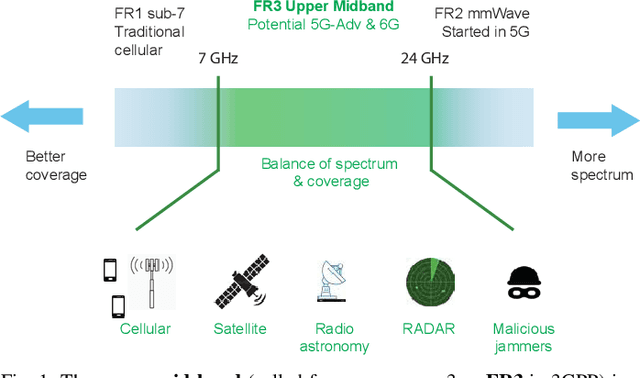
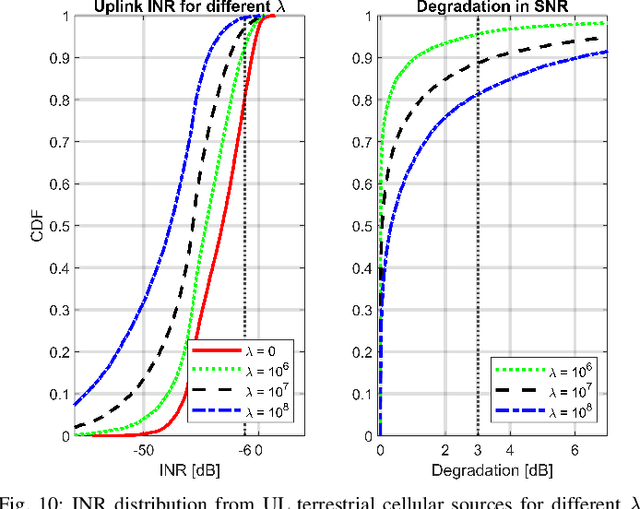
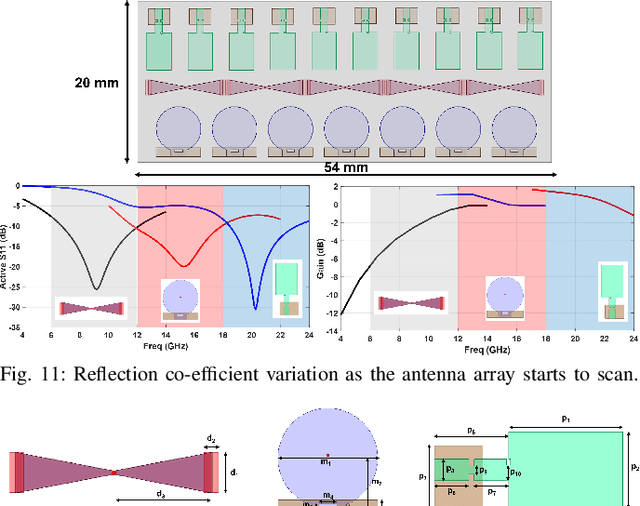
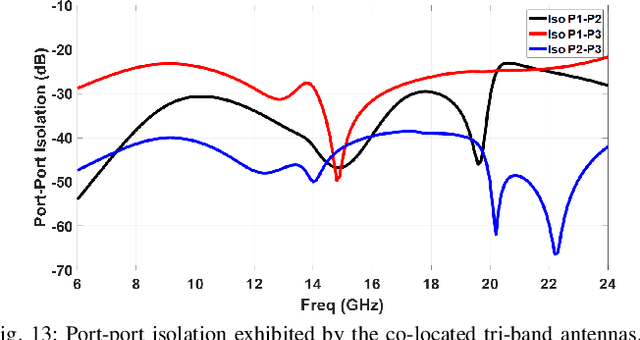
The upper mid-band -- roughly from 7 to 24 GHz -- has attracted considerable recent interest for new cellular services. This frequency range has vastly more spectrum than the highly congested bands below 7 GHz while offering more favorable propagation and coverage than the millimeter wave (mmWave) frequencies. Realizing the full potential of these bands, however, will require fundamental changes to the design of cellular systems. Most importantly, spectrum will likely need to be shared with incumbents including communication satellites, military RADAR, and radio astronomy. Also, due to the wide bandwidth, directional nature of transmission, and intermittent occupancy of incumbents, cellular systems will need to be agile to sense and intelligently use large spatial and bandwidth degrees of freedom. This paper attempts to provide an initial assessment of the feasibility and potential gains of wideband cellular systems operating in the upper mid-band. The study includes: (1) a system study to assess potential gains of multi-band systems in a representative dense urban environment; (2) propagation calculations to assess potential cross interference between satellites and terrestrial cellular services; and (3) design and evaluation of a compact multi-band antenna array structure. Leveraging these preliminary results, we identify potential future research directions to realize next-generation systems in these frequencies.