 Add to Chrome
 Add to Firefox
 Add to Edge
MusicMark: A Robust Generative Watermarking Framework for Music Generation
Jul 13, 2026
AI music generation has rapidly advanced alongside commercial platforms, raising the need for reliable watermarking for provenance and attribution. However, existing audio watermarking research has largely focused on speech, and applying speech-oriented methods to music is challenging due to music's complex structure and rich acoustic texture. Most existing methods are post-hoc, adding imperceptible perturbations after generation rather than embedding watermarks as part of the content. This makes them fragile under transformations and especially vulnerable to neural codec re-synthesis, which can discard imperceptible residual signals. Moreover, since generation and watermarking are decoupled, the watermarking step can be bypassed or omitted, weakening provenance guarantees. To address these issues, we propose MusicMark, which, to the best of our knowledge, is the first generative watermarking framework for music. Specifically, MusicMark embeds watermark messages into the semantic latent space during generation, incorporating the watermark as part of the musical content and ensuring robustness against diverse attacks, particularly neural codec re-synthesis. To this end, we introduce a watermark adapter into a diffusion-based generation model to embed watermark messages across denoising steps. The adapter and detector are trained with a joint objective that preserves fidelity by constraining watermarked latents close to their unwatermarked reference latents, while improving robustness through attack augmentations. Experiments demonstrate that MusicMark substantially outperforms post-hoc baselines across diverse attacks including neural codec re-synthesis, while maintaining comparable generation quality. We further introduce a cover-song attack, converting the singing voice while preserving musical content, and show that MusicMark remains more robust than post-hoc methods.

Enhanced Text-to-Image Generation by Fine-grained Multimodal Reasoning
Apr 16, 2026With the rapid progress of Multimodal Large Language Models (MLLMs), unified MLLMs that jointly perform image understanding and generation have advanced significantly. However, despite the inherent reasoning capabilities of unified MLLMs for self-reflection and self-refinement, their use in text-to-image generation remains largely underexplored. Meanwhile, existing multimodal reasoning-based image generation methods mostly rely on holistic image-text alignment judgments, without fine-grained reflection and refinement of detailed prompt attributes, leading to limited fine-grained control. Therefore, we propose Fine-grained Multimodal Reasoning (FiMR), a framework that leverages decomposed visual question answering (VQA) to break down an input prompt into minimal semantic units-such as entities and attributes-and verify each unit via VQA to generate explicit, fine-grained feedback. Based on this feedback, FiMR then applies targeted, localized refinements. This fine-grained self-reasoning and self-refinement enable MLLMs to achieve more precise improvements in image-prompt alignment and overall generation quality at test time. Extensive experiments demonstrate that FiMR consistently outperforms image generation baselines, including reasoning-based methods, particularly on compositional text-to-image benchmarks. The code and models are available at https://github.com/KU-AGI/FiMR
Slot-MLLM: Object-Centric Visual Tokenization for Multimodal LLM
May 26, 2025Recently, multimodal large language models (MLLMs) have emerged as a key approach in achieving artificial general intelligence. In particular, vision-language MLLMs have been developed to generate not only text but also visual outputs from multimodal inputs. This advancement requires efficient image tokens that LLMs can process effectively both in input and output. However, existing image tokenization methods for MLLMs typically capture only global abstract concepts or uniformly segmented image patches, restricting MLLMs' capability to effectively understand or generate detailed visual content, particularly at the object level. To address this limitation, we propose an object-centric visual tokenizer based on Slot Attention specifically for MLLMs. In particular, based on the Q-Former encoder, diffusion decoder, and residual vector quantization, our proposed discretized slot tokens can encode local visual details while maintaining high-level semantics, and also align with textual data to be integrated seamlessly within a unified next-token prediction framework of LLMs. The resulting Slot-MLLM demonstrates significant performance improvements over baselines with previous visual tokenizers across various vision-language tasks that entail local detailed comprehension and generation. Notably, this work is the first demonstration of the feasibility of object-centric slot attention performed with MLLMs and in-the-wild natural images.
MOANA: Multi-Radar Dataset for Maritime Odometry and Autonomous Navigation Application
Dec 05, 2024
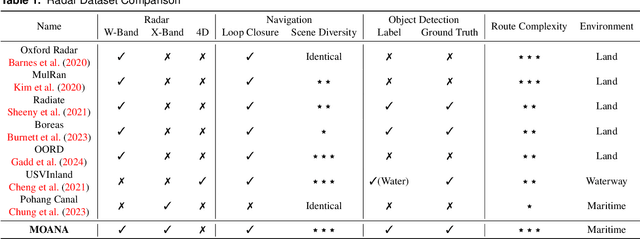
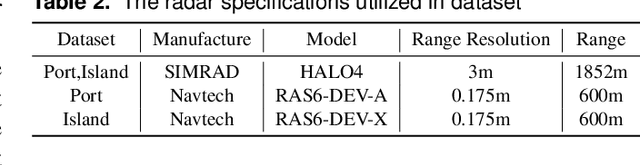

Maritime environmental sensing requires overcoming challenges from complex conditions such as harsh weather, platform perturbations, large dynamic objects, and the requirement for long detection ranges. While cameras and LiDAR are commonly used in ground vehicle navigation, their applicability in maritime settings is limited by range constraints and hardware maintenance issues. Radar sensors, however, offer robust long-range detection capabilities and resilience to physical contamination from weather and saline conditions, making it a powerful sensor for maritime navigation. Among various radar types, X-band radar (e.g., marine radar) is widely employed for maritime vessel navigation, providing effective long-range detection essential for situational awareness and collision avoidance. Nevertheless, it exhibits limitations during berthing operations where close-range object detection is critical. To address this shortcoming, we incorporate W-band radar (e.g., Navtech imaging radar), which excels in detecting nearby objects with a higher update rate. We present a comprehensive maritime sensor dataset featuring multi-range detection capabilities. This dataset integrates short-range LiDAR data, medium-range W-band radar data, and long-range X-band radar data into a unified framework. Additionally, it includes object labels for oceanic object detection usage, derived from radar and stereo camera images. The dataset comprises seven sequences collected from diverse regions with varying levels of estimation difficulty, ranging from easy to challenging, and includes common locations suitable for global localization tasks. This dataset serves as a valuable resource for advancing research in place recognition, odometry estimation, SLAM, object detection, and dynamic object elimination within maritime environments. Dataset can be found in following link: https://sites.google.com/view/rpmmoana
Introducing VaDA: Novel Image Segmentation Model for Maritime Object Segmentation Using New Dataset
Jul 12, 2024


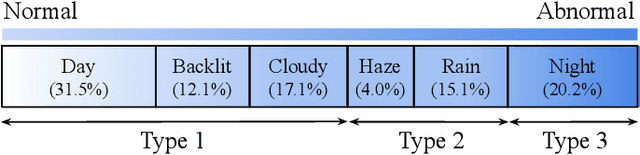
The maritime shipping industry is undergoing rapid evolution driven by advancements in computer vision artificial intelligence (AI). Consequently, research on AI-based object recognition models for maritime transportation is steadily growing, leveraging advancements in sensor technology and computing performance. However, object recognition in maritime environments faces challenges such as light reflection, interference, intense lighting, and various weather conditions. To address these challenges, high-performance deep learning algorithms tailored to maritime imagery and high-quality datasets specialized for maritime scenes are essential. Existing AI recognition models and datasets have limited suitability for composing autonomous navigation systems. Therefore, in this paper, we propose a Vertical and Detail Attention (VaDA) model for maritime object segmentation and a new model evaluation method, the Integrated Figure of Calculation Performance (IFCP), to verify its suitability for the system in real-time. Additionally, we introduce a benchmark maritime dataset, OASIs (Ocean AI Segmentation Initiatives) to standardize model performance evaluation across diverse maritime environments. OASIs dataset and details are available at our website: https://www.navlue.com/dataset
DEEP-BO for Hyperparameter Optimization of Deep Networks
May 23, 2019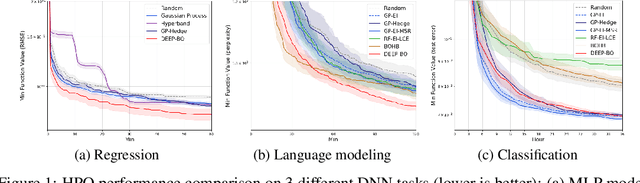
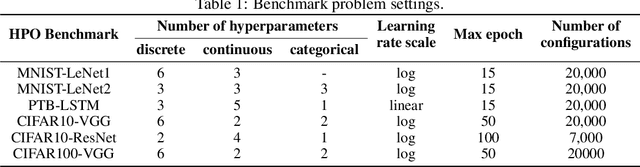
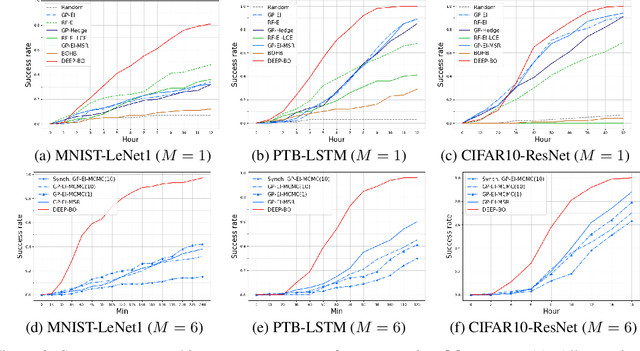
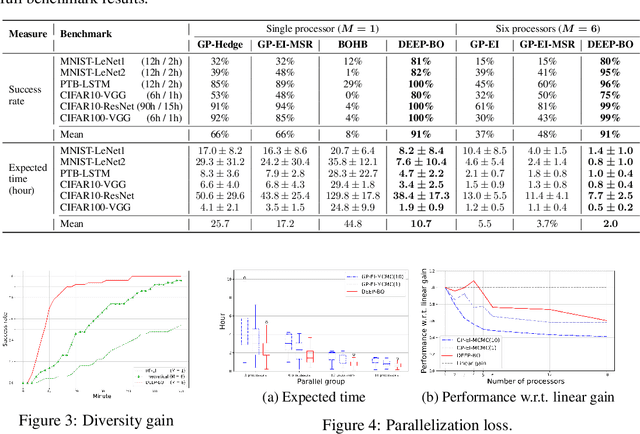
The performance of deep neural networks (DNN) is very sensitive to the particular choice of hyper-parameters. To make it worse, the shape of the learning curve can be significantly affected when a technique like batchnorm is used. As a result, hyperparameter optimization of deep networks can be much more challenging than traditional machine learning models. In this work, we start from well known Bayesian Optimization solutions and provide enhancement strategies specifically designed for hyperparameter optimization of deep networks. The resulting algorithm is named as DEEP-BO (Diversified, Early-termination-Enabled, and Parallel Bayesian Optimization). When evaluated over six DNN benchmarks, DEEP-BO easily outperforms or shows comparable performance with some of the well-known solutions including GP-Hedge, Hyperband, BOHB, Median Stopping Rule, and Learning Curve Extrapolation. The code used is made publicly available at https://github.com/snu-adsl/DEEP-BO.