 Add to Chrome
 Add to Firefox
 Add to Edge
RLDX-1 Technical Report
May 05, 2026
While Vision-Language-Action models (VLAs) have shown remarkable progress toward human-like generalist robotic policies through the versatile intelligence (i.e. broad scene understanding and language-conditioned generalization) inherited from pre-trained Vision-Language Models, they still struggle with complex real-world tasks requiring broader functional capabilities (e.g. motion awareness, memory-aware decision making, and physical sensing). To address this, we introduce RLDX-1, a general-purpose robotic policy for dexterous manipulation built on the Multi-Stream Action Transformer (MSAT), an architecture that unifies these capabilities by integrating heterogeneous modalities through modality-specific streams with cross-modal joint self-attention. RLDX-1 further combines this architecture with system-level design choices, including synthesizing training data for rare manipulation scenarios, learning procedures specialized for human-like manipulation, and inference optimizations for real-time deployment. Through empirical evaluation, we show that RLDX-1 consistently outperforms recent frontier VLAs (e.g. $π_{0.5}$ and GR00T N1.6) across both simulation benchmarks and real-world tasks that require broad functional capabilities beyond general versatility. In particular, RLDX-1 shows superiority in ALLEX humanoid tasks by achieving success rates of 86.8% while $π_{0.5}$ and GR00T N1.6 achieve around 40%, highlighting the ability of RLDX-1 to control a high-DoF humanoid robot under diverse functional demands. Together, these results position RLDX-1 as a promising step toward reliable VLAs for complex, contact-rich, and dynamic real-world dexterous manipulation.

HyperCLOVA X Technical Report
Apr 13, 2024We introduce HyperCLOVA X, a family of large language models (LLMs) tailored to the Korean language and culture, along with competitive capabilities in English, math, and coding. HyperCLOVA X was trained on a balanced mix of Korean, English, and code data, followed by instruction-tuning with high-quality human-annotated datasets while abiding by strict safety guidelines reflecting our commitment to responsible AI. The model is evaluated across various benchmarks, including comprehensive reasoning, knowledge, commonsense, factuality, coding, math, chatting, instruction-following, and harmlessness, in both Korean and English. HyperCLOVA X exhibits strong reasoning capabilities in Korean backed by a deep understanding of the language and cultural nuances. Further analysis of the inherent bilingual nature and its extension to multilingualism highlights the model's cross-lingual proficiency and strong generalization ability to untargeted languages, including machine translation between several language pairs and cross-lingual inference tasks. We believe that HyperCLOVA X can provide helpful guidance for regions or countries in developing their sovereign LLMs.
Ensemble-Based Deep Reinforcement Learning for Chatbots
Aug 27, 2019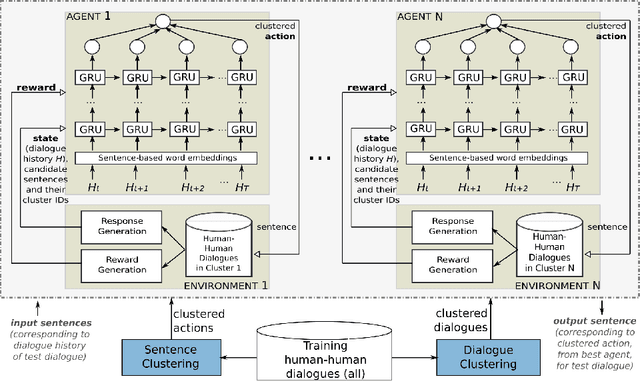
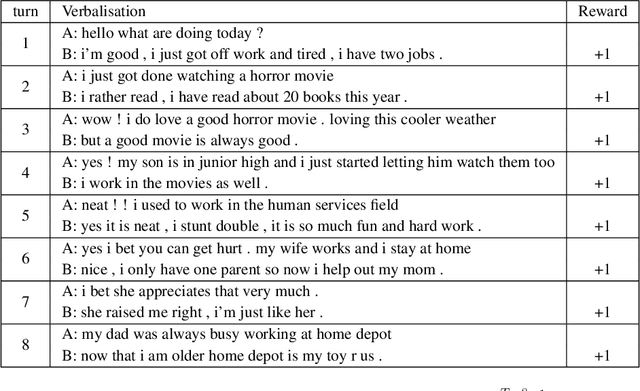
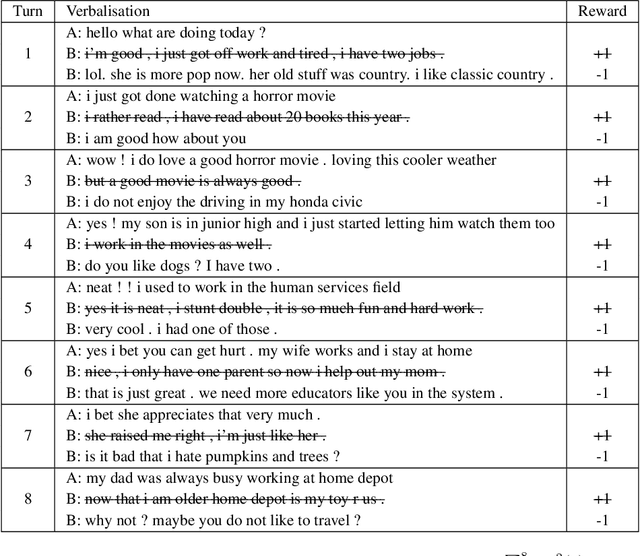
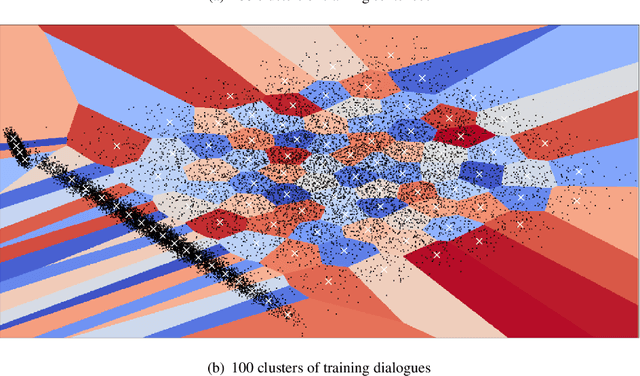
Trainable chatbots that exhibit fluent and human-like conversations remain a big challenge in artificial intelligence. Deep Reinforcement Learning (DRL) is promising for addressing this challenge, but its successful application remains an open question. This article describes a novel ensemble-based approach applied to value-based DRL chatbots, which use finite action sets as a form of meaning representation. In our approach, while dialogue actions are derived from sentence clustering, the training datasets in our ensemble are derived from dialogue clustering. The latter aim to induce specialised agents that learn to interact in a particular style. In order to facilitate neural chatbot training using our proposed approach, we assume dialogue data in raw text only -- without any manually-labelled data. Experimental results using chitchat data reveal that (1) near human-like dialogue policies can be induced, (2) generalisation to unseen data is a difficult problem, and (3) training an ensemble of chatbot agents is essential for improved performance over using a single agent. In addition to evaluations using held-out data, our results are further supported by a human evaluation that rated dialogues in terms of fluency, engagingness and consistency -- which revealed that our proposed dialogue rewards strongly correlate with human judgements.