 Add to Chrome
 Add to Firefox
 Add to Edge
GST-Bench: Can VLMs Develop Global Spatial Awareness from Video?
Aug 06, 2026
Spatial intelligence is fundamental to embodied agents, yet existing benchmarks focus on local spatial perception from single or few viewpoints, overlooking global spatial awareness over continuous, long-horizon visual streams. To address this limitation, we introduce the Global-Spatial-Temporal Benchmark (GST-Bench), a VQA benchmark for global spatial intelligence in video understanding, comprising human-verified questions derived from 6,790 minutes of synthetically generated video. It requires models to perform accurate spatial inference from novel viewpoints unseen in the input video and to map egocentric observations onto global top-down images. A comprehensive evaluation of 22 state-of-the-art VLMs exposes a striking gap between models and humans: the strongest zero-shot model attains only 42.68, far below the human score of 79.08. To probe the cause of this gap, we construct GST-Bench-Local and find that models, despite strong local spatial understanding under the same task formulation, still fail to consolidate long-horizon observations into a globally consistent scene representation. We further provide GST-Train, a dataset for global spatial reasoning, as a complementary resource to facilitate future research on this challenge.

Carbon Emission Prediction and Clean Industry Transformation Based on Machine Learning: A Case Study of Sichuan Province
Sep 03, 2023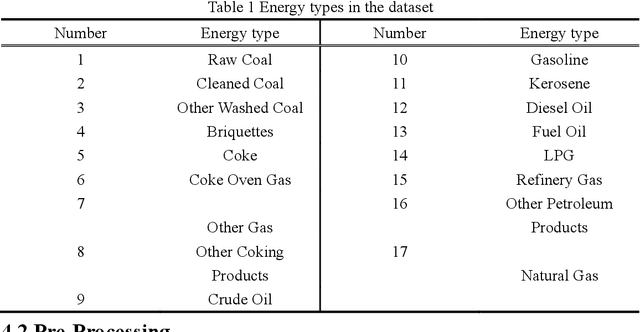
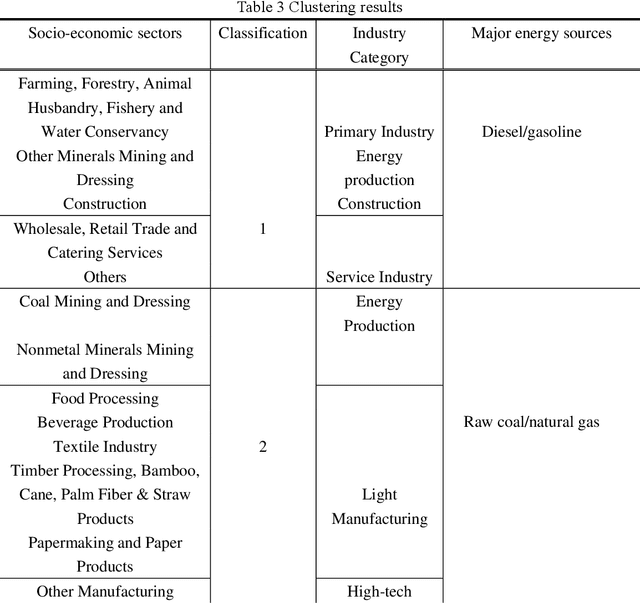
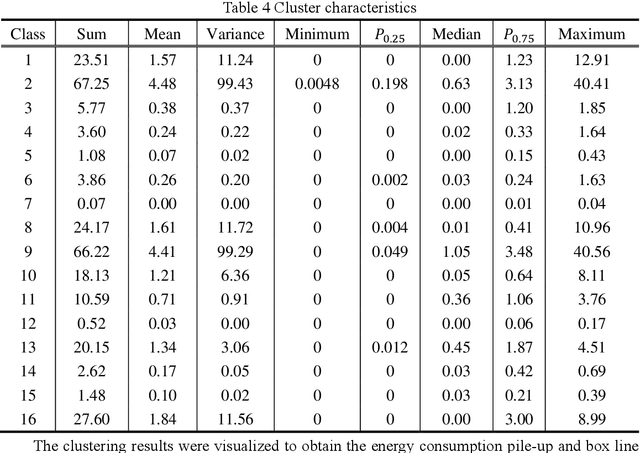
This study preprocessed 2000-2019 energy consumption data for 46 key Sichuan industries using matrix normalization. DBSCAN clustering identified 16 feature classes to objectively group industries. Penalized regression models were then applied for their advantages in overfitting control, high-dimensional data processing, and feature selection - well-suited for the complex energy data. Results showed the second cluster around coal had highest emissions due to production needs. Emissions from gasoline-focused and coke-focused clusters were also significant. Based on this, emission reduction suggestions included clean coal technologies, transportation management, coal-electricity replacement in steel, and industry standardization. The research introduced unsupervised learning to objectively select factors and aimed to explore new emission reduction avenues. In summary, the study identified industry groupings, assessed emissions drivers, and proposed scientific reduction strategies to better inform decision-making using algorithms like DBSCAN and penalized regression models.