 Add to Chrome
 Add to Firefox
 Add to Edge
MedConclusion: A Benchmark for Biomedical Conclusion Generation from Structured Abstracts
Apr 07, 2026
Large language models (LLMs) are widely explored for reasoning-intensive research tasks, yet resources for testing whether they can infer scientific conclusions from structured biomedical evidence remain limited. We introduce $\textbf{MedConclusion}$, a large-scale dataset of $\textbf{5.7M}$ PubMed structured abstracts for biomedical conclusion generation. Each instance pairs the non-conclusion sections of an abstract with the original author-written conclusion, providing naturally occurring supervision for evidence-to-conclusion reasoning. MedConclusion also includes journal-level metadata such as biomedical category and SJR, enabling subgroup analysis across biomedical domains. As an initial study, we evaluate diverse LLMs under conclusion and summary prompting settings and score outputs with both reference-based metrics and LLM-as-a-judge. We find that conclusion writing is behaviorally distinct from summary writing, strong models remain closely clustered under current automatic metrics, and judge identity can substantially shift absolute scores. MedConclusion provides a reusable data resource for studying scientific evidence-to-conclusion reasoning. Our code and data are available at: https://github.com/Harvard-AI-and-Robotics-Lab/MedConclusion.

Entropy Guided Diversification and Preference Elicitation in Agentic Recommendation Systems
Mar 12, 2026Users on e-commerce platforms can be uncertain about their preferences early in their search. Queries to recommendation systems are frequently ambiguous, incomplete, or weakly specified. Agentic systems are expected to proactively reason, ask clarifying questions, and act on the user's behalf, which makes handling such ambiguity increasingly important. In existing platforms, ambiguity led to excessive interactions and question fatigue or overconfident recommendations prematurely collapsing the search space. We present an Interactive Decision Support System (IDSS) that addresses ambiguous user queries using entropy as a unifying signal. IDSS maintains a dynamically filtered candidate product set and quantifies uncertainty over item attributes using entropy. This uncertainty guides adaptive preference elicitation by selecting follow-up questions that maximize expected information gain. When preferences remain incomplete, IDSS explicitly incorporates residual uncertainty into downstream recommendations through uncertainty-aware ranking and entropy-based diversification, rather than forcing premature resolution. We evaluate IDSS using review-driven simulated users grounded in real user reviews, enabling a controlled study of diverse shopping behaviors. Our evaluation measures both interaction efficiency and recommendation quality. Results show that entropy-guided elicitation reduces unnecessary follow-up questions, while uncertainty-aware ranking and presentation yield more informative, diverse, and transparent recommendation sets under ambiguous intent. These findings demonstrate that entropy-guided reasoning provides an effective foundation for agentic recommendation systems operating under uncertainty.
LLM Review: Enhancing Creative Writing via Blind Peer Review Feedback
Jan 12, 2026Large Language Models (LLMs) often struggle with creative generation, and multi-agent frameworks that improve reasoning through interaction can paradoxically hinder creativity by inducing content homogenization. We introduce LLM Review, a peer-review-inspired framework implementing Blind Peer Review: agents exchange targeted feedback while revising independently, preserving divergent creative trajectories. To enable rigorous evaluation, we propose SciFi-100, a science fiction writing dataset with a unified framework combining LLM-as-a-judge scoring, human annotation, and rule-based novelty metrics. Experiments demonstrate that LLM Review consistently outperforms multi-agent baselines, and smaller models with our framework can surpass larger single-agent models, suggesting interaction structure may substitute for model scale.
Effective Skill Unlearning through Intervention and Abstention
Mar 27, 2025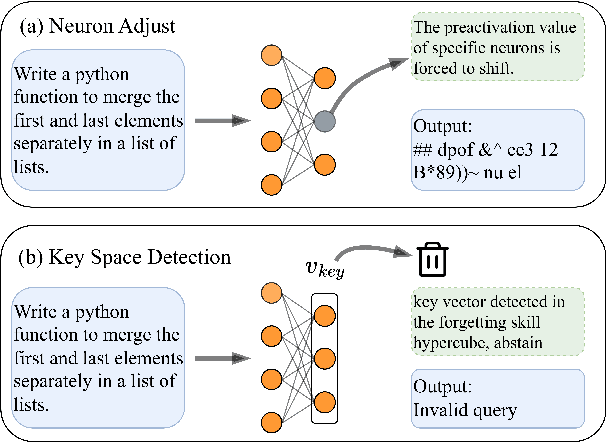
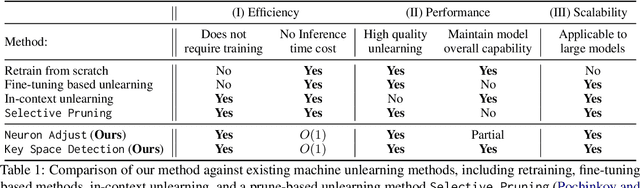
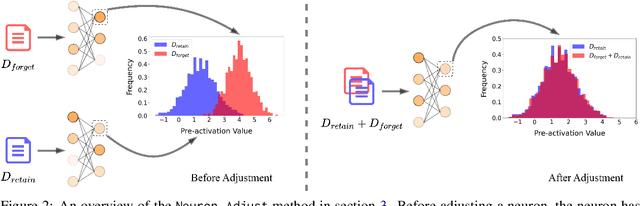
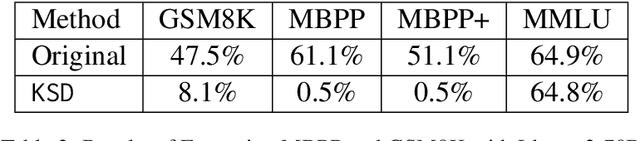
Large language Models (LLMs) have demonstrated remarkable skills across various domains. Understanding the mechanisms behind their abilities and implementing controls over them is becoming increasingly important for developing better models. In this paper, we focus on skill unlearning in LLMs, specifically unlearning a particular skill while retaining their overall capabilities. We introduce two lightweight, training-free machine skill unlearning techniques for LLMs. First, we observe that the pre-activation distribution of neurons in each Feed-Forward Layer (FFL) differs when the model demonstrates different skills. Additionally, we find that queries triggering the same skill cluster within the FFL key space and can be separated from other queries using a hypercube. Based on these observations, we propose two lightweight, training-free skill unlearning methods via \textit{intervention} and \textit{abstention} respectively: \texttt{Neuron Adjust} and \texttt{Key Space Detection}. We evaluate our methods on unlearning math-solving, Python-coding, and comprehension skills across seven different languages. The results demonstrate their strong unlearning capabilities for the designated skills. Specifically, \texttt{Key Space Detection} achieves over 80\% relative performance drop on the forgetting skill and less than 10\% relative performance drop on other skills and the model's general knowledge (MMLU) for most unlearning tasks. Our code is available at https://github.com/Trustworthy-ML-Lab/effective_skill_unlearning