 Add to Chrome
 Add to Firefox
 Add to Edge
MACS: A Hybrid Multi-Agent Framework for Reliable Conversational E-Commerce Recommendation
Aug 14, 2026
Conversational recommendation for e-commerce is increasingly mediated by large language models (LLMs), yet many real-world deployments operate under a stricter requirement: recommendations must be drawn only from a merchant's fixed catalog, without web search or unsupported product claims. In this setting, the main challenge is reliability under hard constraints: the system must satisfy user requirements, remain grounded in available inventory, and preserve preferences across multiple conversational turns. We present MACS (Multi-Agent Commerce System), a hybrid multi-agent framework for reliable conversational recommendation in fixed-catalog settings. MACS uses LLMs for language-facing tasks such as interpreting user requests, eliciting preferences, and generating responses, while correctness-critical operations, including product retrieval, hard-constraint filtering, brand exclusion, and progressive relaxation, are executed deterministically by the merchant agent. A session-persistent preference layer tracks constraints across turns, enabling consistent handling of budget overwrites and exclusion reversals. On a 140-query single-turn benchmark, MACS achieves the highest pass rate (87.1%) and perfect brand compliance (1.000). On a 10-scenario multi-turn benchmark, MACS achieves the strongest macro Pass@5 (72% vs. 56% GPT+Catalog / 52% Gemini+Catalog) with zero constraint drift. The advantage is sharpest on exclusion reversal (100% vs. 20% / 0%) and constraint accumulation (100% vs. 60% / 40%). Mean judged response quality is similar across systems (0.751 vs. 0.736). These results suggest that hybrid architectures combining deterministic constraint enforcement with session-persistent preference tracking provide stronger reliability-oriented performance than catalog-bound prompt-only baselines in the fixed-catalog merchant setting.

Learning to Bid in Discriminatory Auctions with Budget Constraints
Jun 28, 2026We study repeated bidding in multi-unit discriminatory (pay-as-bid) auctions for a single bidder with per-round utility equal to value minus $α$ times payment, where $α\in[0,1]$ is a cost-of-capital parameter. The bidder aims to maximize cumulative utility over $T$ rounds subject to a total budget $B$. The problem is challenging even without budgets: the action space is exponential in $M$, the maximum demand of the bidder and the valuation vector (context) varies over time. Exploiting a decomposition of utility across units, we develop polynomial-time learning algorithms based on shortest paths in a directed acyclic graph, obtaining sublinear regret under both full-information and bandit feedback. In the bandit setting, the regret is independent of the number of contexts due to complete cross-learning: observing the utility of the chosen action under the realized context reveals the utility for the same action under all counterfactual contexts. With budget constraints, when the average normalized per-round budget $ρ=\frac{B}{MT}<1$, we design a coupled primal-dual algorithm in which the DAG-based procedure uses dual-adjusted edge weights for primal updates, while online gradient descent updates the dual variable, yielding $ρ$-approximate sublinear regret. Finally, we give implementations whose per-round time and space are independent of the number of contexts, enabling scalability to large or even infinite context spaces.
Policy Regret for Embedding Model Routing: Contextual Bandits with Low-Rank Experts
Jun 12, 2026Modern recommendation systems increasingly rely on dynamically routing diverse queries to multiple embedding models. Despite its practical significance, this problem remains poorly understood under realistic conditions like adversarial queries, bandit feedback, and limited observability of models. We formalize embedding model routing as an adversarial contextual linear bandit with low-rank experts, where contexts are queries, actions are items, and experts are the embedding models working on low-rank latent representation spaces. We first establish that standard regret notions suffer from structural misspecification or statistical intractability, and we identify a log-quadratic policy class that is expressive enough to capture query-dependent model routing, yet structured enough to allow efficient online learning. Second, we propose a policy gradient algorithm called Hypentropy Policy Gradient (HPG). It provably adapts to the unknown low-rank structure under incomplete information and attains $\tilde{\mathcal O}(s\sqrt{M T})$ linearized policy regret -- where $s, M$, and $T$ are the intrinsic rank of the experts, the number of models, and the number of rounds -- thus avoiding a curse of dimensionality. Finally, we also provide an computationally efficient and parameter-free implementation of HPG.
Market Design for AI: Beyond the Copyright Binary
Jun 10, 2026How can we design a market of human-generated content for use in training AI models that both enables technological progress and preserves individual incentives for high-quality content creation? Existing approaches take polar positions: a "free-for-all" model based on fair use and a "strong intellectual property rights" model. We show that both fail: Free-for-all does not compensate creators, and -- by modeling as a static Stackelberg game -- strong intellectual property rights also underpower creative incentives. We find this especially true for more innovative creators, a phenomenon we term the "originality penalty." Extending this insight to a dynamic model, we find another market failure undermining AI model performance, even for an initially good model: Such a model induces greater reliance by humans on AI-assisted creation, resulting in homogenized content feeding back into training, which degrades the model performance -- a "curse of precision." We further propose a market design with a data intermediary internalizing cross-creator externalities and subsidizing innovative contributions, thereby restoring efficiency.
Entropy Guided Diversification and Preference Elicitation in Agentic Recommendation Systems
Mar 12, 2026Users on e-commerce platforms can be uncertain about their preferences early in their search. Queries to recommendation systems are frequently ambiguous, incomplete, or weakly specified. Agentic systems are expected to proactively reason, ask clarifying questions, and act on the user's behalf, which makes handling such ambiguity increasingly important. In existing platforms, ambiguity led to excessive interactions and question fatigue or overconfident recommendations prematurely collapsing the search space. We present an Interactive Decision Support System (IDSS) that addresses ambiguous user queries using entropy as a unifying signal. IDSS maintains a dynamically filtered candidate product set and quantifies uncertainty over item attributes using entropy. This uncertainty guides adaptive preference elicitation by selecting follow-up questions that maximize expected information gain. When preferences remain incomplete, IDSS explicitly incorporates residual uncertainty into downstream recommendations through uncertainty-aware ranking and entropy-based diversification, rather than forcing premature resolution. We evaluate IDSS using review-driven simulated users grounded in real user reviews, enabling a controlled study of diverse shopping behaviors. Our evaluation measures both interaction efficiency and recommendation quality. Results show that entropy-guided elicitation reduces unnecessary follow-up questions, while uncertainty-aware ranking and presentation yield more informative, diverse, and transparent recommendation sets under ambiguous intent. These findings demonstrate that entropy-guided reasoning provides an effective foundation for agentic recommendation systems operating under uncertainty.
Learning in Repeated Multi-Unit Pay-As-Bid Auctions
Jul 27, 2023Motivated by Carbon Emissions Trading Schemes, Treasury Auctions, and Procurement Auctions, which all involve the auctioning of homogeneous multiple units, we consider the problem of learning how to bid in repeated multi-unit pay-as-bid auctions. In each of these auctions, a large number of (identical) items are to be allocated to the largest submitted bids, where the price of each of the winning bids is equal to the bid itself. The problem of learning how to bid in pay-as-bid auctions is challenging due to the combinatorial nature of the action space. We overcome this challenge by focusing on the offline setting, where the bidder optimizes their vector of bids while only having access to the past submitted bids by other bidders. We show that the optimal solution to the offline problem can be obtained using a polynomial time dynamic programming (DP) scheme. We leverage the structure of the DP scheme to design online learning algorithms with polynomial time and space complexity under full information and bandit feedback settings. We achieve an upper bound on regret of $O(M\sqrt{T\log |\mathcal{B}|})$ and $O(M\sqrt{|\mathcal{B}|T\log |\mathcal{B}|})$ respectively, where $M$ is the number of units demanded by the bidder, $T$ is the total number of auctions, and $|\mathcal{B}|$ is the size of the discretized bid space. We accompany these results with a regret lower bound, which match the linear dependency in $M$. Our numerical results suggest that when all agents behave according to our proposed no regret learning algorithms, the resulting market dynamics mainly converge to a welfare maximizing equilibrium where bidders submit uniform bids. Lastly, our experiments demonstrate that the pay-as-bid auction consistently generates significantly higher revenue compared to its popular alternative, the uniform price auction.
Online Resource Allocation with Convex-set Machine-Learned Advice
Jun 21, 2023Decision-makers often have access to a machine-learned prediction about demand, referred to as advice, which can potentially be utilized in online decision-making processes for resource allocation. However, exploiting such advice poses challenges due to its potential inaccuracy. To address this issue, we propose a framework that enhances online resource allocation decisions with potentially unreliable machine-learned (ML) advice. We assume here that this advice is represented by a general convex uncertainty set for the demand vector. We introduce a parameterized class of Pareto optimal online resource allocation algorithms that strike a balance between consistent and robust ratios. The consistent ratio measures the algorithm's performance (compared to the optimal hindsight solution) when the ML advice is accurate, while the robust ratio captures performance under an adversarial demand process when the advice is inaccurate. Specifically, in a C-Pareto optimal setting, we maximize the robust ratio while ensuring that the consistent ratio is at least C. Our proposed C-Pareto optimal algorithm is an adaptive protection level algorithm, which extends the classical fixed protection level algorithm introduced in Littlewood (2005) and Ball and Queyranne (2009). Solving a complex non-convex continuous optimization problem characterizes the adaptive protection level algorithm. To complement our algorithms, we present a simple method for computing the maximum achievable consistent ratio, which serves as an estimate for the maximum value of the ML advice. Additionally, we present numerical studies to evaluate the performance of our algorithm in comparison to benchmark algorithms. The results demonstrate that by adjusting the parameter C, our algorithms effectively strike a balance between worst-case and average performance, outperforming the benchmark algorithms.
Interpolating Item and User Fairness in Recommendation Systems
Jun 12, 2023Online platforms employ recommendation systems to enhance customer engagement and drive revenue. However, in a multi-sided platform where the platform interacts with diverse stakeholders such as sellers (items) and customers (users), each with their own desired outcomes, finding an appropriate middle ground becomes a complex operational challenge. In this work, we investigate the ``price of fairness'', which captures the platform's potential compromises when balancing the interests of different stakeholders. Motivated by this, we propose a fair recommendation framework where the platform maximizes its revenue while interpolating between item and user fairness constraints. We further examine the fair recommendation problem in a more realistic yet challenging online setting, where the platform lacks knowledge of user preferences and can only observe binary purchase decisions. To address this, we design a low-regret online optimization algorithm that preserves the platform's revenue while achieving fairness for both items and users. Finally, we demonstrate the effectiveness of our framework and proposed method via a case study on MovieLens data.
Multi-Platform Budget Management in Ad Markets with Non-IC Auctions
Jun 12, 2023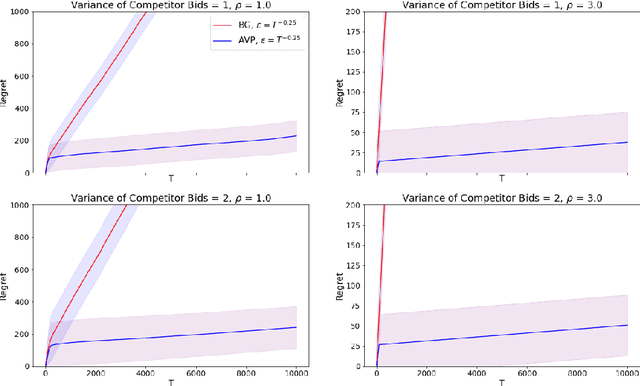
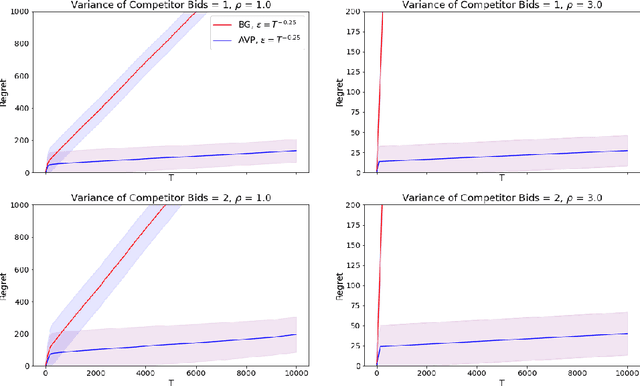
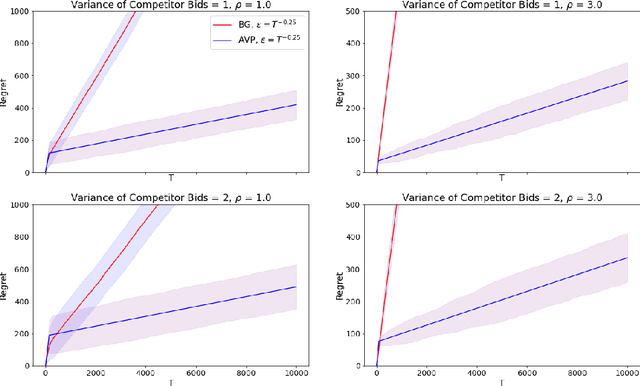
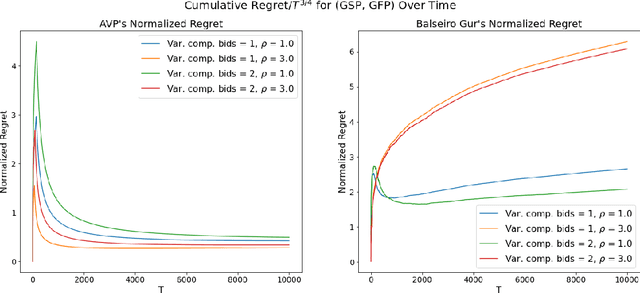
In online advertising markets, budget-constrained advertisers acquire ad placements through repeated bidding in auctions on various platforms. We present a strategy for bidding optimally in a set of auctions that may or may not be incentive-compatible under the presence of budget constraints. Our strategy maximizes the expected total utility across auctions while satisfying the advertiser's budget constraints in expectation. Additionally, we investigate the online setting where the advertiser must submit bids across platforms while learning about other bidders' bids over time. Our algorithm has $O(T^{3/4})$ regret under the full-information setting. Finally, we demonstrate that our algorithms have superior cumulative regret on both synthetic and real-world datasets of ad placement auctions, compared to existing adaptive pacing algorithms.
Online Learning in Multi-unit Auctions
May 27, 2023We consider repeated multi-unit auctions with uniform pricing, which are widely used in practice for allocating goods such as carbon licenses. In each round, $K$ identical units of a good are sold to a group of buyers that have valuations with diminishing marginal returns. The buyers submit bids for the units, and then a price $p$ is set per unit so that all the units are sold. We consider two variants of the auction, where the price is set to the $K$-th highest bid and $(K+1)$-st highest bid, respectively. We analyze the properties of this auction in both the offline and online settings. In the offline setting, we consider the problem that one player $i$ is facing: given access to a data set that contains the bids submitted by competitors in past auctions, find a bid vector that maximizes player $i$'s cumulative utility on the data set. We design a polynomial time algorithm for this problem, by showing it is equivalent to finding a maximum-weight path on a carefully constructed directed acyclic graph. In the online setting, the players run learning algorithms to update their bids as they participate in the auction over time. Based on our offline algorithm, we design efficient online learning algorithms for bidding. The algorithms have sublinear regret, under both full information and bandit feedback structures. We complement our online learning algorithms with regret lower bounds. Finally, we analyze the quality of the equilibria in the worst case through the lens of the core solution concept in the game among the bidders. We show that the $(K+1)$-st price format is susceptible to collusion among the bidders; meanwhile, the $K$-th price format does not have this issue.