 Add to Chrome
 Add to Firefox
 Add to Edge
MACS: A Hybrid Multi-Agent Framework for Reliable Conversational E-Commerce Recommendation
Aug 14, 2026
Conversational recommendation for e-commerce is increasingly mediated by large language models (LLMs), yet many real-world deployments operate under a stricter requirement: recommendations must be drawn only from a merchant's fixed catalog, without web search or unsupported product claims. In this setting, the main challenge is reliability under hard constraints: the system must satisfy user requirements, remain grounded in available inventory, and preserve preferences across multiple conversational turns. We present MACS (Multi-Agent Commerce System), a hybrid multi-agent framework for reliable conversational recommendation in fixed-catalog settings. MACS uses LLMs for language-facing tasks such as interpreting user requests, eliciting preferences, and generating responses, while correctness-critical operations, including product retrieval, hard-constraint filtering, brand exclusion, and progressive relaxation, are executed deterministically by the merchant agent. A session-persistent preference layer tracks constraints across turns, enabling consistent handling of budget overwrites and exclusion reversals. On a 140-query single-turn benchmark, MACS achieves the highest pass rate (87.1%) and perfect brand compliance (1.000). On a 10-scenario multi-turn benchmark, MACS achieves the strongest macro Pass@5 (72% vs. 56% GPT+Catalog / 52% Gemini+Catalog) with zero constraint drift. The advantage is sharpest on exclusion reversal (100% vs. 20% / 0%) and constraint accumulation (100% vs. 60% / 40%). Mean judged response quality is similar across systems (0.751 vs. 0.736). These results suggest that hybrid architectures combining deterministic constraint enforcement with session-persistent preference tracking provide stronger reliability-oriented performance than catalog-bound prompt-only baselines in the fixed-catalog merchant setting.

Entropy Guided Diversification and Preference Elicitation in Agentic Recommendation Systems
Mar 12, 2026Users on e-commerce platforms can be uncertain about their preferences early in their search. Queries to recommendation systems are frequently ambiguous, incomplete, or weakly specified. Agentic systems are expected to proactively reason, ask clarifying questions, and act on the user's behalf, which makes handling such ambiguity increasingly important. In existing platforms, ambiguity led to excessive interactions and question fatigue or overconfident recommendations prematurely collapsing the search space. We present an Interactive Decision Support System (IDSS) that addresses ambiguous user queries using entropy as a unifying signal. IDSS maintains a dynamically filtered candidate product set and quantifies uncertainty over item attributes using entropy. This uncertainty guides adaptive preference elicitation by selecting follow-up questions that maximize expected information gain. When preferences remain incomplete, IDSS explicitly incorporates residual uncertainty into downstream recommendations through uncertainty-aware ranking and entropy-based diversification, rather than forcing premature resolution. We evaluate IDSS using review-driven simulated users grounded in real user reviews, enabling a controlled study of diverse shopping behaviors. Our evaluation measures both interaction efficiency and recommendation quality. Results show that entropy-guided elicitation reduces unnecessary follow-up questions, while uncertainty-aware ranking and presentation yield more informative, diverse, and transparent recommendation sets under ambiguous intent. These findings demonstrate that entropy-guided reasoning provides an effective foundation for agentic recommendation systems operating under uncertainty.
Towards Large-Scale Interpretable Knowledge Graph Reasoning for Dialogue Systems
Mar 20, 2022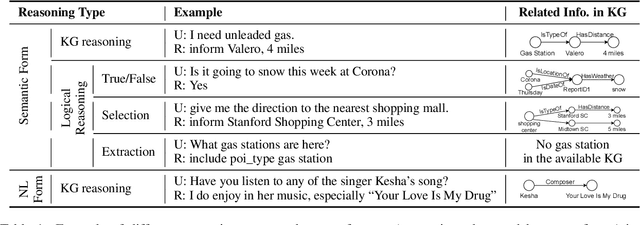
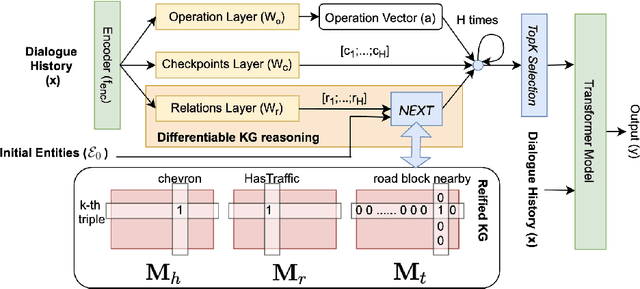
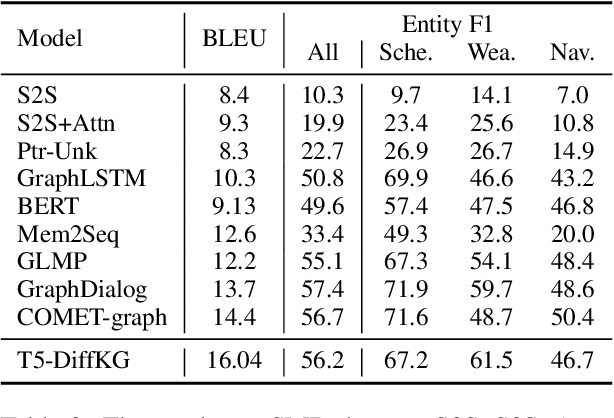
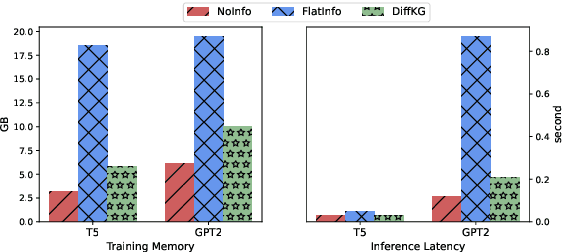
Users interacting with voice assistants today need to phrase their requests in a very specific manner to elicit an appropriate response. This limits the user experience, and is partly due to the lack of reasoning capabilities of dialogue platforms and the hand-crafted rules that require extensive labor. One possible way to improve user experience and relieve the manual efforts of designers is to build an end-to-end dialogue system that can do reasoning itself while perceiving user's utterances. In this work, we propose a novel method to incorporate the knowledge reasoning capability into dialogue systems in a more scalable and generalizable manner. Our proposed method allows a single transformer model to directly walk on a large-scale knowledge graph to generate responses. To the best of our knowledge, this is the first work to have transformer models generate responses by reasoning over differentiable knowledge graphs. We investigate the reasoning abilities of the proposed method on both task-oriented and domain-specific chit-chat dialogues. Empirical results show that this method can effectively and efficiently incorporate a knowledge graph into a dialogue system with fully-interpretable reasoning paths.
Logical Reasoning for Task Oriented Dialogue Systems
Feb 08, 2022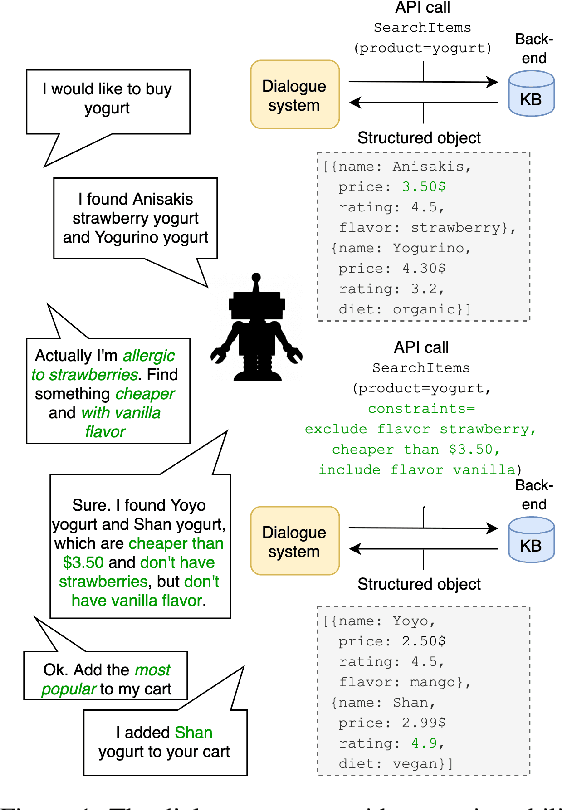

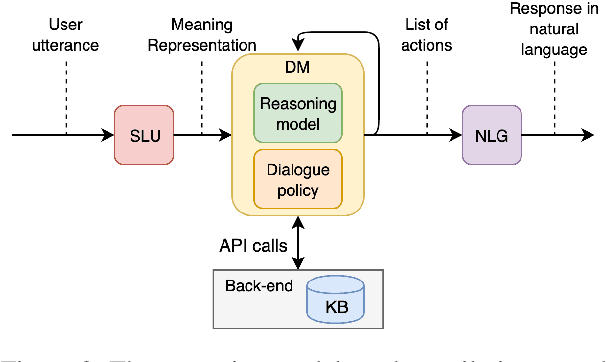

In recent years, large pretrained models have been used in dialogue systems to improve successful task completion rates. However, lack of reasoning capabilities of dialogue platforms make it difficult to provide relevant and fluent responses, unless the designers of a conversational experience spend a considerable amount of time implementing these capabilities in external rule based modules. In this work, we propose a novel method to fine-tune pretrained transformer models such as Roberta and T5. to reason over a set of facts in a given dialogue context. Our method includes a synthetic data generation mechanism which helps the model learn logical relations, such as comparison between list of numerical values, inverse relations (and negation), inclusion and exclusion for categorical attributes, and application of a combination of attributes over both numerical and categorical values, and spoken form for numerical values, without need for additional training dataset. We show that the transformer based model can perform logical reasoning to answer questions when the dialogue context contains all the required information, otherwise it is able to extract appropriate constraints to pass to downstream components (e.g. a knowledge base) when partial information is available. We observe that transformer based models such as UnifiedQA-T5 can be fine-tuned to perform logical reasoning (such as numerical and categorical attributes' comparison) over attributes that been seen in training time (e.g., accuracy of 90\%+ for comparison of smaller than $k_{\max}$=5 values over heldout test dataset).