 Add to Chrome
 Add to Firefox
 Add to Edge
Linearity of Relation Decoding in Transformer Language Models
Aug 17, 2023
Much of the knowledge encoded in transformer language models (LMs) may be expressed in terms of relations: relations between words and their synonyms, entities and their attributes, etc. We show that, for a subset of relations, this computation is well-approximated by a single linear transformation on the subject representation. Linear relation representations may be obtained by constructing a first-order approximation to the LM from a single prompt, and they exist for a variety of factual, commonsense, and linguistic relations. However, we also identify many cases in which LM predictions capture relational knowledge accurately, but this knowledge is not linearly encoded in their representations. Our results thus reveal a simple, interpretable, but heterogeneously deployed knowledge representation strategy in transformer LMs.

Instructed to Bias: Instruction-Tuned Language Models Exhibit Emergent Cognitive Bias
Aug 01, 2023Recent studies show that instruction tuning and learning from human feedback improve the abilities of large language models (LMs) dramatically. While these tuning methods can make models generate high-quality text, we conjecture that more implicit cognitive biases may arise in these fine-tuned models. Our work provides evidence that these fine-tuned models exhibit biases that were absent or less pronounced in their pretrained predecessors. We examine the extent of this phenomenon in three cognitive biases - the decoy effect, the certainty effect, and the belief bias - all of which are known to influence human decision-making and reasoning. Our findings highlight the presence of these biases in various models, especially those that have undergone instruction tuning, such as Flan-T5, GPT3.5, and GPT4. This research constitutes a step toward comprehending cognitive biases in instruction-tuned LMs, which is crucial for the development of more reliable and unbiased language models.
Generating Benchmarks for Factuality Evaluation of Language Models
Jul 13, 2023


Before deploying a language model (LM) within a given domain, it is important to measure its tendency to generate factually incorrect information in that domain. Existing factual generation evaluation methods focus on facts sampled from the LM itself, and thus do not control the set of evaluated facts and might under-represent rare and unlikely facts. We propose FACTOR: Factual Assessment via Corpus TransfORmation, a scalable approach for evaluating LM factuality. FACTOR automatically transforms a factual corpus of interest into a benchmark evaluating an LM's propensity to generate true facts from the corpus vs. similar but incorrect statements. We use our framework to create two benchmarks: Wiki-FACTOR and News-FACTOR. We show that: (i) our benchmark scores increase with model size and improve when the LM is augmented with retrieval; (ii) benchmark score correlates with perplexity, but the two metrics do not always agree on model ranking; and (iii) when perplexity and benchmark score disagree, the latter better reflects factuality in open-ended generation, as measured by human annotators. We make our data and code publicly available in https://github.com/AI21Labs/factor.
ReFACT: Updating Text-to-Image Models by Editing the Text Encoder
Jun 01, 2023Text-to-image models are trained on extensive amounts of data, leading them to implicitly encode factual knowledge within their parameters. While some facts are useful, others may be incorrect or become outdated (e.g., the current President of the United States). We introduce ReFACT, a novel approach for editing factual knowledge in text-to-image generative models. ReFACT updates the weights of a specific layer in the text encoder, only modifying a tiny portion of the model's parameters, and leaving the rest of the model unaffected. We empirically evaluate ReFACT on an existing benchmark, alongside RoAD, a newly curated dataset. ReFACT achieves superior performance in terms of generalization to related concepts while preserving unrelated concepts. Furthermore, ReFACT maintains image generation quality, making it a valuable tool for updating and correcting factual information in text-to-image models.
Understanding Arithmetic Reasoning in Language Models using Causal Mediation Analysis
May 24, 2023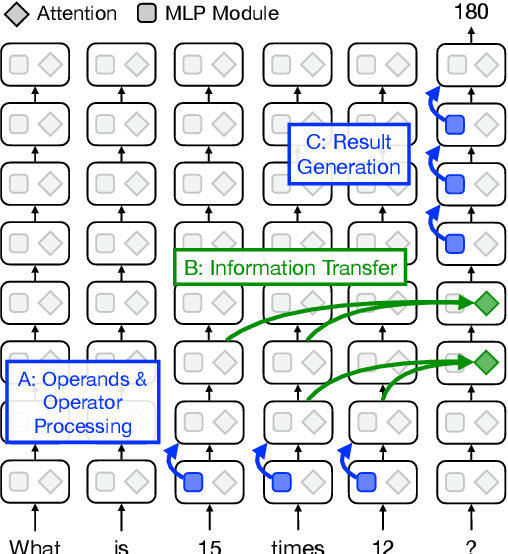
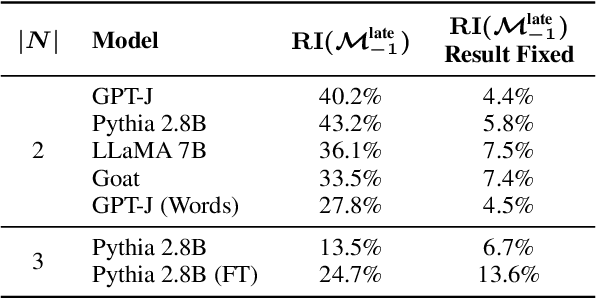
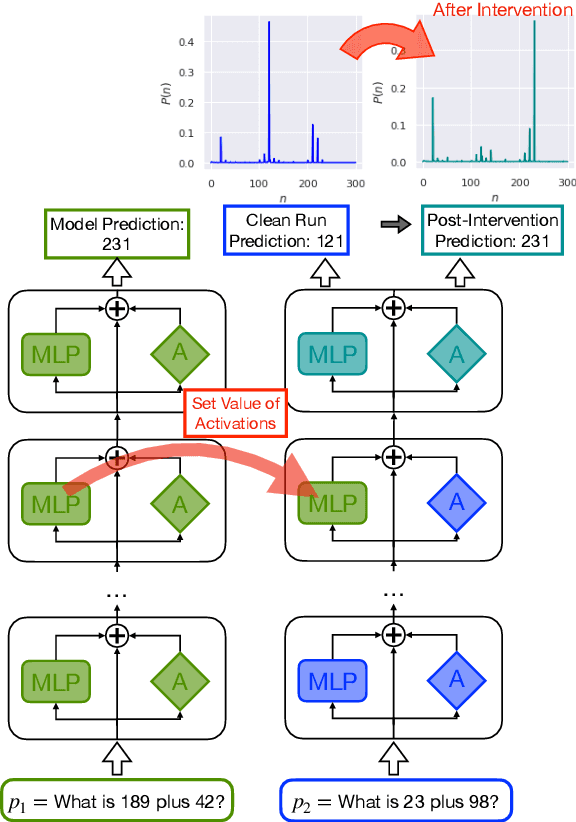
Mathematical reasoning in large language models (LLMs) has garnered attention in recent research, but there is limited understanding of how these models process and store information related to arithmetic tasks. In this paper, we present a mechanistic interpretation of LLMs for arithmetic-based questions using a causal mediation analysis framework. By intervening on the activations of specific model components and measuring the resulting changes in predicted probabilities, we identify the subset of parameters responsible for specific predictions. We analyze two pre-trained language models with different sizes (2.8B and 6B parameters). Experimental results reveal that a small set of mid-late layers significantly affect predictions for arithmetic-based questions, with distinct activation patterns for correct and wrong predictions. We also investigate the role of the attention mechanism and compare the model's activation patterns for arithmetic queries with the prediction of factual knowledge. Our findings provide insights into the mechanistic interpretation of LLMs for arithmetic tasks and highlight the specific components involved in arithmetic reasoning.
Interpreting Transformer's Attention Dynamic Memory and Visualizing the Semantic Information Flow of GPT
May 22, 2023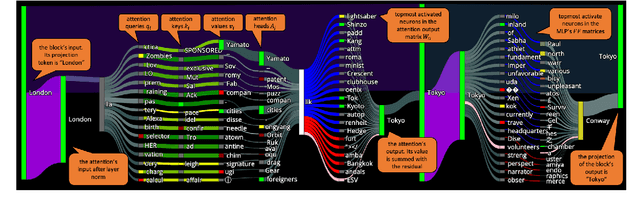
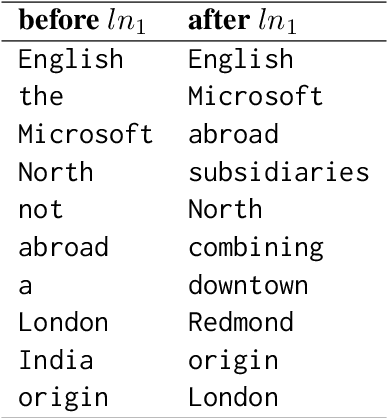

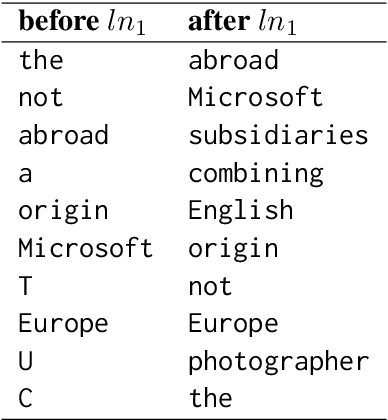
Recent advances in interpretability suggest we can project weights and hidden states of transformer-based language models (LMs) to their vocabulary, a transformation that makes them human interpretable and enables us to assign semantics to what was seen only as numerical vectors. In this paper, we interpret LM attention heads and memory values, the vectors the models dynamically create and recall while processing a given input. By analyzing the tokens they represent through this projection, we identify patterns in the information flow inside the attention mechanism. Based on these discoveries, we create a tool to visualize a forward pass of Generative Pre-trained Transformers (GPTs) as an interactive flow graph, with nodes representing neurons or hidden states and edges representing the interactions between them. Our visualization simplifies huge amounts of data into easy-to-read plots that reflect why models output their results. We demonstrate the utility of our modeling by identifying the effect LM components have on the intermediate processing in the model before outputting a prediction. For instance, we discover that layer norms are used as semantic filters and find neurons that act as regularization vectors.
Shielded Representations: Protecting Sensitive Attributes Through Iterative Gradient-Based Projection
May 17, 2023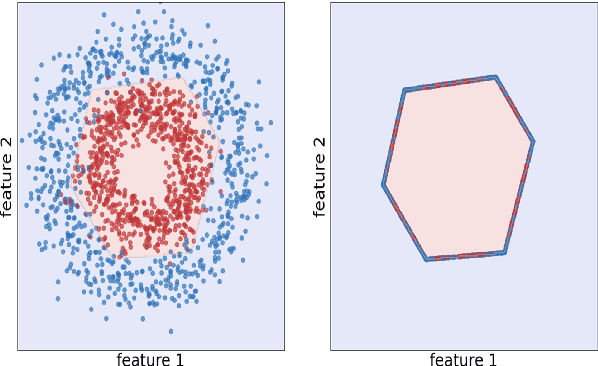
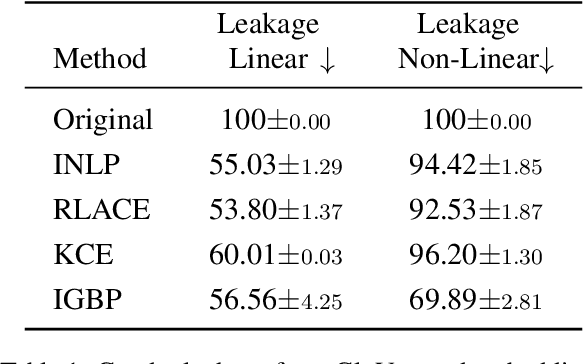
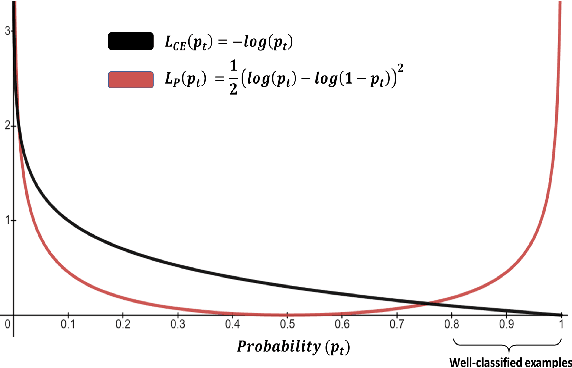
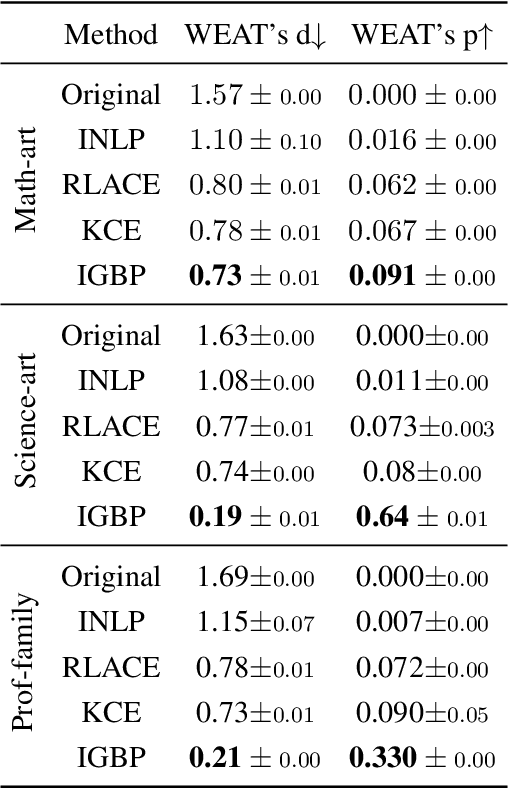
Natural language processing models tend to learn and encode social biases present in the data. One popular approach for addressing such biases is to eliminate encoded information from the model's representations. However, current methods are restricted to removing only linearly encoded information. In this work, we propose Iterative Gradient-Based Projection (IGBP), a novel method for removing non-linear encoded concepts from neural representations. Our method consists of iteratively training neural classifiers to predict a particular attribute we seek to eliminate, followed by a projection of the representation on a hypersurface, such that the classifiers become oblivious to the target attribute. We evaluate the effectiveness of our method on the task of removing gender and race information as sensitive attributes. Our results demonstrate that IGBP is effective in mitigating bias through intrinsic and extrinsic evaluations, with minimal impact on downstream task accuracy.
ContraSim -- A Similarity Measure Based on Contrastive Learning
Mar 29, 2023Recent work has compared neural network representations via similarity-based analyses, shedding light on how different aspects (architecture, training data, etc.) affect models' internal representations. The quality of a similarity measure is typically evaluated by its success in assigning a high score to representations that are expected to be matched. However, existing similarity measures perform mediocrely on standard benchmarks. In this work, we develop a new similarity measure, dubbed ContraSim, based on contrastive learning. In contrast to common closed-form similarity measures, ContraSim learns a parameterized measure by using both similar and dissimilar examples. We perform an extensive experimental evaluation of our method, with both language and vision models, on the standard layer prediction benchmark and two new benchmarks that we introduce: the multilingual benchmark and the image-caption benchmark. In all cases, ContraSim achieves much higher accuracy than previous similarity measures, even when presented with challenging examples, and reveals new insights not captured by previous measures.
Editing Implicit Assumptions in Text-to-Image Diffusion Models
Mar 14, 2023Text-to-image diffusion models often make implicit assumptions about the world when generating images. While some assumptions are useful (e.g., the sky is blue), they can also be outdated, incorrect, or reflective of social biases present in the training data. Thus, there is a need to control these assumptions without requiring explicit user input or costly re-training. In this work, we aim to edit a given implicit assumption in a pre-trained diffusion model. Our Text-to-Image Model Editing method, TIME for short, receives a pair of inputs: a "source" under-specified prompt for which the model makes an implicit assumption (e.g., "a pack of roses"), and a "destination" prompt that describes the same setting, but with a specified desired attribute (e.g., "a pack of blue roses"). TIME then updates the model's cross-attention layers, as these layers assign visual meaning to textual tokens. We edit the projection matrices in these layers such that the source prompt is projected close to the destination prompt. Our method is highly efficient, as it modifies a mere 2.2% of the model's parameters in under one second. To evaluate model editing approaches, we introduce TIMED (TIME Dataset), containing 147 source and destination prompt pairs from various domains. Our experiments (using Stable Diffusion) show that TIME is successful in model editing, generalizes well for related prompts unseen during editing, and imposes minimal effect on unrelated generations.
Parallel Context Windows Improve In-Context Learning of Large Language Models
Dec 21, 2022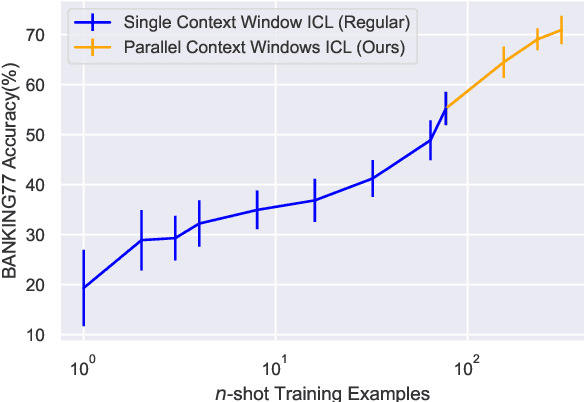
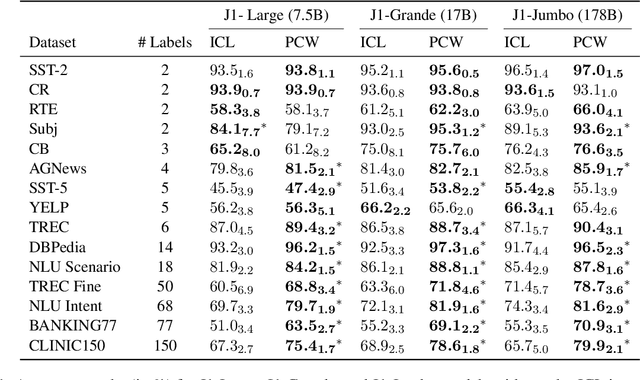
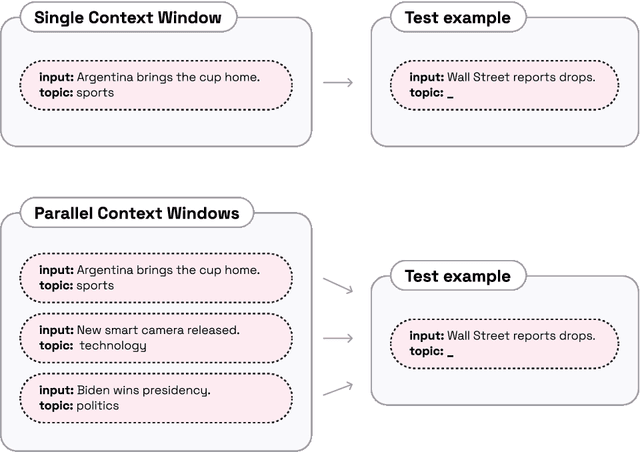
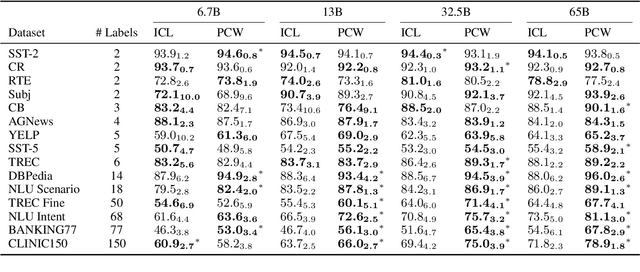
For applications that require processing large amounts of text at inference time, Large Language Models (LLMs) are handicapped by their limited context windows, which are typically 2048 tokens. In-context learning, an emergent phenomenon in LLMs in sizes above a certain parameter threshold, constitutes one significant example because it can only leverage training examples that fit into the context window. Existing efforts to address the context window limitation involve training specialized architectures, which tend to be smaller than the sizes in which in-context learning manifests due to the memory footprint of processing long texts. We present Parallel Context Windows (PCW), a method that alleviates the context window restriction for any off-the-shelf LLM without further training. The key to the approach is to carve a long context into chunks (``windows'') that fit within the architecture, restrict the attention mechanism to apply only within each window, and re-use the positional embeddings among the windows. We test the PCW approach on in-context learning with models that range in size between 750 million and 178 billion parameters, and show substantial improvements for tasks with diverse input and output spaces. Our results motivate further investigation of Parallel Context Windows as a method for applying off-the-shelf LLMs in other settings that require long text sequences.