 Add to Chrome
 Add to Firefox
 Add to Edge
Structuring Sparsity: Block-Sparse Featurizers Capture Visual Concept Manifolds
Jun 23, 2026
What is the geometry of a visual percept? The most widely used protocols for decomposing neural network representations into interpretable parts treat concepts as isolated directions, yet recent work shows that concepts are often realized as geometric structures in low dimensional regions of activation space. We turn to the literature of Structured sparsity to close this gap, and show that block sparsity, which groups directions into blocks, is the prior matched to a generative model in which a representation is a sparse sum of low-dimensional manifolds: the modern, learned form of a classical idea in visual neuroscience, where a visual feature is carried by a coordinated group of neurons rather than a single tuned one. We implement three variants of block-sparse featurizers (BSFs) and, through a minimum-description-length analysis, show that all three describe activations more compactly than direction-based featurizers, with the recovered concepts typically two- to four-dimensional. We then use BSFs to (i) recontextualize prior work, showing that curve detectors in InceptionV1 actually read from a single continuous curve manifold, (ii) discover novel manifolds including shadows and lighting in DINOv3, and (iii) support interpretable control of image generation in diffusion models (SDXL) via manifold steering.

Manifold Steering Reveals the Shared Geometry of Neural Network Representation and Behavior
May 06, 2026Neural representations carry rich geometric structure; but does that structure causally shape behavior? To address this question, we intervene along paths through activation space defined by different geometries, and measure the behavioral trajectories they induce. In particular, we test whether interventions that respect the geometry of activation space will yield behaviors close to those the model exhibits naturally. Concretely, we first fit an activation manifold $M_h$ to representations and a behavior manifold $M_y$ to output probability distributions. We then test the link $M_h \leftrightarrow M_y$ via interventions: we find that steering along $M_h$, which we term manifold steering, yields behavioral trajectories that follow $M_y$, while linear steering -- which assumes a Euclidean geometry -- cuts through off-manifold regions and hence produces unnatural outputs. Moreover, optimizing interventions in activation space to produce paths along $M_y$ recovers activation trajectories that trace the curvature of $M_h$. We demonstrate this bidirectional relationship between the geometry of representation and behavior across tasks and modalities. In language models, we use reasoning tasks with cyclic and sequential geometries as well as in-context learning tasks with more complex graph geometries. In a video world model, we use a task with geometry corresponding to physical dynamics. Overall, our work shows that geometry in neural representation is not merely incidental, but is in fact the proper object for enabling principled control via intervention on internals. This recasts the core problem of steering from finding the right direction to finding the right geometry.
Pitfalls in Evaluating Interpretability Agents
Mar 20, 2026Automated interpretability systems aim to reduce the need for human labor and scale analysis to increasingly large models and diverse tasks. Recent efforts toward this goal leverage large language models (LLMs) at increasing levels of autonomy, ranging from fixed one-shot workflows to fully autonomous interpretability agents. This shift creates a corresponding need to scale evaluation approaches to keep pace with both the volume and complexity of generated explanations. We investigate this challenge in the context of automated circuit analysis -- explaining the roles of model components when performing specific tasks. To this end, we build an agentic system in which a research agent iteratively designs experiments and refines hypotheses. When evaluated against human expert explanations across six circuit analysis tasks in the literature, the system appears competitive. However, closer examination reveals several pitfalls of replication-based evaluation: human expert explanations can be subjective or incomplete, outcome-based comparisons obscure the research process, and LLM-based systems may reproduce published findings via memorization or informed guessing. To address some of these pitfalls, we propose an unsupervised intrinsic evaluation based on the functional interchangeability of model components. Our work demonstrates fundamental challenges in evaluating complex automated interpretability systems and reveals key limitations of replication-based evaluation.
MIB: A Mechanistic Interpretability Benchmark
Apr 17, 2025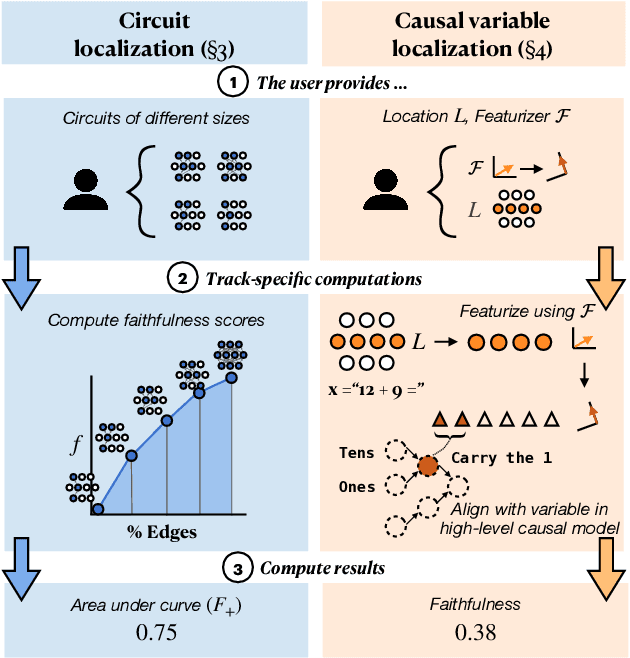
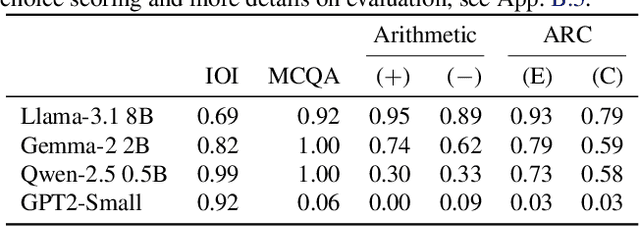
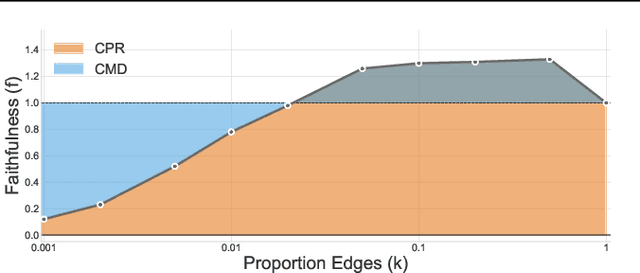
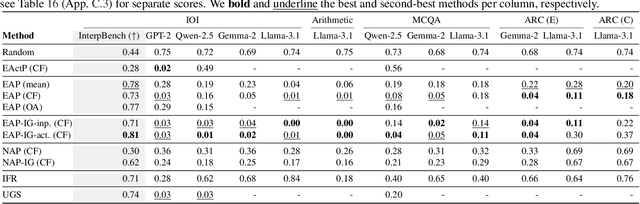
How can we know whether new mechanistic interpretability methods achieve real improvements? In pursuit of meaningful and lasting evaluation standards, we propose MIB, a benchmark with two tracks spanning four tasks and five models. MIB favors methods that precisely and concisely recover relevant causal pathways or specific causal variables in neural language models. The circuit localization track compares methods that locate the model components - and connections between them - most important for performing a task (e.g., attribution patching or information flow routes). The causal variable localization track compares methods that featurize a hidden vector, e.g., sparse autoencoders (SAEs) or distributed alignment search (DAS), and locate model features for a causal variable relevant to the task. Using MIB, we find that attribution and mask optimization methods perform best on circuit localization. For causal variable localization, we find that the supervised DAS method performs best, while SAE features are not better than neurons, i.e., standard dimensions of hidden vectors. These findings illustrate that MIB enables meaningful comparisons of methods, and increases our confidence that there has been real progress in the field.
Position-aware Automatic Circuit Discovery
Feb 07, 2025A widely used strategy to discover and understand language model mechanisms is circuit analysis. A circuit is a minimal subgraph of a model's computation graph that executes a specific task. We identify a gap in existing circuit discovery methods: they assume circuits are position-invariant, treating model components as equally relevant across input positions. This limits their ability to capture cross-positional interactions or mechanisms that vary across positions. To address this gap, we propose two improvements to incorporate positionality into circuits, even on tasks containing variable-length examples. First, we extend edge attribution patching, a gradient-based method for circuit discovery, to differentiate between token positions. Second, we introduce the concept of a dataset schema, which defines token spans with similar semantics across examples, enabling position-aware circuit discovery in datasets with variable length examples. We additionally develop an automated pipeline for schema generation and application using large language models. Our approach enables fully automated discovery of position-sensitive circuits, yielding better trade-offs between circuit size and faithfulness compared to prior work.
Fine-Tuning Enhances Existing Mechanisms: A Case Study on Entity Tracking
Feb 22, 2024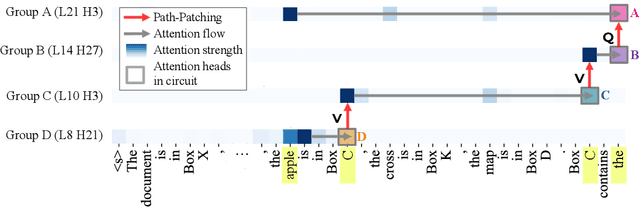


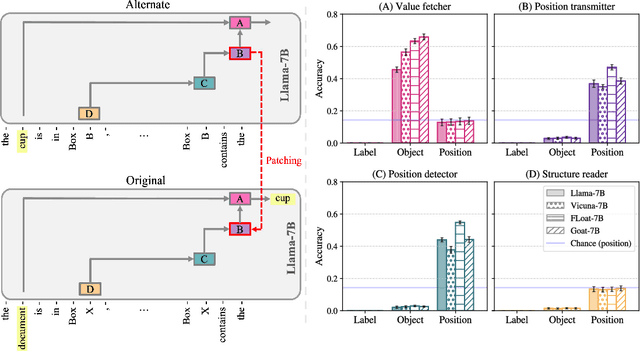
Fine-tuning on generalized tasks such as instruction following, code generation, and mathematics has been shown to enhance language models' performance on a range of tasks. Nevertheless, explanations of how such fine-tuning influences the internal computations in these models remain elusive. We study how fine-tuning affects the internal mechanisms implemented in language models. As a case study, we explore the property of entity tracking, a crucial facet of language comprehension, where models fine-tuned on mathematics have substantial performance gains. We identify the mechanism that enables entity tracking and show that (i) in both the original model and its fine-tuned versions primarily the same circuit implements entity tracking. In fact, the entity tracking circuit of the original model on the fine-tuned versions performs better than the full original model. (ii) The circuits of all the models implement roughly the same functionality: Entity tracking is performed by tracking the position of the correct entity in both the original model and its fine-tuned versions. (iii) Performance boost in the fine-tuned models is primarily attributed to its improved ability to handle the augmented positional information. To uncover these findings, we employ: Patch Patching, DCM, which automatically detects model components responsible for specific semantics, and CMAP, a new approach for patching activations across models to reveal improved mechanisms. Our findings suggest that fine-tuning enhances, rather than fundamentally alters, the mechanistic operation of the model.
Linearity of Relation Decoding in Transformer Language Models
Aug 17, 2023Much of the knowledge encoded in transformer language models (LMs) may be expressed in terms of relations: relations between words and their synonyms, entities and their attributes, etc. We show that, for a subset of relations, this computation is well-approximated by a single linear transformation on the subject representation. Linear relation representations may be obtained by constructing a first-order approximation to the LM from a single prompt, and they exist for a variety of factual, commonsense, and linguistic relations. However, we also identify many cases in which LM predictions capture relational knowledge accurately, but this knowledge is not linearly encoded in their representations. Our results thus reveal a simple, interpretable, but heterogeneously deployed knowledge representation strategy in transformer LMs.