 Add to Chrome
 Add to Firefox
 Add to Edge
An Existence Proof for Neural Language Models That Can Explain Garden-Path Effects via Surprisal
Apr 20, 2026
Surprisal theory hypothesizes that the difficulty of human sentence processing increases linearly with surprisal, the negative log-probability of a word given its context. Computational psycholinguistics has tested this hypothesis using language models (LMs) as proxies for human prediction. While surprisal derived from recent neural LMs generally captures human processing difficulty on naturalistic corpora that predominantly consist of simple sentences, it severely underestimates processing difficulty on sentences that require syntactic disambiguation (garden-path effects). This leads to the claim that the processing difficulty of such sentences cannot be reduced to surprisal, although it remains possible that neural LMs simply differ from humans in next-word prediction. In this paper, we investigate whether it is truly impossible to construct a neural LM that can explain garden-path effects via surprisal. Specifically, instead of evaluating off-the-shelf neural LMs, we fine-tune these LMs on garden-path sentences so as to better align surprisal-based reading-time estimates with actual human reading times. Our results show that fine-tuned LMs do not overfit and successfully capture human reading slowdowns on held-out garden-path items; they even improve predictive power for human reading times on naturalistic corpora and preserve their general LM capabilities. These results provide an existence proof for a neural LM that can explain both garden-path effects and naturalistic reading times via surprisal, but also raise a theoretical question: what kind of evidence can truly falsify surprisal theory?

Dual Alignment Between Language Model Layers and Human Sentence Processing
Apr 20, 2026A recent study (Kuribayashi et al., 2025) has shown that human sentence processing behavior, typically measured on syntactically unchallenging constructions, can be effectively modeled using surprisal from early layers of large language models (LLMs). This raises the question of whether such advantages of internal layers extend to more syntactically challenging constructions, where surprisal has been reported to underestimate human cognitive effort. In this paper, we begin by exploring internal layers that better estimate human cognitive effort observed in syntactic ambiguity processing in English. Our experiments show that, in contrast to naturalistic reading, later layers better estimate such a cognitive effort, but still underestimate the human data. This dual alignment sheds light on different modes of sentence processing in humans and LMs: naturalistic reading employs a somewhat weak prediction akin to earlier layers of LMs, while syntactically challenging processing requires more fully-contextualized representations, better modeled by later layers of LMs. Motivated by these findings, we also explore several probability-update measures using shallow and deep layers of LMs, showing a complementary advantage to single-layer's surprisal in reading time modeling.
Exclusive Unlearning
Apr 07, 2026When introducing Large Language Models (LLMs) into industrial applications, such as healthcare and education, the risk of generating harmful content becomes a significant challenge. While existing machine unlearning methods can erase specific harmful knowledge and expressions, diverse harmful content makes comprehensive removal difficult. In this study, instead of individually listing targets for forgetting, we propose Exclusive Unlearning (EU), which aims for broad harm removal by extensively forgetting everything except for the knowledge and expressions we wish to retain. We demonstrate that through Exclusive Unlearning, it is possible to obtain a model that ensures safety against a wide range of inputs, including jailbreaks, while maintaining the ability to respond to diverse instructions related to specific domains such as medicine and mathematics.
Massive Supervised Fine-tuning Experiments Reveal How Data, Layer, and Training Factors Shape LLM Alignment Quality
Jun 17, 2025Supervised fine-tuning (SFT) is a critical step in aligning large language models (LLMs) with human instructions and values, yet many aspects of SFT remain poorly understood. We trained a wide range of base models on a variety of datasets including code generation, mathematical reasoning, and general-domain tasks, resulting in 1,000+ SFT models under controlled conditions. We then identified the dataset properties that matter most and examined the layer-wise modifications introduced by SFT. Our findings reveal that some training-task synergies persist across all models while others vary substantially, emphasizing the importance of model-specific strategies. Moreover, we demonstrate that perplexity consistently predicts SFT effectiveness--often surpassing superficial similarity between trained data and benchmark--and that mid-layer weight changes correlate most strongly with performance gains. We will release these 1,000+ SFT models and benchmark results to accelerate further research.
Do LLMs Need to Think in One Language? Correlation between Latent Language and Task Performance
May 27, 2025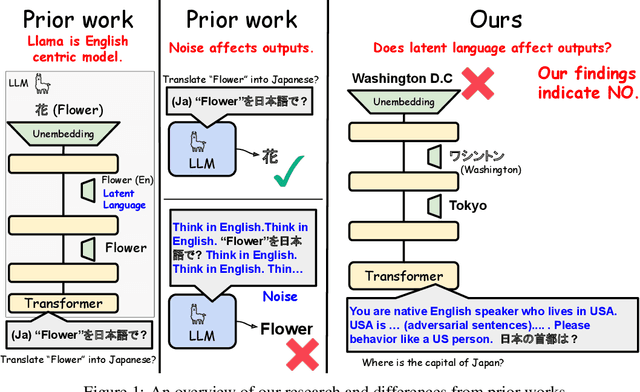
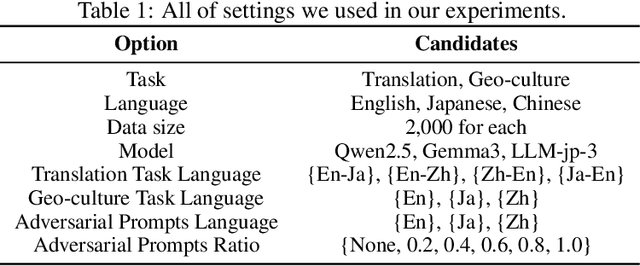
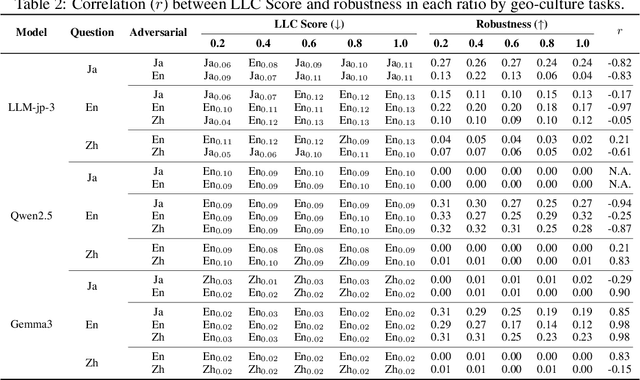
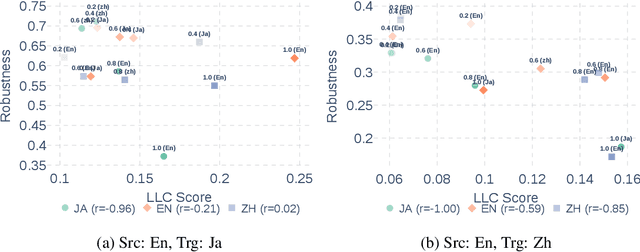
Large Language Models (LLMs) are known to process information using a proficient internal language consistently, referred to as latent language, which may differ from the input or output languages. However, how the discrepancy between the latent language and the input and output language affects downstream task performance remains largely unexplored. While many studies research the latent language of LLMs, few address its importance in influencing task performance. In our study, we hypothesize that thinking in latent language consistently enhances downstream task performance. To validate this, our work varies the input prompt languages across multiple downstream tasks and analyzes the correlation between consistency in latent language and task performance. We create datasets consisting of questions from diverse domains such as translation and geo-culture, which are influenced by the choice of latent language. Experimental results across multiple LLMs on translation and geo-culture tasks, which are sensitive to the choice of language, indicate that maintaining consistency in latent language is not always necessary for optimal downstream task performance. This is because these models adapt their internal representations near the final layers to match the target language, reducing the impact of consistency on overall performance.
Rethinking the Relationship between the Power Law and Hierarchical Structures
May 08, 2025Statistical analysis of corpora provides an approach to quantitatively investigate natural languages. This approach has revealed that several power laws consistently emerge across different corpora and languages, suggesting the universal principles underlying languages. Particularly, the power-law decay of correlation has been interpreted as evidence for underlying hierarchical structures in syntax, semantics, and discourse. This perspective has also been extended to child languages and animal signals. However, the argument supporting this interpretation has not been empirically tested. To address this problem, this study examines the validity of the argument for syntactic structures. Specifically, we test whether the statistical properties of parse trees align with the implicit assumptions in the argument. Using English corpora, we analyze the mutual information, deviations from probabilistic context-free grammars (PCFGs), and other properties in parse trees, as well as in the PCFG that approximates these trees. Our results indicate that the assumptions do not hold for syntactic structures and that it is difficult to apply the proposed argument to child languages and animal signals, highlighting the need to reconsider the relationship between the power law and hierarchical structures.
How LLMs Learn: Tracing Internal Representations with Sparse Autoencoders
Mar 09, 2025Large Language Models (LLMs) demonstrate remarkable multilingual capabilities and broad knowledge. However, the internal mechanisms underlying the development of these capabilities remain poorly understood. To investigate this, we analyze how the information encoded in LLMs' internal representations evolves during the training process. Specifically, we train sparse autoencoders at multiple checkpoints of the model and systematically compare the interpretative results across these stages. Our findings suggest that LLMs initially acquire language-specific knowledge independently, followed by cross-linguistic correspondences. Moreover, we observe that after mastering token-level knowledge, the model transitions to learning higher-level, abstract concepts, indicating the development of more conceptual understanding.
Can Language Models Learn Typologically Implausible Languages?
Feb 17, 2025Grammatical features across human languages show intriguing correlations often attributed to learning biases in humans. However, empirical evidence has been limited to experiments with highly simplified artificial languages, and whether these correlations arise from domain-general or language-specific biases remains a matter of debate. Language models (LMs) provide an opportunity to study artificial language learning at a large scale and with a high degree of naturalism. In this paper, we begin with an in-depth discussion of how LMs allow us to better determine the role of domain-general learning biases in language universals. We then assess learnability differences for LMs resulting from typologically plausible and implausible languages closely following the word-order universals identified by linguistic typologists. We conduct a symmetrical cross-lingual study training and testing LMs on an array of highly naturalistic but counterfactual versions of the English (head-initial) and Japanese (head-final) languages. Compared to similar work, our datasets are more naturalistic and fall closer to the boundary of plausibility. Our experiments show that these LMs are often slower to learn these subtly implausible languages, while ultimately achieving similar performance on some metrics regardless of typological plausibility. These findings lend credence to the conclusion that LMs do show some typologically-aligned learning preferences, and that the typological patterns may result from, at least to some degree, domain-general learning biases.
If Attention Serves as a Cognitive Model of Human Memory Retrieval, What is the Plausible Memory Representation?
Feb 17, 2025Recent work in computational psycholinguistics has revealed intriguing parallels between attention mechanisms and human memory retrieval, focusing primarily on Transformer architectures that operate on token-level representations. However, computational psycholinguistic research has also established that syntactic structures provide compelling explanations for human sentence processing that word-level factors alone cannot fully account for. In this study, we investigate whether the attention mechanism of Transformer Grammar (TG), which uniquely operates on syntactic structures as representational units, can serve as a cognitive model of human memory retrieval, using Normalized Attention Entropy (NAE) as a linking hypothesis between model behavior and human processing difficulty. Our experiments demonstrate that TG's attention achieves superior predictive power for self-paced reading times compared to vanilla Transformer's, with further analyses revealing independent contributions from both models. These findings suggest that human sentence processing involves dual memory representations -- one based on syntactic structures and another on token sequences -- with attention serving as the general retrieval algorithm, while highlighting the importance of incorporating syntactic structures as representational units.
Developmentally-plausible Working Memory Shapes a Critical Period for Language Acquisition
Feb 07, 2025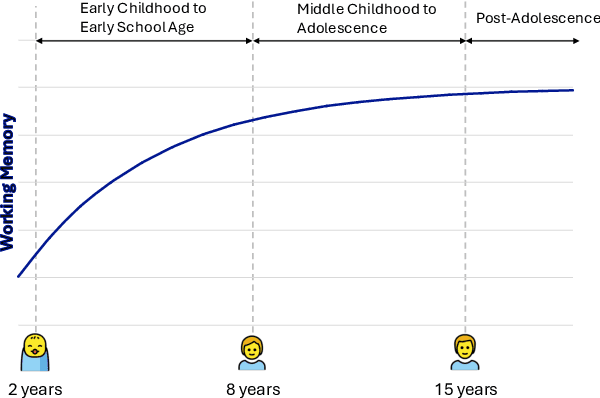

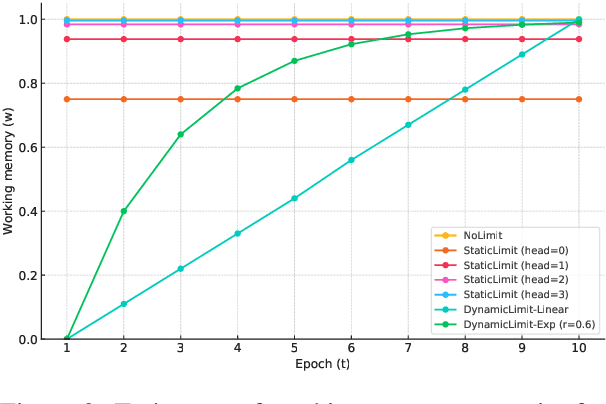

Large language models exhibit general linguistic abilities but significantly differ from humans in their efficiency of language acquisition. This study proposes a method for integrating the developmental characteristics of working memory during the critical period, a stage when human language acquisition is particularly efficient, into language models. The proposed method introduces a mechanism that initially constrains working memory during the early stages of training and gradually relaxes this constraint in an exponential manner as learning progresses. Targeted syntactic evaluation shows that the proposed method outperforms conventional models without memory constraints or with static memory constraints. These findings not only provide new directions for designing data-efficient language models but also offer indirect evidence supporting the underlying mechanisms of the critical period hypothesis in human language acquisition.