 Add to Chrome
 Add to Firefox
 Add to Edge
AMap: Distilling Future Priors for Ahead-Aware Online HD Map Construction
Dec 22, 2025
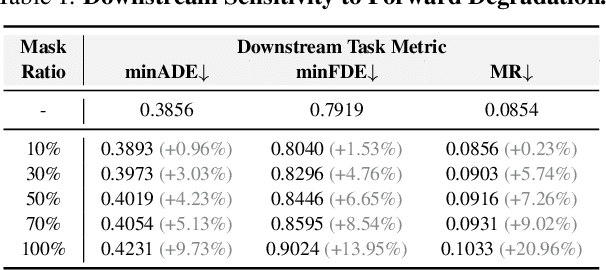
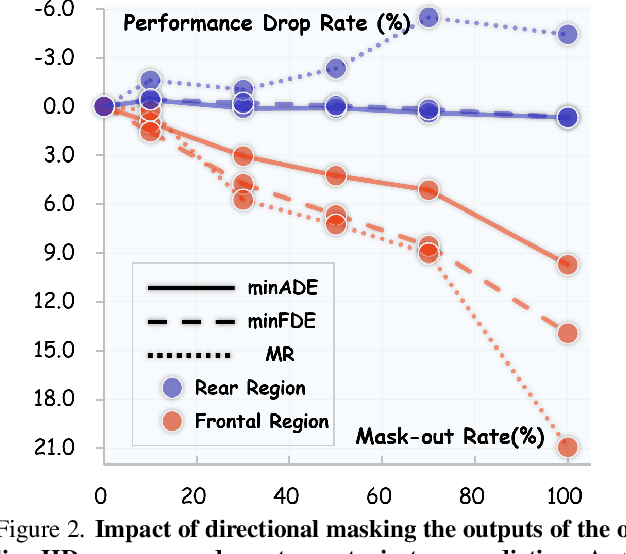
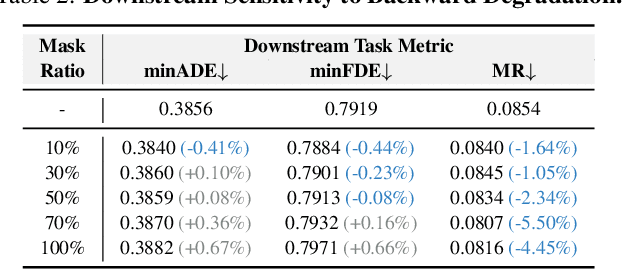
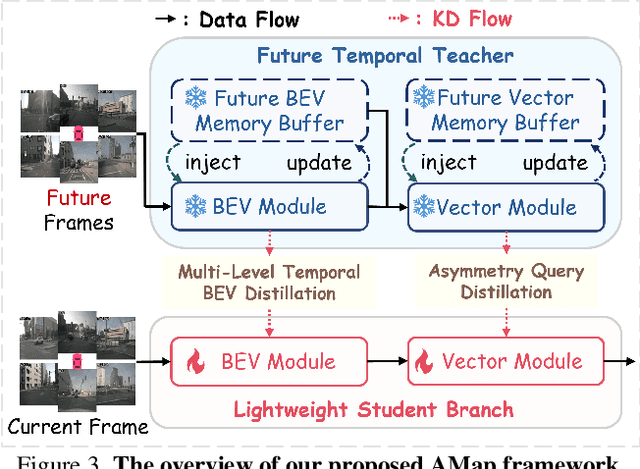
Online High-Definition (HD) map construction is pivotal for autonomous driving. While recent approaches leverage historical temporal fusion to improve performance, we identify a critical safety flaw in this paradigm: it is inherently ``spatially backward-looking." These methods predominantly enhance map reconstruction in traversed areas, offering minimal improvement for the unseen road ahead. Crucially, our analysis of downstream planning tasks reveals a severe asymmetry: while rearward perception errors are often tolerable, inaccuracies in the forward region directly precipitate hazardous driving maneuvers. To bridge this safety gap, we propose AMap, a novel framework for Ahead-aware online HD Mapping. We pioneer a ``distill-from-future" paradigm, where a teacher model with privileged access to future temporal contexts guides a lightweight student model restricted to the current frame. This process implicitly compresses prospective knowledge into the student model, endowing it with ``look-ahead" capabilities at zero inference-time cost. Technically, we introduce a Multi-Level BEV Distillation strategy with spatial masking and an Asymmetric Query Adaptation module to effectively transfer future-aware representations to the student's static queries. Extensive experiments on the nuScenes and Argoverse 2 benchmark demonstrate that AMap significantly enhances current-frame perception. Most notably, it outperforms state-of-the-art temporal models in critical forward regions while maintaining the efficiency of single current frame inference.

SPHR-SAR-Net: Superpixel High-resolution SAR Imaging Network Based on Nonlocal Total Variation
Apr 10, 2023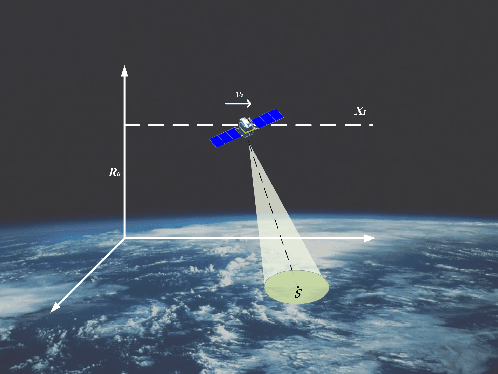
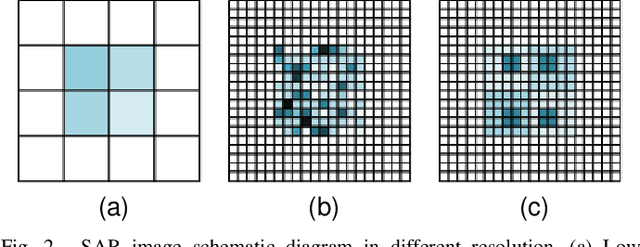
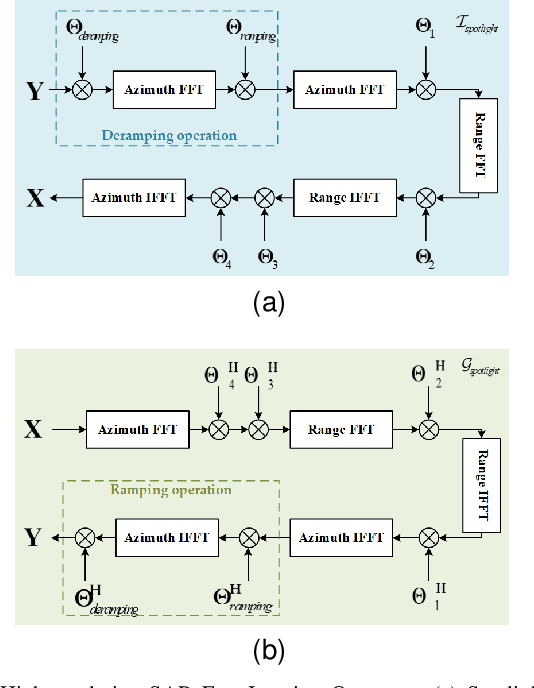
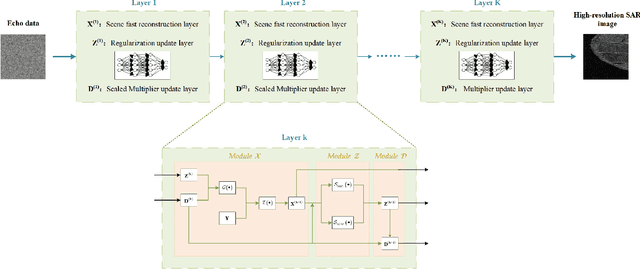
High-resolution is a key trend in the development of synthetic aperture radar (SAR), which enables the capture of fine details and accurate representation of backscattering properties. However, traditional high-resolution SAR imaging algorithms face several challenges. Firstly, these algorithms tend to focus on local information, neglecting non-local information between different pixel patches. Secondly, speckle is more pronounced and difficult to filter out in high-resolution SAR images. Thirdly, the process of high-resolution SAR imaging generally involves high time and computational complexity, making real-time imaging difficult to achieve. To address these issues, we propose a Superpixel High-Resolution SAR Imaging Network (SPHR-SAR-Net) for rapid despeckling in high-resolution SAR mode. Based on the concept of superpixel techniques, we initially combine non-convex and non-local total variation as compound regularization. This approach more effectively despeckles and manages the relationship between pixels while reducing bias effects caused by convex constraints. Subsequently, we solve the compound regularization model using the Alternating Direction Method of Multipliers (ADMM) algorithm and unfold it into a Deep Unfolded Network (DUN). The network's parameters are adaptively learned in a data-driven manner, and the learned network significantly increases imaging speed. Additionally, the Deep Unfolded Network is compatible with high-resolution imaging modes such as spotlight, staring spotlight, and sliding spotlight. In this paper, we demonstrate the superiority of SPHR-SAR-Net through experiments in both simulated and real SAR scenarios. The results indicate that SPHR-SAR-Net can rapidly perform high-resolution SAR imaging from raw echo data, producing accurate imaging results.