 Add to Chrome
 Add to Firefox
 Add to Edge
FreeBalance: Pre-Routing Online Moe Load Balancing via Residual Workload Prediction
Aug 14, 2026
Load imbalance poses a major bottleneck to the efficiency of expert parallelism in distributed inference of Mixture-of-Experts (MoE) models. The most heavily loaded rank stalls global execution due to skewed routing distributions, directly increasing latency. While offline expert placement can alleviate persistent imbalance, practical multi-task serving workloads exhibit layer- and batch-dependent routing dynamics, making online load balancing indispensable. Existing approaches rely on routing statistics collected after each MoE router, requiring expert weight load or migration to begin only after routing decisions are available, consequently placing migration overhead on the inference critical path. In this work, we observe that online balancing can instead be largely overlapped with computation before target routing (e.g., attention), if routing distributions can be predicted accurately in advance. Therefore, we propose FreeBalance, a lossless online load-balancing framework that overlaps expert migration with preceding computation stages via residual workload prediction. FreeBalance leverages cross-layer similarities in hidden representations within the residual network to build a lightweight workload predictor. This enables proactive expert migration planning before routing decisions are available, creating substantial overlap between weight transfer and computation-heavy pre-routing stages. Furthermore, a cost model constrains the number of swaps to fully hide the synchronization overhead within the available window. Experiments across models and datasets show that FreeBalance reduces the max-to-mean rank load ratio by 32.8% and end-to-end prefill latency by 13.1%. Specifically, our method hides balancing overhead of an average of 5.1 experts per layer, which would otherwise account for about 8.5% of the critical-path latency.

EasyBalance: Cross-Layer Load Balancing in Distributed MoE Inference
Aug 08, 2026Load Balancing has emerged as a critical problem in expert-parallel distributed inference of Mixture-of-Experts (MoE) models. As routing distributions are typically skewed across experts, devices hosting lighter-loaded experts must idle to wait for the heaviest during expert computing, leading to inefficiency. Existing load-balancing approaches primarily rely on expert replication or migration within each layer, which introduce additional overhead and limit their flexibility and scalability. To address this problem, we propose EasyBalance, a cross-layer load balancing strategy that requires no modifications to the expert-device mapping, enabling instant adaptability and incurring essentially no additional overhead. Our key insights are that (1) experts of other layers can be viewed as naturally redundant for the current layer, and (2) cross-layer MoE workloads can be jointly executed to mitigate their individual imbalance. Based on these observations, EasyBalance greedily schedules a subset of cross-layer workloads to run at each MoE step and defers the remaining workloads for future balancing opportunities, effectively leveraging cross-layer imbalance mitigation. Extensive experiments across models, tasks, and configurations demonstrate that EasyBalance consistently accelerates distributed MoE inference, reducing GPU idling by mostly over 40%. Code is available at https://github.com/yize-wu/EasyInfra.
Director: Instance-aware Gaussian Splatting for Dynamic Scene Modeling and Understanding
Apr 02, 2026Volumetric video seeks to model dynamic scenes as temporally coherent 4D representations. While recent Gaussian-based approaches achieve impressive rendering fidelity, they primarily emphasize appearance but are largely agnostic to instance-level structure, limiting stable tracking and semantic reasoning in highly dynamic scenarios. In this paper, we present Director, a unified spatio-temporal Gaussian representation that jointly models human performance, high-fidelity rendering, and instance-level semantics. Our key insight is that embedding instance-consistent semantics naturally complements 4D modeling, enabling more accurate scene decomposition while supporting robust dynamic scene understanding. To this end, we leverage temporally aligned instance masks and sentence embeddings derived from Multimodal Large Language Models to supervise the learnable semantic features of each Gaussian via two MLP decoders, enabling language-aligned 4D representations and enforcing identity consistency over time. To enhance temporal stability, we bridge 2D optical flow with 4D Gaussians and finetune their motions, yielding reliable initialization and reducing drift. For the training, we further introduce a geometry-aware SDF constraints, along with regularization terms that enforces surface continuity, enhancing temporal coherence in dynamic foreground modeling. Experiments demonstrate that Director achieves temporally coherent 4D reconstructions while simultaneously enabling instance segmentation and open-vocabulary querying.
Stable-LoRA: Stabilizing Feature Learning of Low-Rank Adaptation
Mar 05, 2026Low-Rank Adaptation (LoRA) is a widely adopted parameter-efficient method for fine-tuning Large Langauge Models. It updates the weight matrix as $W=W_0+sBA$, where $W_0$ is the original frozen weight, $s$ is a scaling factor and $A$,$B$ are trainable low-rank matrices. Despite its robust empirical effectiveness, the theoretical foundations of LoRA remain insufficiently understood, particularly with respect to feature learning stability. In this paper, we first establish that, LoRA can, in principle, naturally achieve and sustain stable feature learning (i.e., be self-stabilized) under appropriate hyper-parameters and initializations of $A$ and $B$. However, we also uncover a fundamental limitation that the necessary non-zero initialization of $A$ compromises self-stability, leading to suboptimal performances. To address this challenge, we propose Stable-LoRA, a weight-shrinkage optimization strategy that dynamically enhances stability of LoRA feature learning. By progressively shrinking $A$ during the earliest training steps, Stable-LoRA is both theoretically and empirically validated to effectively eliminate instability of LoRA feature learning while preserving the benefits of the non-zero start. Experiments show that Stable-LoRA consistently outperforms other baselines across diverse models and tasks, with no additional memory usage and only negligible computation overheads. The code is available at https://github.com/Yize-Wu/Stable-LoRA.
BEAM: Bridging Physically-based Rendering and Gaussian Modeling for Relightable Volumetric Video
Feb 12, 2025Volumetric video enables immersive experiences by capturing dynamic 3D scenes, enabling diverse applications for virtual reality, education, and telepresence. However, traditional methods struggle with fixed lighting conditions, while neural approaches face trade-offs in efficiency, quality, or adaptability for relightable scenarios. To address these limitations, we present BEAM, a novel pipeline that bridges 4D Gaussian representations with physically-based rendering (PBR) to produce high-quality, relightable volumetric videos from multi-view RGB footage. BEAM recovers detailed geometry and PBR properties via a series of available Gaussian-based techniques. It first combines Gaussian-based performance tracking with geometry-aware rasterization in a coarse-to-fine optimization framework to recover spatially and temporally consistent geometries. We further enhance Gaussian attributes by incorporating PBR properties step by step. We generate roughness via a multi-view-conditioned diffusion model, and then derive AO and base color using a 2D-to-3D strategy, incorporating a tailored Gaussian-based ray tracer for efficient visibility computation. Once recovered, these dynamic, relightable assets integrate seamlessly into traditional CG pipelines, supporting real-time rendering with deferred shading and offline rendering with ray tracing. By offering realistic, lifelike visualizations under diverse lighting conditions, BEAM opens new possibilities for interactive entertainment, storytelling, and creative visualization.
EasySpec: Layer-Parallel Speculative Decoding for Efficient Multi-GPU Utilization
Feb 04, 2025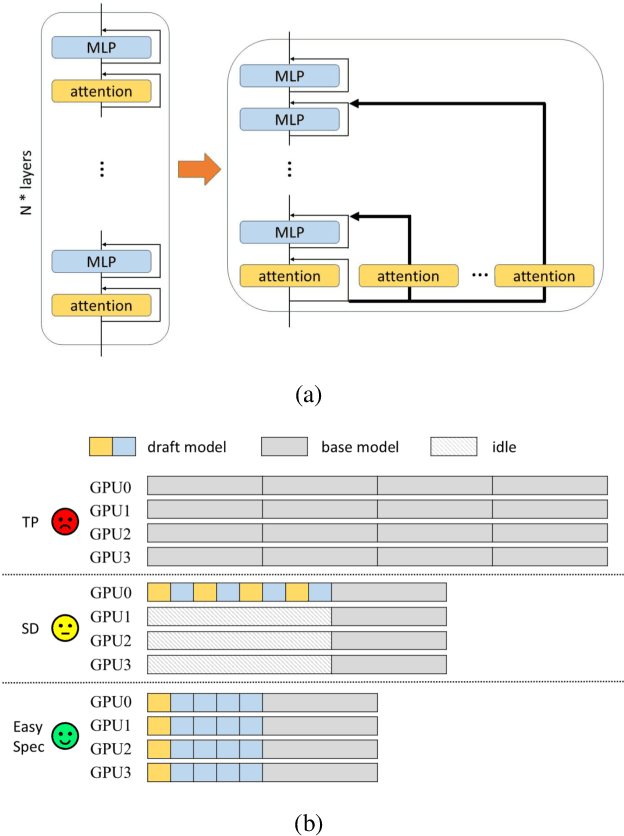
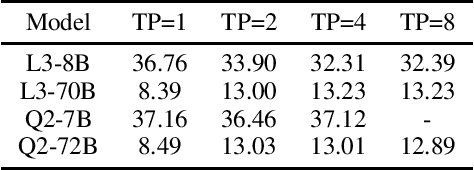
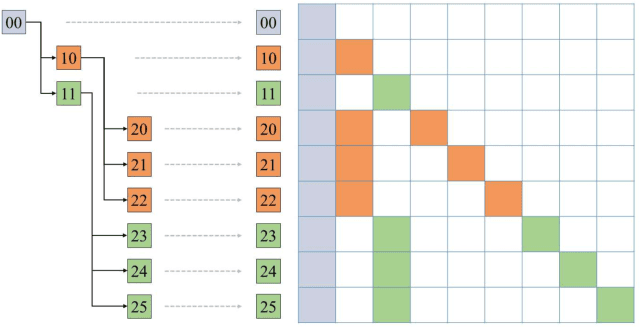
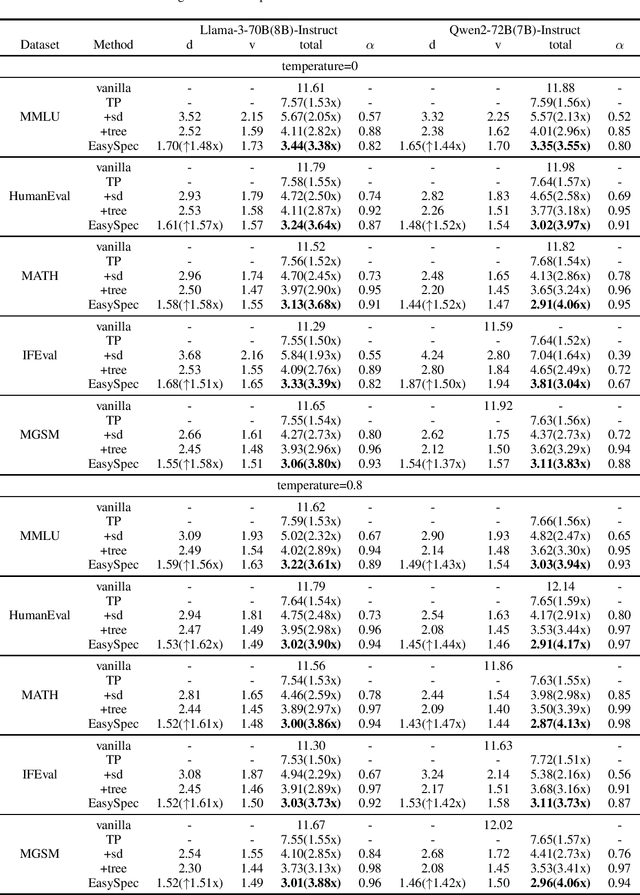
Speculative decoding is an effective and lossless method for Large Language Model (LLM) inference acceleration. It employs a smaller model to generate a draft token sequence, which is then verified by the original base model. In multi-GPU systems, inference latency can be further reduced through tensor parallelism (TP), while the optimal TP size of the draft model is typically smaller than that of the base model, leading to GPU idling during the drafting stage. To solve this problem, we propose EasySpec, a layer-parallel speculation strategy that optimizes the efficiency of multi-GPU utilization.EasySpec breaks the sequential execution order of layers in the drafting model, enabling multi-layer parallelization across devices, albeit with some induced approximation errors. After each drafting-and-verification iteration, the draft model's key-value (KV) cache is calibrated in a single forward pass, preventing long-term error accumulation at minimal additional latency. We evaluated EasySpec on several mainstream open-source LLMs, using smaller versions of models from the same series as drafters. The results demonstrate that EasySpec can achieve a peak speedup of 4.17x compared to vanilla decoding, while preserving the original distribution of the base LLMs. Specifically, the drafting stage can be accelerated by up to 1.62x with a maximum accuracy drop of only 7%, requiring no training or fine-tuning on the draft models.
Robust Dual Gaussian Splatting for Immersive Human-centric Volumetric Videos
Sep 12, 2024Volumetric video represents a transformative advancement in visual media, enabling users to freely navigate immersive virtual experiences and narrowing the gap between digital and real worlds. However, the need for extensive manual intervention to stabilize mesh sequences and the generation of excessively large assets in existing workflows impedes broader adoption. In this paper, we present a novel Gaussian-based approach, dubbed \textit{DualGS}, for real-time and high-fidelity playback of complex human performance with excellent compression ratios. Our key idea in DualGS is to separately represent motion and appearance using the corresponding skin and joint Gaussians. Such an explicit disentanglement can significantly reduce motion redundancy and enhance temporal coherence. We begin by initializing the DualGS and anchoring skin Gaussians to joint Gaussians at the first frame. Subsequently, we employ a coarse-to-fine training strategy for frame-by-frame human performance modeling. It includes a coarse alignment phase for overall motion prediction as well as a fine-grained optimization for robust tracking and high-fidelity rendering. To integrate volumetric video seamlessly into VR environments, we efficiently compress motion using entropy encoding and appearance using codec compression coupled with a persistent codebook. Our approach achieves a compression ratio of up to 120 times, only requiring approximately 350KB of storage per frame. We demonstrate the efficacy of our representation through photo-realistic, free-view experiences on VR headsets, enabling users to immersively watch musicians in performance and feel the rhythm of the notes at the performers' fingertips.