 Add to Chrome
 Add to Firefox
 Add to Edge
MoonSplat: Monocular Online Gaussian Splatting with Sim(3) Global Optimization
Jun 16, 2026
Online 3D reconstruction from monocular image sequences is a challenging and ongoing research topic. 3D Gaussian Splatting (3DGS), leveraging its high-quality real-time rendering capability, empowers online 3D reconstruction to represent dense scenes with enhanced expressiveness, and thus holds great promise for a wide range of applications such as robotics and AR/VR. However, existing online 3DGS methods still suffer from some key challenges: fragile camera pose estimation due to the lack of global optimization, and low optimization efficiency in large-scale or long-sequence scenarios. To address these issues, we propose a robust and efficient online voxelized 3DGS reconstruction framework integrated with global $\text{Sim}(3)$ optimization, which enables reliable camera tracking and efficient global loop closure for both camera poses and voxelized 3DGS. To accelerate the convergence of the voxelized 3DGS, we further introduce a color residual learning strategy, which not only boosts optimization speed but also enhances rendering quality. Extensive experiments on diverse indoor and outdoor datasets demonstrate that our method achieves state-of-the-art performance in both camera pose estimation accuracy and rendering quality, while retaining real-time efficiency. Additionally, we develop and deploy a real-world UAV-based active reconstruction system grounded on our proposed method, validating its robustness and generalizability for practical online 3D reconstruction tasks. Our code and data are available at https://github.com/TrickyGo/MoonSplat.

ActMVS: Active Scene Reconstruction with Monocular Multi-View Stereo
May 31, 2026Active scene reconstruction enables robots/UAVs to autonomously plan trajectories and reconstruct environments without costly manual data acquisition. Unlike passive methods, active reconstruction requires real-time construction of high-confidence occupancy maps for collision-free navigation. Existing approaches rely on depth sensors for occupancy map updates, increasing platform cost and weight. To advance spatial intelligence, we aim for a vision-only monocular solution. However, current monocular scene reconstruction methods operate offline and fail to deliver globally consistent dense depth at the frame rates required for robots/UAVs navigation. To bridge this gap, we introduce ActMVS, the first framework for monocular active reconstruction. Our framework integrates a view factor graph construction for informed Multi-View Stereo depth prediction, along with a global depth optimization, to enable the online generation of high-quality, globally consistent dense depth maps. This enables monocular robots/UAVs to maintain reliable occupancy maps for safe trajectory planning during reconstruction. Experiments on Replica datasets demonstrate performance competitive with RGB-D methods. Our code and data are available at https://github.com/TrickyGo/ActMVS.
Dynamic Experts Search: Enhancing Reasoning in Mixture-of-Experts LLMs at Test Time
Sep 26, 2025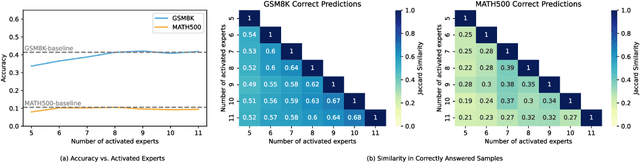
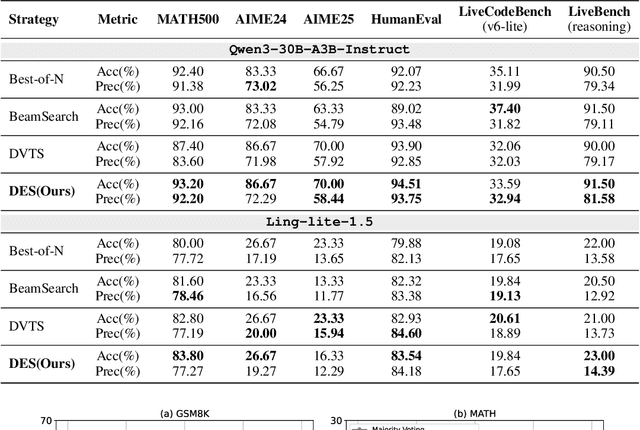
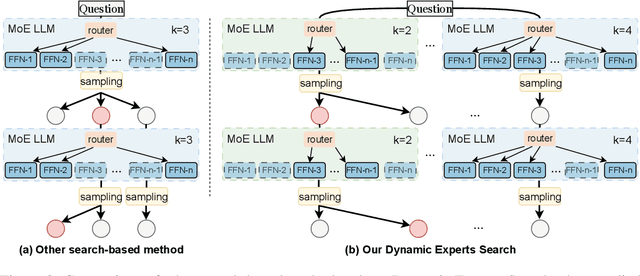
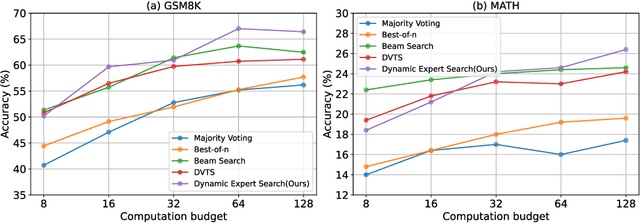
Test-Time Scaling (TTS) enhances the reasoning ability of large language models (LLMs) by allocating additional computation during inference. However, existing approaches primarily rely on output-level sampling while overlooking the role of model architecture. In mainstream Mixture-of-Experts (MoE) LLMs, we observe that varying the number of activated experts yields complementary solution sets with stable accuracy, revealing a new and underexplored source of diversity. Motivated by this observation, we propose Dynamic Experts Search (DES), a TTS strategy that elevates expert activation into a controllable dimension of the search space. DES integrates two key components: (1) Dynamic MoE, which enables direct control of expert counts during inference to generate diverse reasoning trajectories without additional cost; and (2) Expert Configuration Inheritance, which preserves consistent expert counts within a reasoning path while varying them across runs, thereby balancing stability and diversity throughout the search. Extensive experiments across MoE architectures, verifiers and reasoning benchmarks (i.e., math, code and knowledge) demonstrate that DES reliably outperforms TTS baselines, enhancing accuracy and stability without additional cost. These results highlight DES as a practical and scalable form of architecture-aware TTS, illustrating how structural flexibility in modern LLMs can advance reasoning.