 Add to Chrome
 Add to Firefox
 Add to Edge
Disco: Densely-overlapping Cell Instance Segmentation via Adjacency-aware Collaborative Coloring
Feb 05, 2026
Accurate cell instance segmentation is foundational for digital pathology analysis. Existing methods based on contour detection and distance mapping still face significant challenges in processing complex and dense cellular regions. Graph coloring-based methods provide a new paradigm for this task, yet the effectiveness of this paradigm in real-world scenarios with dense overlaps and complex topologies has not been verified. Addressing this issue, we release a large-scale dataset GBC-FS 2025, which contains highly complex and dense sub-cellular nuclear arrangements. We conduct the first systematic analysis of the chromatic properties of cell adjacency graphs across four diverse datasets and reveal an important discovery: most real-world cell graphs are non-bipartite, with a high prevalence of odd-length cycles (predominantly triangles). This makes simple 2-coloring theory insufficient for handling complex tissues, while higher-chromaticity models would cause representational redundancy and optimization difficulties. Building on this observation of complex real-world contexts, we propose Disco (Densely-overlapping Cell Instance Segmentation via Adjacency-aware COllaborative Coloring), an adjacency-aware framework based on the "divide and conquer" principle. It uniquely combines a data-driven topological labeling strategy with a constrained deep learning system to resolve complex adjacency conflicts. First, "Explicit Marking" strategy transforms the topological challenge into a learnable classification task by recursively decomposing the cell graph and isolating a "conflict set." Second, "Implicit Disambiguation" mechanism resolves ambiguities in conflict regions by enforcing feature dissimilarity between different instances, enabling the model to learn separable feature representations.

Beyond Textual Context: Structural Graph Encoding with Adaptive Space Alignment to alleviate the hallucination of LLMs
Sep 26, 2025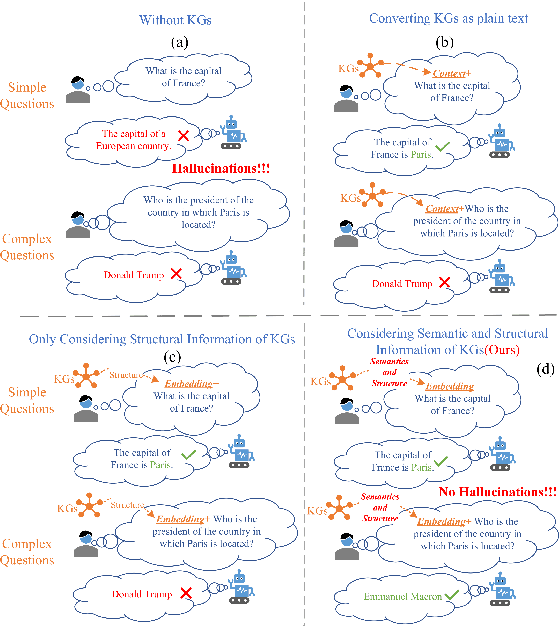
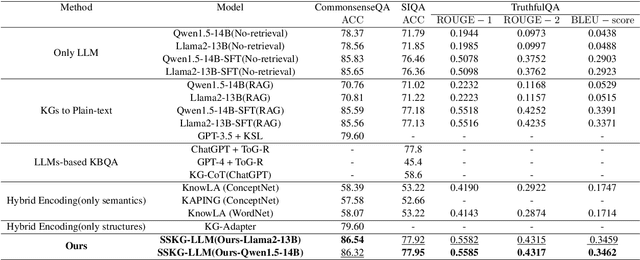
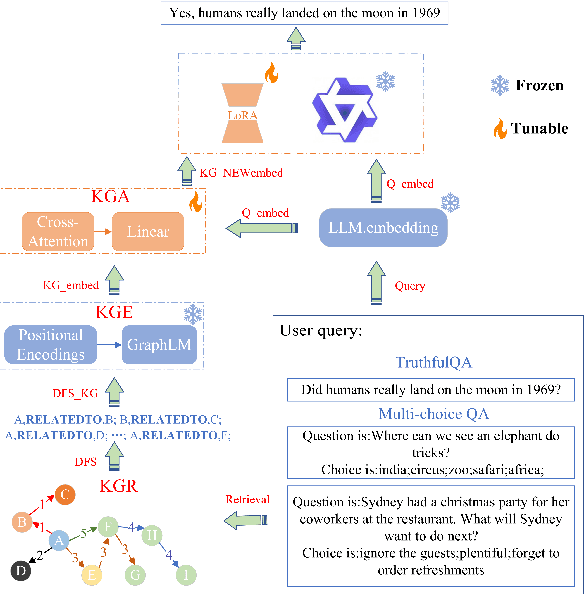
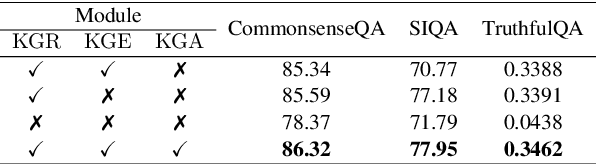
Currently, the main approach for Large Language Models (LLMs) to tackle the hallucination issue is incorporating Knowledge Graphs(KGs).However, LLMs typically treat KGs as plain text, extracting only semantic information and limiting their use of the crucial structural aspects of KGs. Another challenge is the gap between the embedding spaces of KGs encoders and LLMs text embeddings, which hinders the effective integration of structured knowledge. To overcome these obstacles, we put forward the SSKG-LLM, an innovative model architecture that is designed to efficiently integrate both the Structural and Semantic information of KGs into the reasoning processes of LLMs. SSKG-LLM incorporates the Knowledge Graph Retrieval (KGR) module and the Knowledge Graph Encoding (KGE) module to preserve semantics while utilizing structure. Then, the Knowledge Graph Adaptation (KGA) module is incorporated to enable LLMs to understand KGs embeddings. We conduct extensive experiments and provide a detailed analysis to explore how incorporating the structural information of KGs can enhance the factual reasoning abilities of LLMs. Our code are available at https://github.com/yfangZhang/SSKG-LLM.