 Add to Chrome
 Add to Firefox
 Add to Edge
Do World Action Models Generalize Better than VLAs? A Robustness Study
Mar 23, 2026
Robot action planning in the real world is challenging as it requires not only understanding the current state of the environment but also predicting how it will evolve in response to actions. Vision-language-action (VLA), which repurpose large-scale vision-language models for robot action generation using action experts, have achieved notable success across a variety of robotic tasks. Nevertheless, their performance remains constrained by the scope of their training data, exhibiting limited generalization to unseen scenarios and vulnerability to diverse contextual perturbations. More recently, world models have been revisited as an alternative to VLAs. These models, referred to as world action models (WAMs), are built upon world models that are trained on large corpora of video data to predict future states. With minor adaptations, their latent representation can be decoded into robot actions. It has been suggested that their explicit dynamic prediction capacity, combined with spatiotemporal priors acquired from web-scale video pretraining, enables WAMs to generalize more effectively than VLAs. In this paper, we conduct a comparative study of prominent state-of-the-art VLA policies and recently released WAMs. We evaluate their performance on the LIBERO-Plus and RoboTwin 2.0-Plus benchmarks under various visual and language perturbations. Our results show that WAMs achieve strong robustness, with LingBot-VA reaching 74.2% success rate on RoboTwin 2.0-Plus and Cosmos-Policy achieving 82.2% on LIBERO-Plus. While VLAs such as $π_{0.5}$ can achieve comparable robustness on certain tasks, they typically require extensive training with diverse robotic datasets and varied learning objectives. Hybrid approaches that partially incorporate video-based dynamic learning exhibit intermediate robustness, highlighting the importance of how video priors are integrated.

A Spontaneous Driver Emotion Facial Expression (DEFE) Dataset for Intelligent Vehicles
Apr 26, 2020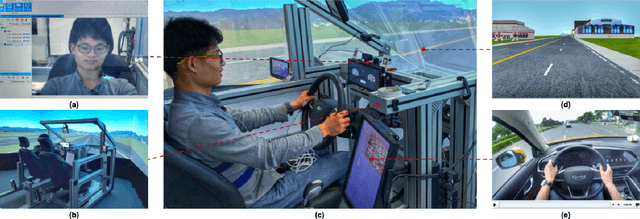
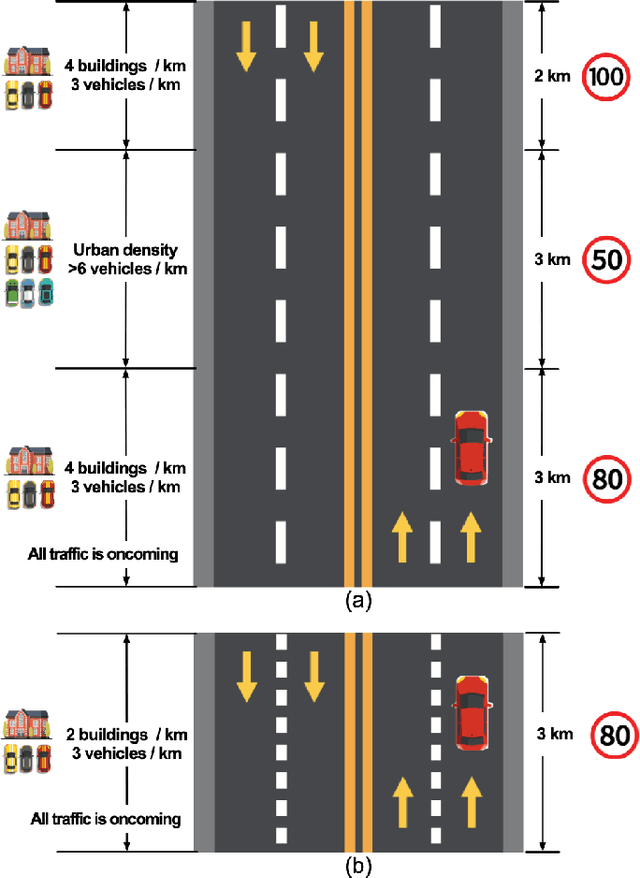
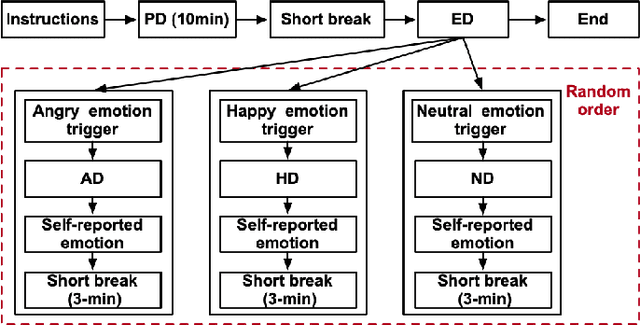
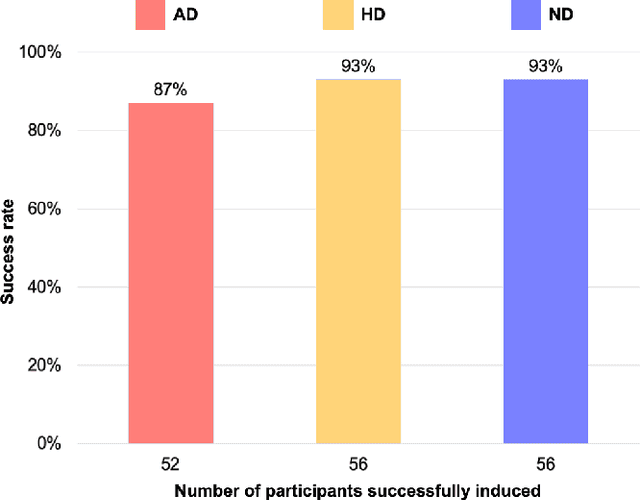
In this paper, we introduce a new dataset, the driver emotion facial expression (DEFE) dataset, for driver spontaneous emotions analysis. The dataset includes facial expression recordings from 60 participants during driving. After watching a selected video-audio clip to elicit a specific emotion, each participant completed the driving tasks in the same driving scenario and rated their emotional responses during the driving processes from the aspects of dimensional emotion and discrete emotion. We also conducted classification experiments to recognize the scales of arousal, valence, dominance, as well as the emotion category and intensity to establish baseline results for the proposed dataset. Besides, this paper compared and discussed the differences in facial expressions between driving and non-driving scenarios. The results show that there were significant differences in AUs (Action Units) presence of facial expressions between driving and non-driving scenarios, indicating that human emotional expressions in driving scenarios were different from other life scenarios. Therefore, publishing a human emotion dataset specifically for the driver is necessary for traffic safety improvement. The proposed dataset will be publicly available so that researchers worldwide can use it to develop and examine their driver emotion analysis methods. To the best of our knowledge, this is currently the only public driver facial expression dataset.