 Add to Chrome
 Add to Firefox
 Add to Edge
AFD-Ledger: Deployment Provisioning for Attention--FFN Disaggregation
Aug 05, 2026
Attention--Feed-Forward Network (FFN) Disaggregation (AFD) is emerging as a promising architecture for serving Mixture-of-Experts (MoE) language models. While existing AFD systems improve the efficiency of disaggregated execution, they leave a deployment question unanswered: under the same model, workload, time-per-output-token (TPOT) service-level objective (SLO), hardware budget, hardware catalog, and runtime capabilities, does AFD provide higher throughput than the best collocated deployment? Answering this question requires jointly optimizing hardware assignment and deployment organization for both architectures, making exhaustive provisioning prohibitively expensive. We present AFD-Ledger, an offline analytical provisioning system that independently provisions AFD and collocated deployments using an analytical execution model and an evaluation-bounded hardware search. Across deployment spaces where exhaustive provisioning is feasible, AFD-Ledger reduces complete deployment evaluations by 68.8%--83.5% while still recovering the globally optimal deployment. On three physical LongCat 2.0 deployments, it preserves the correct architecture decision while predicting AFD-to-collocated throughput within 6.6%--9.6% of measurement. Using this validated framework, we show that homogeneous AFD improves fixed-budget throughput in only a minority of the studied settings, heterogeneous AFD requires deployment-level hardware complementarity rather than heuristic device selection, and role-specific hardware improvements matter primarily when they enable better deployment organizations by crossing deployment capability--price boundaries.

Seer: Online Context Learning for Fast Synchronous LLM Reinforcement Learning
Nov 18, 2025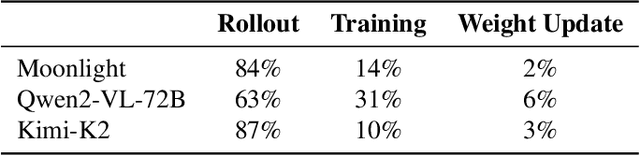
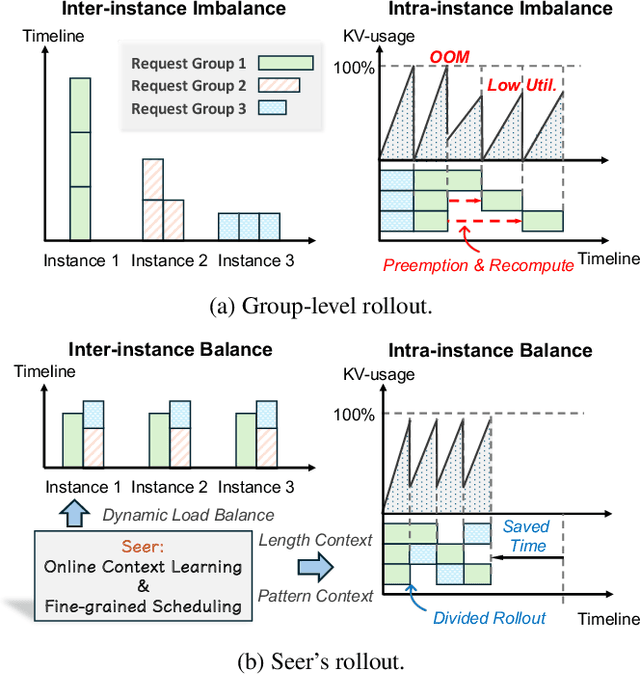
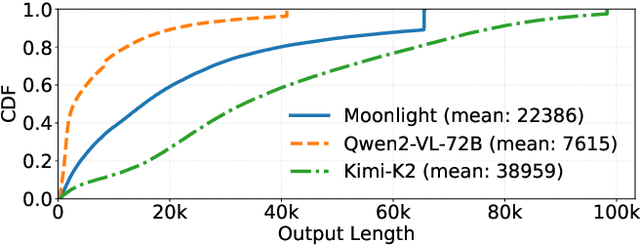
Reinforcement Learning (RL) has become critical for advancing modern Large Language Models (LLMs), yet existing synchronous RL systems face severe performance bottlenecks. The rollout phase, which dominates end-to-end iteration time, suffers from substantial long-tail latency and poor resource utilization due to inherent workload imbalance. We present Seer, a novel online context learning system that addresses these challenges by exploiting previously overlooked similarities in output lengths and generation patterns among requests sharing the same prompt. Seer introduces three key techniques: divided rollout for dynamic load balancing, context-aware scheduling, and adaptive grouped speculative decoding. Together, these mechanisms substantially reduce long-tail latency and improve resource efficiency during rollout. Evaluations on production-grade RL workloads demonstrate that Seer improves end-to-end rollout throughput by 74% to 97% and reduces long-tail latency by 75% to 93% compared to state-of-the-art synchronous RL systems, significantly accelerating RL training iterations.