 Add to Chrome
 Add to Firefox
 Add to Edge
SkillMemo: Expert-guided Skill Memory Framework for Compositional Embodied Manipulation
Aug 06, 2026
Embodied visuomotor models, including Diffusion Policy (DP) and Vision-Language-Action (VLA) models, have demonstrated promising performance on robotic manipulation benchmarks. However, their potential remains fundamentally constrained by the scarcity of large-scale embodied trajectory datasets, leading to insufficient compositional generalization in out-of-distribution (OOD) scenarios with limited capability to capture reusable skill structures. To address this limitation, we propose Skill-Based Memory (SkillMemo) framework that implicitly decomposes long-horizon demonstrations into latent atomic skills and integrates skill-level features into a dynamic episodic memory bank for solving compositional tasks. Specifically, we first introduce an expert-guided trajectory segmentation module built upon a Mixture-of-Experts (MoE) architecture, which implicitly partitions trajectories into distinct skill primitives represented by learned gating coefficients. We further design a skill-level episodic memory architecture that stores compact skill representations as retrievable key-value pairs. During inference, the memory bank retrieves the most relevant skill primitives which are subsequently fused with the model's current gating distribution, providing a robust contextual prior to refine action predictions. Extensive experiments on the simulation benchmark and real-world manipulation tasks demonstrate that SkillMemo consistently enhances both DP and VLA backbones, achieving state-of-the-art performance and outperforming $π_{0.5}$, while exhibiting strong compositional generalization to unseen task configurations.

AllDayNav: Lifelong Navigation via Real-World Reinforcement Learning
Jun 09, 2026Lifelong embodied navigation in dynamic environments requires robots to form persistent scene understanding from fragmentary observations, which remains difficult for existing methods that rely on explicit maps or scene graphs and struggle to generalize beyond structured settings. We propose AllDayNav, a lifelong self-learning navigation framework that implicitly encodes scene dynamics into the billion-scale parameters of a large model via reinforcement learning, powered by a self-evolving multimodal memory that maintains and updates visual keyframes, semantic descriptions, and temporal context while autonomously generating open-vocabulary instructions, image goals, and structured rewards. Experiments in both synthetic and real-world environments across cross-room, cross-episode, and cross-task scenarios show that AllDayNav achieves success rates approaching $100\%$ and consistently surpasses strong map-based, VLM, and RL baselines in path efficiency and robustness, demonstrating implicit, memory-driven reinforcement learning as a scalable alternative to explicit mapping for reliable lifelong navigation.
GEM: Generative Supervision Helps Embodied Intelligence
May 27, 2026Embodied Vision-Language Models (VLMs) have demonstrated impressive performance and generalization in robotics, particularly within Vision-Language-Action frameworks. However, a significant gap remains between the high-level semantic focus of standard text-guided pre-training paradigms and the low-level spatial and physical knowledge critical for execution in embodied environments. In this paper, we introduce GEM, a Generative-supervised Embodied vision-language Model designed to bridge this divide. We propose integrating a depth map generation task directly into the VLM pre-training phase. By training this generative objective jointly with the main model, we observe substantial improvements in embodied intelligence, significantly enhancing both semantic understanding and physical operation capabilities. To support this paradigm, we curate and release GEM-4M, a comprehensive large-scale dataset featuring a mixture of grounding, reasoning, and planning data paired with high-quality depth supervision. Extensive experiments demonstrate that GEM achieves state-of-the-art results across diverse embodied benchmarks. Furthermore, our deployed action model, GEM-VLA, exhibits vastly superior task execution abilities in both simulation environments and real-world evaluations. Code, models, and datasets are available at https://zhaorw02.github.io/GEM/
UniManip: General-Purpose Zero-Shot Robotic Manipulation with Agentic Operational Graph
Feb 13, 2026Achieving general-purpose robotic manipulation requires robots to seamlessly bridge high-level semantic intent with low-level physical interaction in unstructured environments. However, existing approaches falter in zero-shot generalization: end-to-end Vision-Language-Action (VLA) models often lack the precision required for long-horizon tasks, while traditional hierarchical planners suffer from semantic rigidity when facing open-world variations. To address this, we present UniManip, a framework grounded in a Bi-level Agentic Operational Graph (AOG) that unifies semantic reasoning and physical grounding. By coupling a high-level Agentic Layer for task orchestration with a low-level Scene Layer for dynamic state representation, the system continuously aligns abstract planning with geometric constraints, enabling robust zero-shot execution. Unlike static pipelines, UniManip operates as a dynamic agentic loop: it actively instantiates object-centric scene graphs from unstructured perception, parameterizes these representations into collision-free trajectories via a safety-aware local planner, and exploits structured memory to autonomously diagnose and recover from execution failures. Extensive experiments validate the system's robust zero-shot capability on unseen objects and tasks, demonstrating a 22.5% and 25.0% higher success rate compared to state-of-the-art VLA and hierarchical baselines, respectively. Notably, the system enables direct zero-shot transfer from fixed-base setups to mobile manipulation without fine-tuning or reconfiguration. Our open-source project page can be found at https://henryhcliu.github.io/unimanip.
EfficientLLaVA:Generalizable Auto-Pruning for Large Vision-language Models
Mar 19, 2025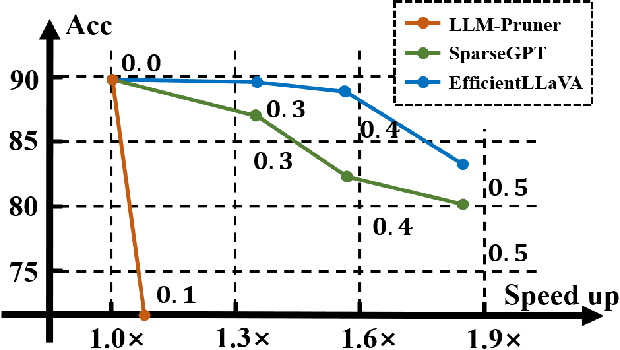
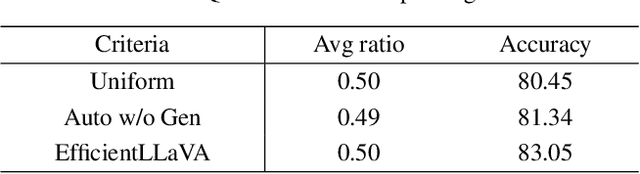
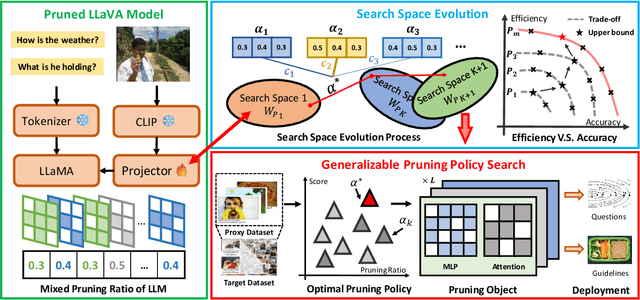

While multimodal large language models demonstrate strong performance in complex reasoning tasks, they pose significant challenges related to model complexity during deployment, especially for resource-limited devices. In this paper, we propose an automatic pruning method for large vision-language models to enhance the efficiency of multimodal reasoning. Conventional methods rely on the training data of the original model to select the proper pruning ratio for different network components. However, these methods are impractical for large vision-language models due to the unaffordable search costs caused by web-scale training corpus. In contrast, our approach only leverages a small number of samples to search for the desired pruning policy by maximizing its generalization ability on unknown training data while maintaining the model accuracy, which enables the achievement of an optimal trade-off between accuracy and efficiency for large visual language models. Specifically, we formulate the generalization gap of the pruning strategy using the structural risk minimization principle. Based on both task performance and generalization capability, we iteratively search for the optimal pruning policy within a given search space and optimize the vision projector to evolve the search space with higher upper bound of performance. We conduct extensive experiments on the ScienceQA, Vizwiz, MM-vet, and LLaVA-Bench datasets for the task of visual question answering. Using only 64 samples for pruning policy search, EfficientLLaVA achieves an accuracy of 83.05% on ScienceQA, along with a $\times$ 1.8 speedup compared to the dense LLaVA-v1.5-7B model.
MCUFormer: Deploying Vision Tranformers on Microcontrollers with Limited Memory
Oct 27, 2023

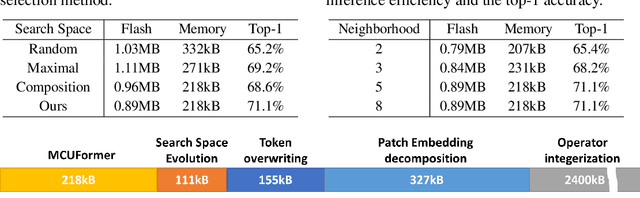

Due to the high price and heavy energy consumption of GPUs, deploying deep models on IoT devices such as microcontrollers makes significant contributions for ecological AI. Conventional methods successfully enable convolutional neural network inference of high resolution images on microcontrollers, while the framework for vision transformers that achieve the state-of-the-art performance in many vision applications still remains unexplored. In this paper, we propose a hardware-algorithm co-optimizations method called MCUFormer to deploy vision transformers on microcontrollers with extremely limited memory, where we jointly design transformer architecture and construct the inference operator library to fit the memory resource constraint. More specifically, we generalize the one-shot network architecture search (NAS) to discover the optimal architecture with highest task performance given the memory budget from the microcontrollers, where we enlarge the existing search space of vision transformers by considering the low-rank decomposition dimensions and patch resolution for memory reduction. For the construction of the inference operator library of vision transformers, we schedule the memory buffer during inference through operator integration, patch embedding decomposition, and token overwriting, allowing the memory buffer to be fully utilized to adapt to the forward pass of the vision transformer. Experimental results demonstrate that our MCUFormer achieves 73.62\% top-1 accuracy on ImageNet for image classification with 320KB memory on STM32F746 microcontroller. Code is available at https://github.com/liangyn22/MCUFormer.