 Add to Chrome
 Add to Firefox
 Add to Edge
VNDUQE: Information-Theoretic Novelty Detection using Deep Variational Information Bottleneck
May 12, 2026
Detecting out-of-distribution (OOD) samples is critical for safe deployment of neural networks in safety-critical applications. While maximum softmax probability (MSP) provides a simple baseline, it lacks theoretical grounding and suffers from miscalibration. We propose VNDUQE (VIB-based Novelty Detection and Uncertainty Quantification for Nondestructive Evaluation), which investigates novelty detection through the Deep Variational Information Bottleneck (VIB), which explicitly constrains information flow through learned representations. We train VIB models on MNIST with held-out digit classes and evaluate OOD detection using information-theoretic metrics: KL divergence and prediction entropy. Our results reveal complementary detection signals: KL divergence achieves perfect detection (100\% AUROC on noise) on far-OOD samples (noise, domain shift), while prediction entropy excels at near-OOD detection (94.7\% AUROC on novel digit classes). A parallel detection strategy combining both metrics achieves 95.3\% average AUROC and 92\% true positive rate at 5\% false positive rate, which is a 32 percentage point improvement over baseline MSP (85.0\% AUROC, 60.1\% TPR). Compression via the information bottleneck principle ($β=10^{-3}$) reduces Expected Calibration Error by 38\%, demonstrating that information-theoretic constraints produce fundamentally more reliable uncertainty estimates. These findings directly support active learning with expensive computational oracles, where well-calibrated novelty detection enables principled threshold selection for oracle queries.

AGPO: Asymmetric Group Policy Optimization for Verifiable Reasoning and Search Ads Relevance at JD
May 07, 2026Reinforcement Learning with Verifiable Rewards (RLVR) has demonstrated notable success in enhancing the reasoning performance of large language models (LLMs). However, recent studies reveal that while current RLVR methods improve sampling efficiency towards correct paths, they do not elicit fundamentally new reasoning patterns. Instead, the reasoning capability boundary of trained models often narrows compared to their base models, with base models achieving higher coverage at large sample sizes. In this work, we propose Asymmetric Group Policy Optimization (AGPO) to counteract this boundary shrinkage. AGPO adopts a negative-dominant reinforcement strategy to suppress incorrect reasoning paths, maintaining the base model's exploration capacity. For positive reinforcement, AGPO adopts a group advantage mechanism, which scales positive updates based on intra-group variance, allowing the model to focus on rare correct paths while suppressing updates from trivial paths. Our experiments on five mathematical benchmarks demonstrate that AGPO achieves state-of-the-art accuracy while consistently improving pass@$k$ performance at scale. In a large-scale industrial application for search ads relevance optimization, AGPO effectively enhances the quality of the data annotation, leading to substantial performance gains in downstream student models.
DIAS: A Comprehensive Benchmark for DSA-sequence Intracranial Artery Segmentation
Jun 21, 2023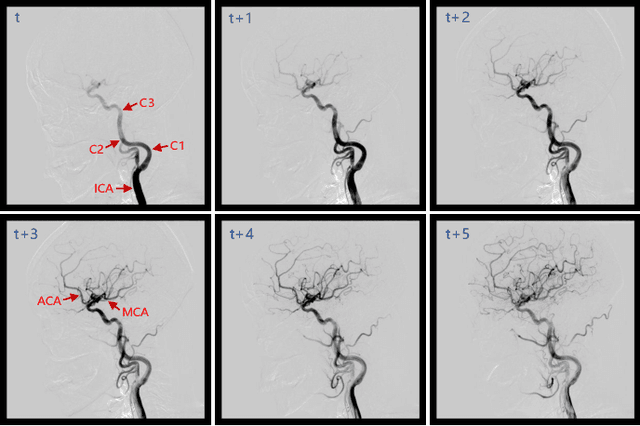
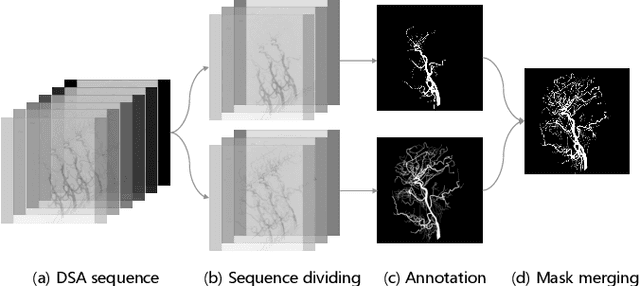


Automatic segmentation of the intracranial artery (IA) in digital subtraction angiography (DSA) sequence is an essential step in diagnosing IA-related diseases and guiding neuro-interventional surgery. However, the lack of publicly available datasets has impeded research in this area. In this paper, we release DIAS, an IA segmentation dataset, consisting of 120 DSA sequences from intracranial interventional therapy. In addition to pixel-wise annotations, this dataset provides two types of scribble annotations for weakly supervised IA segmentation research. We present a comprehensive benchmark for evaluating the performance of this challenging dataset by utilizing fully-, weakly-, and semi-supervised learning approaches. Specifically, we propose a method that incorporates a dimensionality reduction module into a 2D/3D model to achieve vessel segmentation in DSA sequences. For weakly-supervised learning, we propose a scribble learning-based image segmentation framework, SSCR, which comprises scribble supervision and consistency regularization. Furthermore, we introduce a random patch-based self-training framework that utilizes unlabeled DSA sequences to improve segmentation performance. Our extensive experiments on the DIAS dataset demonstrate the effectiveness of these methods as potential baselines for future research and clinical applications.