 Add to Chrome
 Add to Firefox
 Add to Edge
DySL-VLA: Efficient Vision-Language-Action Model Inference via Dynamic-Static Layer-Skipping for Robot Manipulation
Feb 26, 2026
Vision-Language-Action (VLA) models have shown remarkable success in robotic tasks like manipulation by fusing a language model's reasoning with a vision model's 3D understanding. However, their high computational cost remains a major obstacle for real-world applications that require real-time performance. We observe that the actions within a task have varying levels of importance: critical steps demand high precision, while less important ones can tolerate more variance. Leveraging this insight, we propose DySL-VLA, a novel framework that addresses computational cost by dynamically skipping VLA layers based on each action's importance. DySL-VLA categorizes its layers into two types: informative layers, which are consistently executed, and incremental layers, which can be selectively skipped. To intelligently skip layers without sacrificing accuracy, we invent a prior-post skipping guidance mechanism to determine when to initiate layer-skipping. We also propose a skip-aware two-stage knowledge distillation algorithm to efficiently train a standard VLA into a DySL-VLA. Our experiments indicate that DySL-VLA achieves 2.1% improvement in success length over Deer-VLA on the Calvin dataset, while simultaneously reducing trainable parameters by a factor of 85.7 and providing a 3.75x speedup relative to the RoboFlamingo baseline at iso-accuracy. Our code is available on https://github.com/PKU-SEC-Lab/DYSL_VLA.

Efficient Mixture-of-Agents Serving via Tree-Structured Routing, Adaptive Pruning, and Dependency-Aware Prefill-Decode Overlap
Dec 19, 2025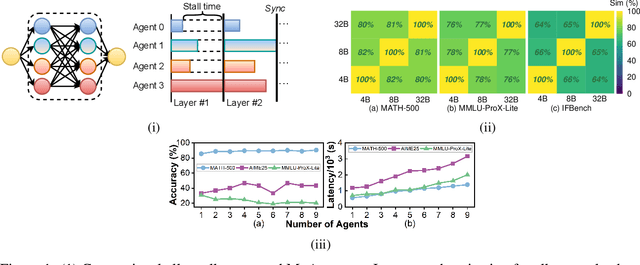
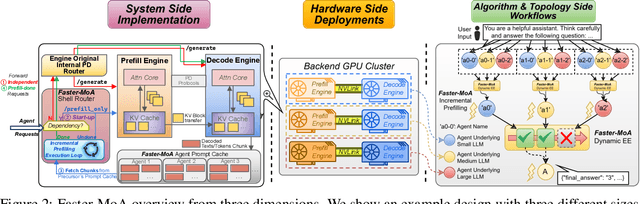
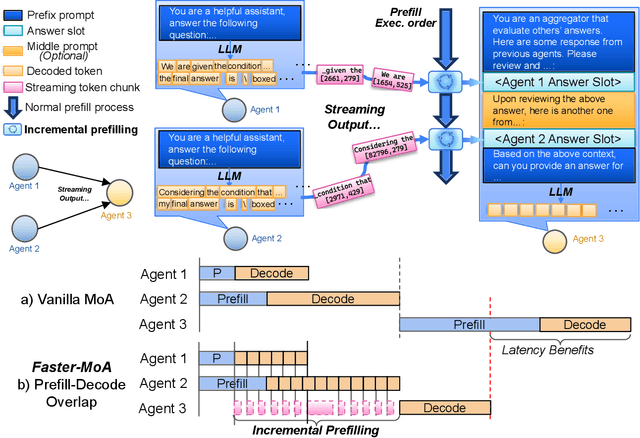
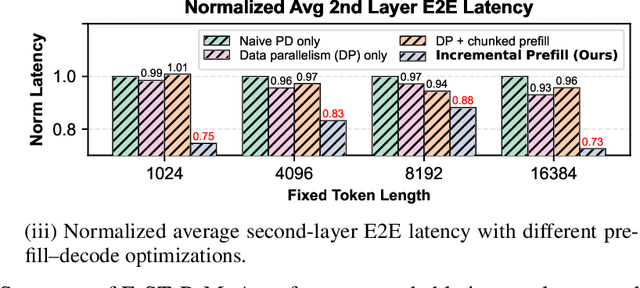
Mixture-of-Agents (MoA) inference can suffer from dense inter-agent communication and low hardware utilization, which jointly inflate serving latency. We present a serving design that targets these bottlenecks through an algorithm-system co-design. First, we replace dense agent interaction graphs with a hierarchical tree topology that induces structured sparsity in inter-agent communication. Second, we introduce a runtime adaptive mechanism that selectively terminates or skips downstream agent invocations using semantic agreement and confidence signals from intermediate outputs. Third, we pipeline agent execution by overlapping incremental prefilling with decoding across dependency-related agents, improving utilization and reducing inference latency. Across representative tasks, this approach substantially reduces end-to-end latency (up to 90%) while maintaining comparable accuracy (within $\pm$1%) relative to dense-connectivity MoA baselines, and can improve accuracy in certain settings.