 Add to Chrome
 Add to Firefox
 Add to Edge
Split4D: Decomposed 4D Scene Reconstruction Without Video Segmentation
Dec 28, 2025
This paper addresses the problem of decomposed 4D scene reconstruction from multi-view videos. Recent methods achieve this by lifting video segmentation results to a 4D representation through differentiable rendering techniques. Therefore, they heavily rely on the quality of video segmentation maps, which are often unstable, leading to unreliable reconstruction results. To overcome this challenge, our key idea is to represent the decomposed 4D scene with the Freetime FeatureGS and design a streaming feature learning strategy to accurately recover it from per-image segmentation maps, eliminating the need for video segmentation. Freetime FeatureGS models the dynamic scene as a set of Gaussian primitives with learnable features and linear motion ability, allowing them to move to neighboring regions over time. We apply a contrastive loss to Freetime FeatureGS, forcing primitive features to be close or far apart based on whether their projections belong to the same instance in the 2D segmentation map. As our Gaussian primitives can move across time, it naturally extends the feature learning to the temporal dimension, achieving 4D segmentation. Furthermore, we sample observations for training in a temporally ordered manner, enabling the streaming propagation of features over time and effectively avoiding local minima during the optimization process. Experimental results on several datasets show that the reconstruction quality of our method outperforms recent methods by a large margin.

From Laser Speckle to Particle Size Distribution in drying powders: A Physics-Enhanced AutoCorrelation-based Estimator (PEACE)
Apr 20, 2022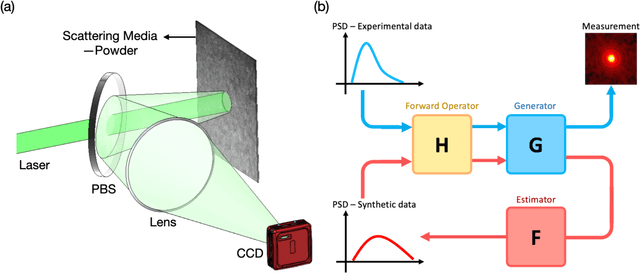
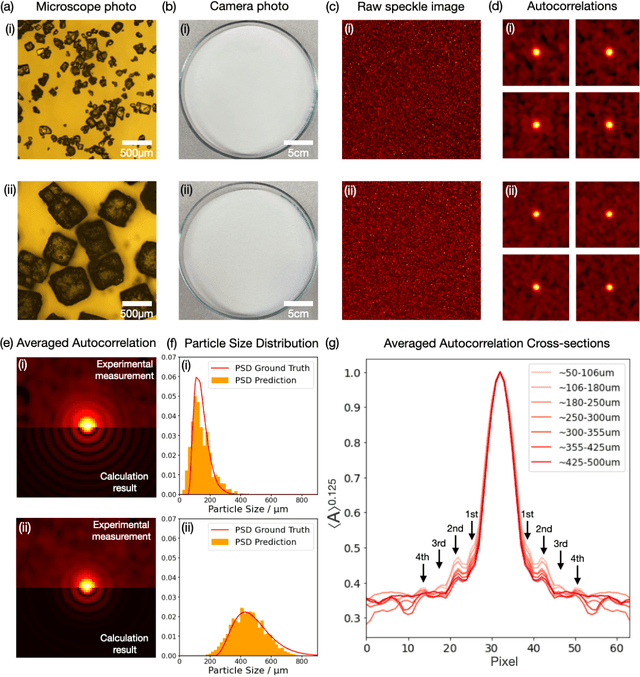
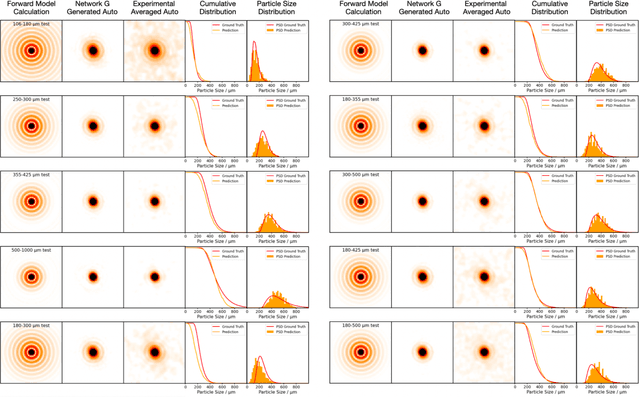
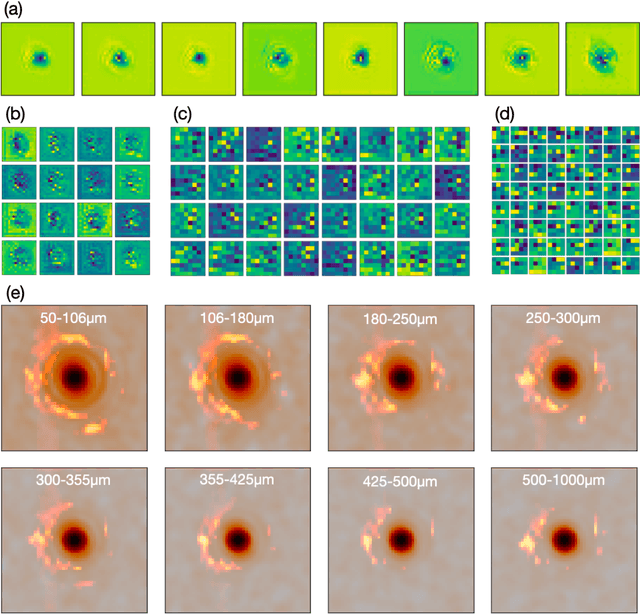
Extracting quantitative information about highly scattering surfaces from an imaging system is challenging because the phase of the scattered light undergoes multiple folds upon propagation, resulting in complex speckle patterns. One specific application is the drying of wet powders in the pharmaceutical industry, where quantifying the particle size distribution (PSD) is of particular interest. A non-invasive and real-time monitoring probe in the drying process is required, but there is no suitable candidate for this purpose. In this report, we develop a theoretical relationship from the PSD to the speckle image and describe a physics-enhanced autocorrelation-based estimator (PEACE) machine learning algorithm for speckle analysis to measure the PSD of a powder surface. This method solves both the forward and inverse problems together and enjoys increased interpretability, since the machine learning approximator is regularized by the physical law.