 Add to Chrome
 Add to Firefox
 Add to Edge
EvoTS-Agent: A Self-Evolving LLM Agent for Financial Time Series Change Point Detection
Aug 18, 2026
Financial time series exhibit non-stationary and heterogeneous statistical properties, making change-point detection challenging because no single unsupervised algorithm performs consistently across assets and market regimes. Conventional workflows consequently depend heavily on expert-driven model selection, feature design, and hyperparameter tuning, limiting their scalability and adaptability. We propose EvoTS-Agent, a validation-guided self-evolving LLM agent for autonomous financial time-series change-point detection. EvoTS-Agent first performs curated exploratory data analysis to characterize dataset properties and initialize candidate detection models. It then evolves executable experiment trajectories through three complementary operators: \textit{Revision} exploits the current best solution, \textit{Alternative Strategy} explores fundamentally different modeling directions when progress stagnates, and \textit{Recombination} synthesizes complementary evidence from high-performing trajectories. Validation feedback guides trajectory evolution throughout the search, enabling the agent to adapt its detection pipeline to the statistical characteristics of each dataset while preserving reliable optimization. Experiments across four benchmark datasets demonstrate that EvoTS-Agent consistently outperforms existing LLM-based agents while maintaining a 100\% execution success rate across all evaluated backbone LLMs.

MOSAIC: Modular Orchestration for Structured Agentic Intelligence and Composition
May 30, 2026Automated data science is a structured model-selection problem. A solution must choose data transformations, feature representations, architecture, training procedure, evaluation protocol, and refinement strategy for a task. AutoML systems automate parts of this process, but typically search within predefined pipeline, model, and hyperparameter spaces. LLM-based agents offer greater flexibility through retrieval, code generation, and execution feedback, yet their modelling decisions are often unstructured, difficult to verify, and hard to reuse. We introduce \textsc{MOSAIC} (Modular Orchestration for Structured Agentic Intelligence and Composition), a structured agentic framework for memory-grounded model selection and workflow construction. Given a task and dataset, \textsc{MOSAIC} builds a semantic task profile, retrieves prior cases and source-code modules, and constructs a blueprint: an intermediate representation specifying selected modelling components, composition, interface constraints, and execution requirements. This blueprint turns model selection into a staged, context-grounded search and grounds LLM-based code generation in retrieved evidence rather than unconstrained synthesis. Candidate models are validated by execution and refined using diagnostic feedback, training traces, task metrics, and a failure-aware reinforcement learning policy. We instantiate \textsc{MOSAIC} on financial time-series forecasting and generation, where models must satisfy predictive accuracy, distributional fidelity, execution reliability, and downstream financial criteria such as risk and tail behaviour. Experiments against AutoML and agentic baselines show that \textsc{MOSAIC} improves task performance, execution success, and decision traceability, demonstrating the value of treating automated data science as structured, reusable, and execution-grounded model selection.
Weight-Informed Self-Explaining Clustering for Mixed-Type Tabular Data
Apr 07, 2026Clustering mixed-type tabular data is fundamental for exploratory analysis, yet remains challenging due to misaligned numerical-categorical representations, uneven and context-dependent feature relevance, and disconnected and post-hoc explanation from the clustering process. We propose WISE, a Weight-Informed Self-Explaining framework that unifies representation, feature weighting, clustering, and interpretation in a fully unsupervised and transparent pipeline. WISE introduces Binary Encoding with Padding (BEP) to align heterogeneous features in a unified sparse space, a Leave-One-Feature-Out (LOFO) strategy to sense multiple high-quality and diverse feature-weighting views, and a two-stage weight-aware clustering procedure to aggregate alternative semantic partitions. To ensure intrinsic interpretability, we further develop Discriminative FreqItems (DFI), which yields feature-level explanations that are consistent from instances to clusters with an additive decomposition guarantee. Extensive experiments on six real-world datasets demonstrate that WISE consistently outperforms classical and neural baselines in clustering quality while remaining efficient, and produces faithful, human-interpretable explanations grounded in the same primitives that drive clustering.
Towards Controllable Time Series Generation
Mar 06, 2024Time Series Generation (TSG) has emerged as a pivotal technique in synthesizing data that accurately mirrors real-world time series, becoming indispensable in numerous applications. Despite significant advancements in TSG, its efficacy frequently hinges on having large training datasets. This dependency presents a substantial challenge in data-scarce scenarios, especially when dealing with rare or unique conditions. To confront these challenges, we explore a new problem of Controllable Time Series Generation (CTSG), aiming to produce synthetic time series that can adapt to various external conditions, thereby tackling the data scarcity issue. In this paper, we propose \textbf{C}ontrollable \textbf{T}ime \textbf{S}eries (\textsf{CTS}), an innovative VAE-agnostic framework tailored for CTSG. A key feature of \textsf{CTS} is that it decouples the mapping process from standard VAE training, enabling precise learning of a complex interplay between latent features and external conditions. Moreover, we develop a comprehensive evaluation scheme for CTSG. Extensive experiments across three real-world time series datasets showcase \textsf{CTS}'s exceptional capabilities in generating high-quality, controllable outputs. This underscores its adeptness in seamlessly integrating latent features with external conditions. Extending \textsf{CTS} to the image domain highlights its remarkable potential for explainability and further reinforces its versatility across different modalities.
TSGBench: Time Series Generation Benchmark
Sep 07, 2023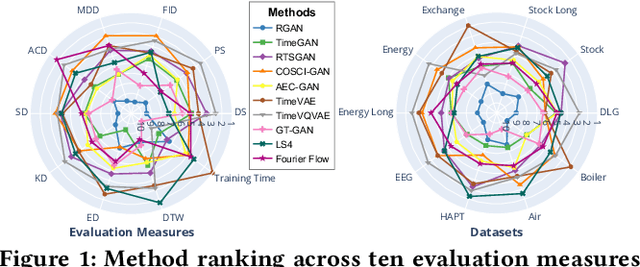
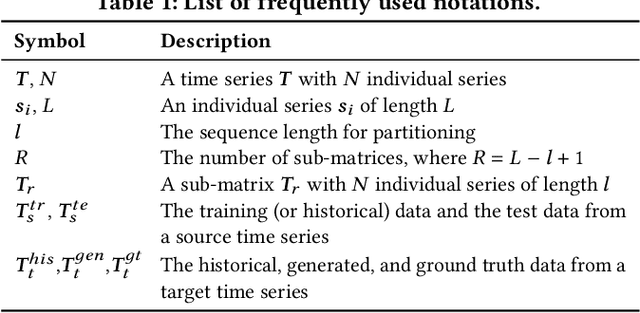

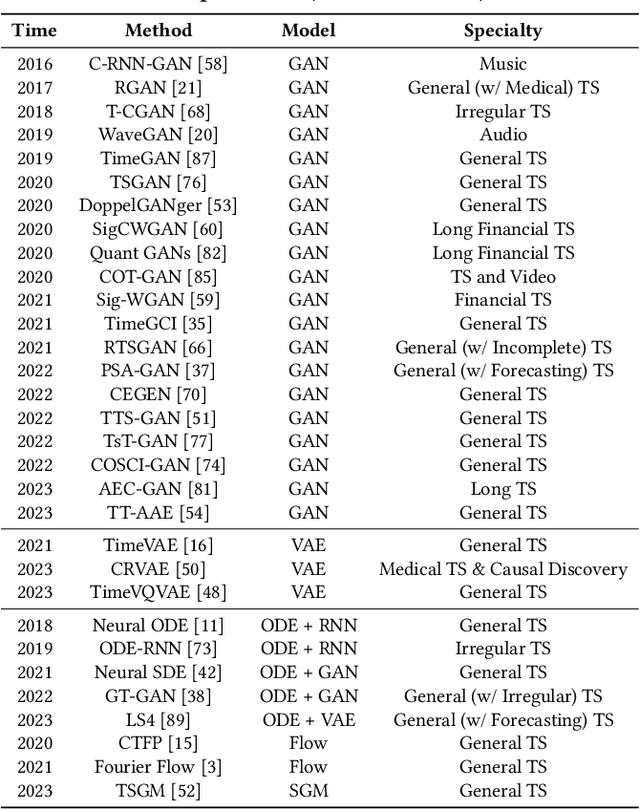
Synthetic Time Series Generation (TSG) is crucial in a range of applications, including data augmentation, anomaly detection, and privacy preservation. Although significant strides have been made in this field, existing methods exhibit three key limitations: (1) They often benchmark against similar model types, constraining a holistic view of performance capabilities. (2) The use of specialized synthetic and private datasets introduces biases and hampers generalizability. (3) Ambiguous evaluation measures, often tied to custom networks or downstream tasks, hinder consistent and fair comparison. To overcome these limitations, we introduce \textsf{TSGBench}, the inaugural TSG Benchmark, designed for a unified and comprehensive assessment of TSG methods. It comprises three modules: (1) a curated collection of publicly available, real-world datasets tailored for TSG, together with a standardized preprocessing pipeline; (2) a comprehensive evaluation measures suite including vanilla measures, new distance-based assessments, and visualization tools; (3) a pioneering generalization test rooted in Domain Adaptation (DA), compatible with all methods. We have conducted extensive experiments across ten real-world datasets from diverse domains, utilizing ten advanced TSG methods and twelve evaluation measures, all gauged through \textsf{TSGBench}. The results highlight its remarkable efficacy and consistency. More importantly, \textsf{TSGBench} delivers a statistical breakdown of method rankings, illuminating performance variations across different datasets and measures, and offering nuanced insights into the effectiveness of each method.