 Add to Chrome
 Add to Firefox
 Add to Edge
Tac-DINO: Learning Vision-Tactile Features with Patch Alignment
Jun 10, 2026
Touch is the primary medium through which humans interact with the environment. Currently, tactile learning mainly focuses on image-level pretraining or alignment. However, tactile signals correspond to local object contact, while research into scale alignment and holographic matching remains limited and proper datasets and benchmarks also lack. To bridge this gap, we first construct a data collection system to acquire a large-scale tactile dataset, with over 20 K tactile contacts from 505 real-world objects. Building on this dataset, we design a Vis-Tac Holographic Matching Benchmark to evaluate vision-tactile local-to-global alignment ability. Then we propose Vision-Tactile Patch Alignment (VTPA) methods for vision-tactile representation learning. Experiments demonstrate that these exceed the performance of methods without alignment and align with whole-object images.

AetheRock: An Arm-Worn Robot Teaching System for Force-Guided Vision-Tactile Learning
Jun 08, 2026Force and tactile sensing are indispensable in contact-rich manipulation. However, force-aware robot learning faces critical challenges due to the incompatible assembly of tactile and force sensors in handheld or wearable devices. To address these limitations, we first introduce AetheRock for gripper-force, vision, and tactile data collection, which is an arm-worn device featuring a modular and easily manufactured visuo-tactile sensor, GelSlim-MiniFab, at the fingertip, a resistive pressure sensor at the human finger contact region, a customized PCB module, and a wearable kit for comfortable and robust collection. Building on this, we propose ForceVT, a representation learning framework that uses force and vision to guide fidelity-agnostic tactile learning, enabling robust inference in any tactile situation. Real-world experiments show that AetheRock achieves qualified data efficiency and that ForceVT effectively alleviates inefficiencies when visuo-tactile sensors exhibit manufacturing and utilization inconsistencies. Overall, our work mitigates the limitations of gripper-force vision-tactile robot learning through innovative hardware design and algorithms.
CTPD: Cross-Modal Temporal Pattern Discovery for Enhanced Multimodal Electronic Health Records Analysis
Nov 01, 2024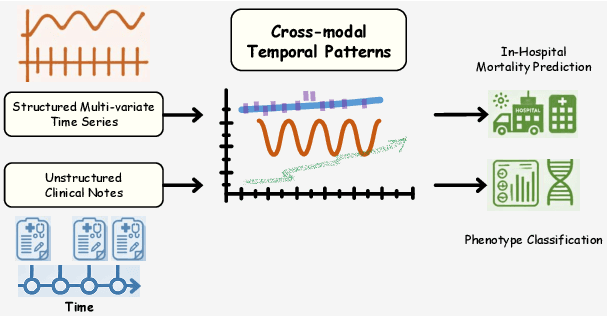
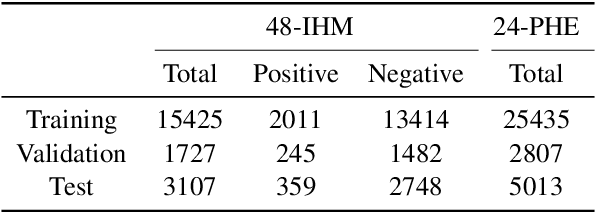
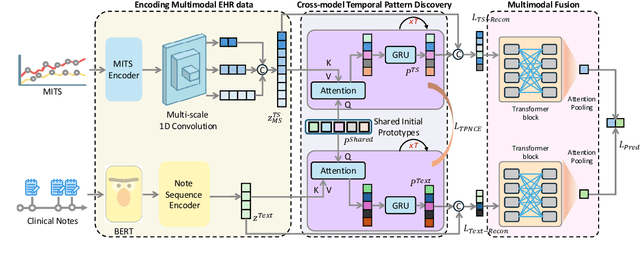
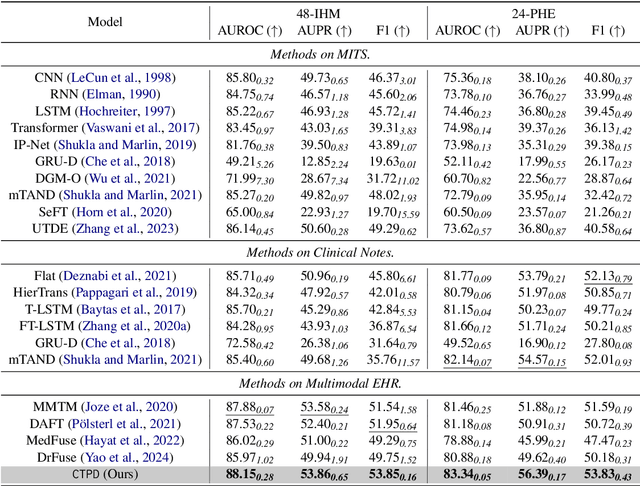
Integrating multimodal Electronic Health Records (EHR) data, such as numerical time series and free-text clinical reports, has great potential in predicting clinical outcomes. However, prior work has primarily focused on capturing temporal interactions within individual samples and fusing multimodal information, overlooking critical temporal patterns across patients. These patterns, such as trends in vital signs like abnormal heart rate or blood pressure, can indicate deteriorating health or an impending critical event. Similarly, clinical notes often contain textual descriptions that reflect these patterns. Identifying corresponding temporal patterns across different modalities is crucial for improving the accuracy of clinical outcome predictions, yet it remains a challenging task. To address this gap, we introduce a Cross-Modal Temporal Pattern Discovery (CTPD) framework, designed to efficiently extract meaningful cross-modal temporal patterns from multimodal EHR data. Our approach introduces shared initial temporal pattern representations which are refined using slot attention to generate temporal semantic embeddings. To ensure rich cross-modal temporal semantics in the learned patterns, we introduce a contrastive-based TPNCE loss for cross-modal alignment, along with two reconstruction losses to retain core information of each modality. Evaluations on two clinically critical tasks, 48-hour in-hospital mortality and 24-hour phenotype classification, using the MIMIC-III database demonstrate the superiority of our method over existing approaches.