 Add to Chrome
 Add to Firefox
 Add to Edge
One Framework for All: Cross-Modal Membership Inference for Generative Models
Jul 05, 2026
Large generative models across text-to-text, text-to-image, and image-to-text modalities have been shown to pose significant privacy risks. One fundamental threat is membership inference attacks (MIA), which aim to determine whether a given data point was used in a model's training set. Although prior work has investigated MIAs against these three classes of generative models, existing approaches treat them in isolation and are not cross-applicable, thereby limiting their real-world utility. To address this limitation, we present the first comprehensive study of a unified membership inference framework that applies across text-to-text, text-to-image, and image-to-text modalities. Our approach is grounded in a key modality-agnostic observation: the output distribution of a generative model can approximate its training data distribution. Leveraging this property, we model the distributions of model-generated outputs and auxiliary non-member samples in a shared embedding space, and perform membership inference via likelihood ratio testing. We conduct extensive experiments in a strict black-box setting under both partial-knowledge and zero-knowledge threat models, and evaluate membership inference against both fine-tuning and pre-training data. Experimental results demonstrate our approach's superior performance in comparison to existing state-of-the-art methods, which are typically optimized for a single model class.

Reinforcement Learning Based Optimal Camera Placement for Depth Observation of Indoor Scenes
Oct 21, 2021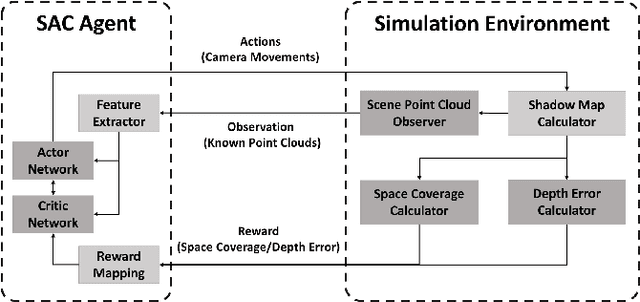
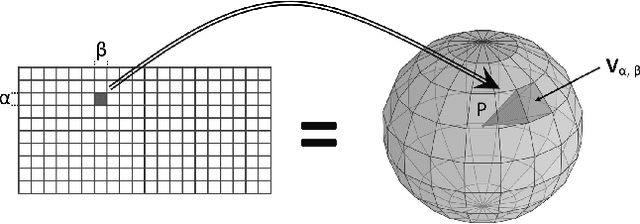
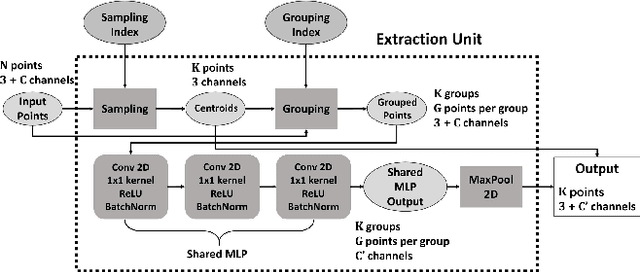
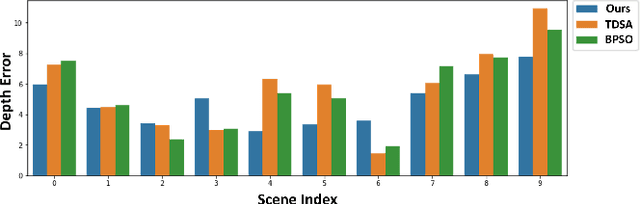
Exploring the most task-friendly camera setting -- optimal camera placement (OCP) problem -- in tasks that use multiple cameras is of great importance. However, few existing OCP solutions specialize in depth observation of indoor scenes, and most versatile solutions work offline. To this problem, an OCP online solution to depth observation of indoor scenes based on reinforcement learning is proposed in this paper. The proposed solution comprises a simulation environment that implements scene observation and reward estimation using shadow maps and an agent network containing a soft actor-critic (SAC)-based reinforcement learning backbone and a feature extractor to extract features from the observed point cloud layer-by-layer. Comparative experiments with two state-of-the-art optimization-based offline methods are conducted. The experimental results indicate that the proposed system outperforms seven out of ten test scenes in obtaining lower depth observation error. The total error in all test scenes is also less than 90% of the baseline ones. Therefore, the proposed system is more competent for depth camera placement in scenarios where there is no prior knowledge of the scenes or where a lower depth observation error is the main objective.