 Add to Chrome
 Add to Firefox
 Add to Edge
Plug-and-Play Volumetric Reconstruction for Compressive Sensing Light-Sheet Microscopy
Jul 02, 2026
We investigate volumetric reconstruction for compressive sensing light-sheet microscopy (CS-LSM), where fast volumetric imaging is achieved by encoding multiple axial planes into each camera exposure. To recover the underlying volume from highly multiplexed measurements, we propose a plug-and-play (PnP) framework that flexibly incorporates any user-specified denoiser into the reconstruction process. Building on a slice-based formulation, we further introduce an axial-coupled model that exploits correlations between adjacent slices to improve volumetric continuity. For efficient computation, we derive a Woodbury-based update for the data-consistency step in both the slice-based and axial-coupled formulations, and employ a Gauss-Seidel sweep for the denoising step in the axial-coupled model. Under a weakly convex regularization assumption, we establish subsequential convergence of the proposed algorithm. Experiments on synthetic and real zebrafish-heart data demonstrate that the proposed framework successfully recovers cellular structures from compressed measurements, and provide practical insights into the comparative performance of commonly used denoisers within the PnP framework under the CS-LSM setup.

EgoSpeed-Net: Forecasting Speed-Control in Driver Behavior from Egocentric Video Data
Sep 27, 2022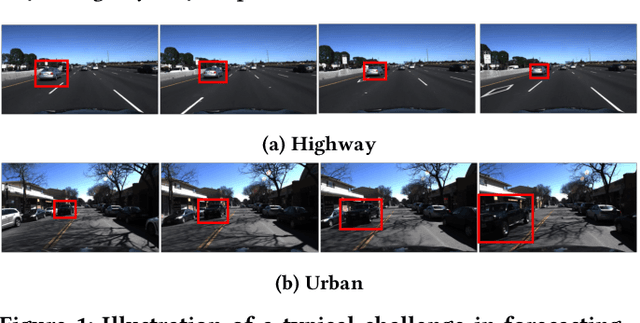
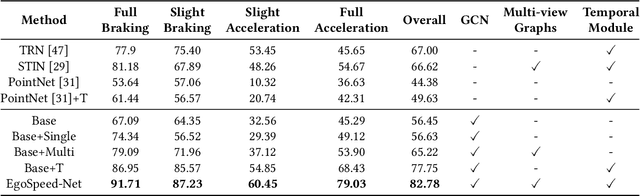
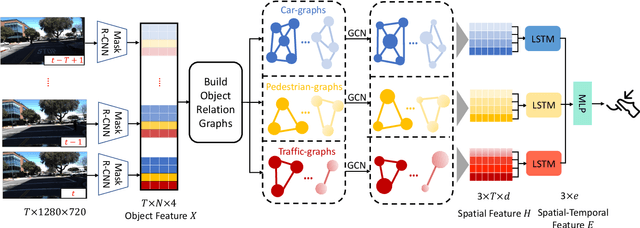
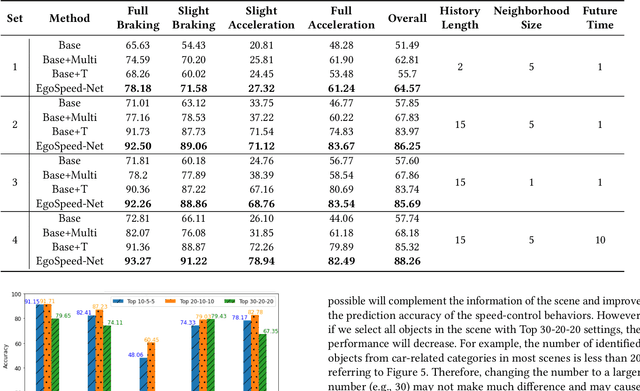
Speed-control forecasting, a challenging problem in driver behavior analysis, aims to predict the future actions of a driver in controlling vehicle speed such as braking or acceleration. In this paper, we try to address this challenge solely using egocentric video data, in contrast to the majority of works in the literature using either third-person view data or extra vehicle sensor data such as GPS, or both. To this end, we propose a novel graph convolutional network (GCN) based network, namely, EgoSpeed-Net. We are motivated by the fact that the position changes of objects over time can provide us very useful clues for forecasting the speed change in future. We first model the spatial relations among the objects from each class, frame by frame, using fully-connected graphs, on top of which GCNs are applied for feature extraction. Then we utilize a long short-term memory network to fuse such features per class over time into a vector, concatenate such vectors and forecast a speed-control action using a multilayer perceptron classifier. We conduct extensive experiments on the Honda Research Institute Driving Dataset and demonstrate the superior performance of EgoSpeed-Net.