 Add to Chrome
 Add to Firefox
 Add to Edge
UHD-MFF: Shattering Barriers in Multi-Focus Ultra-High-Definition Image Fusion via Learnable Lookup Tables
Jun 30, 2026
With the advancement of imaging technology, ultra-high-definition images have become increasingly essential in modern visual applications. However, existing multi-focus image fusion remains largely confined to low-resolution images and faces three major barriers in UHD scenarios, namely data availability, model adaptability, and deployment feasibility, which severely hinder its practical application. To shatter these barriers, first, we propose the UHD-MFF dataset, the first large-scale ultra-high-resolution multi-focus fusion dataset. Second, we propose a scale-specialized lookup-table framework tailored for ultra-high-resolution images, termed as UMF-LUT. It consists of Coarse-Region Lookup Table (C-LUT) and Detail-Edge Lookup Table (D-LUT). Specifically, C-LUT performs joint queries of multiple gradient cues and semantic cues at low-resolution scales to enable region-level decision-making. Also, D-LUT operates at high-resolution scales, leveraging efficient Laplacian cues to provide complementary edge-level decision information. Such a design makes the model particularly well-suited for ultra-high-resolution multi-focus image fusion. Finally, it offers strong deployability with minimal computational overhead, enabling real-time 4K multi-focus fusion and showing promising potential for smartphone. Extensive experiments demonstrate that it outperforms SOTA methods in both visual fidelity and quantitative metrics. It effectively advances the development of multi-focus image fusion toward ultra-high-resolution imaging scenarios. The code is available at https://github.com/zyb5/UHD-MFF.

VideoFusion: A Spatio-Temporal Collaborative Network for Mutli-modal Video Fusion and Restoration
Mar 30, 2025Compared to images, videos better align with real-world acquisition scenarios and possess valuable temporal cues. However, existing multi-sensor fusion research predominantly integrates complementary context from multiple images rather than videos. This primarily stems from two factors: 1) the scarcity of large-scale multi-sensor video datasets, limiting research in video fusion, and 2) the inherent difficulty of jointly modeling spatial and temporal dependencies in a unified framework. This paper proactively compensates for the dilemmas. First, we construct M3SVD, a benchmark dataset with $220$ temporally synchronized and spatially registered infrared-visible video pairs comprising 153,797 frames, filling the data gap for the video fusion community. Secondly, we propose VideoFusion, a multi-modal video fusion model that fully exploits cross-modal complementarity and temporal dynamics to generate spatio-temporally coherent videos from (potentially degraded) multi-modal inputs. Specifically, 1) a differential reinforcement module is developed for cross-modal information interaction and enhancement, 2) a complete modality-guided fusion strategy is employed to adaptively integrate multi-modal features, and 3) a bi-temporal co-attention mechanism is devised to dynamically aggregate forward-backward temporal contexts to reinforce cross-frame feature representations. Extensive experiments reveal that VideoFusion outperforms existing image-oriented fusion paradigms in sequential scenarios, effectively mitigating temporal inconsistency and interference.
ControlFusion: A Controllable Image Fusion Framework with Language-Vision Degradation Prompts
Mar 30, 2025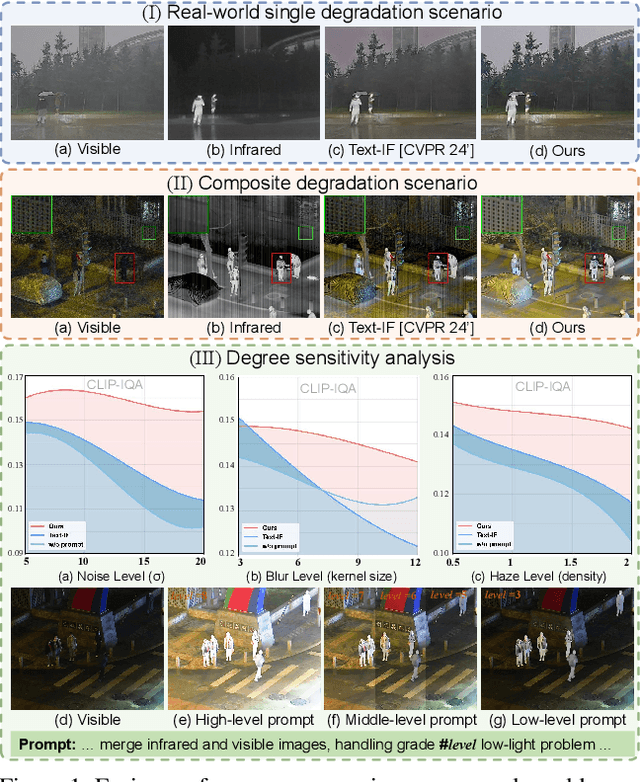
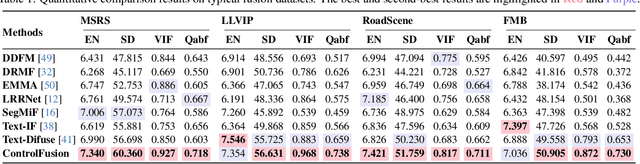
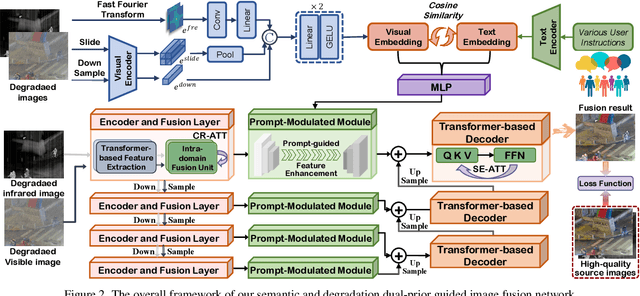
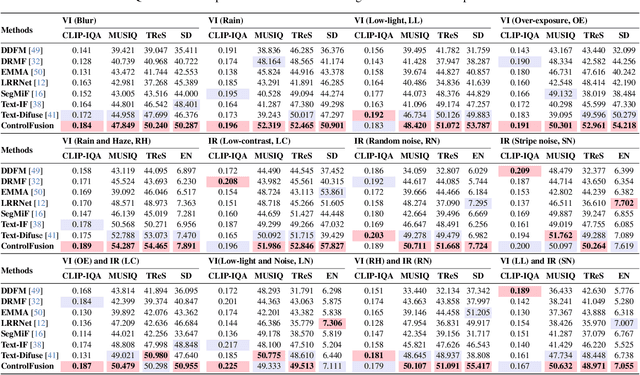
Current image fusion methods struggle to address the composite degradations encountered in real-world imaging scenarios and lack the flexibility to accommodate user-specific requirements. In response to these challenges, we propose a controllable image fusion framework with language-vision prompts, termed ControlFusion, which adaptively neutralizes composite degradations. On the one hand, we develop a degraded imaging model that integrates physical imaging mechanisms, including the Retinex theory and atmospheric scattering principle, to simulate composite degradations, thereby providing potential for addressing real-world complex degradations from the data level. On the other hand, we devise a prompt-modulated restoration and fusion network that dynamically enhances features with degradation prompts, enabling our method to accommodate composite degradation of varying levels. Specifically, considering individual variations in quality perception of users, we incorporate a text encoder to embed user-specified degradation types and severity levels as degradation prompts. We also design a spatial-frequency collaborative visual adapter that autonomously perceives degradations in source images, thus eliminating the complete dependence on user instructions. Extensive experiments demonstrate that ControlFusion outperforms SOTA fusion methods in fusion quality and degradation handling, particularly in countering real-world and compound degradations with various levels.