 Add to Chrome
 Add to Firefox
 Add to Edge
Factor-Informed Uncertainty Distillation for Gaze Estimation
Jul 22, 2026
Deep gaze estimation works well in controlled capture but degrades in unconstrained settings, where systems must reject unreliable predictions. Single-pass uncertainty (e.g., heteroscedastic regression) infers uncertainty from pixels without explicit input-validity cues, while sampling based methods are often too costly for real time use. We propose Factor-Informed Uncertainty Distillation (FIUD), a teacher-student framework that aligns uncertainty with interpretable image-quality failure modes. A gradient-boosting teacher predicts expected gaze error from factors such as illumination, sharpness, eye visibility and symmetry; a neural student distills these signals via curriculum learning and ranking supervision into a lightweight single-pass uncertainty head. Across ETH-XGaze, Gaze360, and MPIIFaceGaze (>300k samples), FIUD improves uncertainty, error rank correlation and selective prediction versus deterministic and sampling-based baselines, with the largest gains in unconstrained settings.

Coordinate Singularities Break Conformal Coverage for Gaze and Head Pose
Jun 29, 2026Conformal prediction provides distribution-free reliability guarantees for vision systems, but these guarantees depend on how prediction errors are measured in the output space. Many vision tasks produce outputs on curved spaces (e.g. gaze directions on the sphere or 3D head rotations), yet intermediate prediction heads, residuals, uncertainty estimates, or conformal scores are often defined in flat coordinate charts such as yaw-pitch or Euler angles. We show that this scoring choice introduces systematic geometric distortion near coordinate singularities (large pitch angles on the sphere and poses approaching gimbal lock in 3D rotations). Across four datasets (ETH-XGaze, Gaze360, BIWI, AFLW2000-3D), slice-conditional coverage at a nominal 90% target drops by 30-50 percentage points in these regions, falling to 38.9% on ETH-XGaze and 42.0% on Gaze360 at gaze pitch above 70 degrees, and to 57.5% on BIWI and 55.2% on AFLW2000-3D at head pose pitch above 60 degrees near gimbal lock, despite marginal coverage remaining near 90%. We prove that this is structural. Scalar thresholding changes the size of chart-coordinate prediction sets but leaves their distorted axis ratios unchanged. To diagnose this hidden failure mode, we show that a simple geometric quantity, the Riemannian volume density, strongly correlates with where coverage collapse occurs. Finally, we show that coordinate-free geodesic scoring removes this distortion. It requires no retraining and adds negligible computational cost.
A Neuro-Symbolic System for Interpretable Multimodal Physiological Signals Integration in Human Fatigue Detection
Mar 25, 2026We propose a neuro-symbolic architecture that learns four interpretable physiological concepts, oculomotor dynamics, gaze stability, prefrontal hemodynamics, and multimodal, from eye-tracking and neural hemodynamics, functional near-infrared spectroscopy, (fNIRS) windows using attention-based encoders, and combines them with differentiable approximate reasoning rules using learned weights and soft thresholds, to address both rigid hand-crafted rules and the lack of subject-level alignment diagnostics. We apply this system to fatigue classification from multimodal physiological signals, a domain that requires models that are accurate and interpretable, with internal reasoning that can be inspected for safety-critical use. In leave-one-subject-out evaluation on 18 participants (560 samples), the method achieves 72.1% +/- 12.3% accuracy, comparable to tuned baselines while exposing concept activations and rule firing strengths. Ablations indicate gains from participant-specific calibration (+5.2 pp), a modest drop without the fNIRS concept (-1.2 pp), and slightly better performance with Lukasiewicz operators than product (+0.9 pp). We also introduce concept fidelity, an offline per-subject audit metric from held-out labels, which correlates strongly with per-subject accuracy (r=0.843, p < 0.0001).
MAC-Gaze: Motion-Aware Continual Calibration for Mobile Gaze Tracking
May 28, 2025Mobile gaze tracking faces a fundamental challenge: maintaining accuracy as users naturally change their postures and device orientations. Traditional calibration approaches, like one-off, fail to adapt to these dynamic conditions, leading to degraded performance over time. We present MAC-Gaze, a Motion-Aware continual Calibration approach that leverages smartphone Inertial measurement unit (IMU) sensors and continual learning techniques to automatically detect changes in user motion states and update the gaze tracking model accordingly. Our system integrates a pre-trained visual gaze estimator and an IMU-based activity recognition model with a clustering-based hybrid decision-making mechanism that triggers recalibration when motion patterns deviate significantly from previously encountered states. To enable accumulative learning of new motion conditions while mitigating catastrophic forgetting, we employ replay-based continual learning, allowing the model to maintain performance across previously encountered motion conditions. We evaluate our system through extensive experiments on the publicly available RGBDGaze dataset and our own 10-hour multimodal MotionGaze dataset (481K+ images, 800K+ IMU readings), encompassing a wide range of postures under various motion conditions including sitting, standing, lying, and walking. Results demonstrate that our method reduces gaze estimation error by 19.9% on RGBDGaze (from 1.73 cm to 1.41 cm) and by 31.7% on MotionGaze (from 2.81 cm to 1.92 cm) compared to traditional calibration approaches. Our framework provides a robust solution for maintaining gaze estimation accuracy in mobile scenarios.
An End-to-End Review of Gaze Estimation and its Interactive Applications on Handheld Mobile Devices
Jun 30, 2023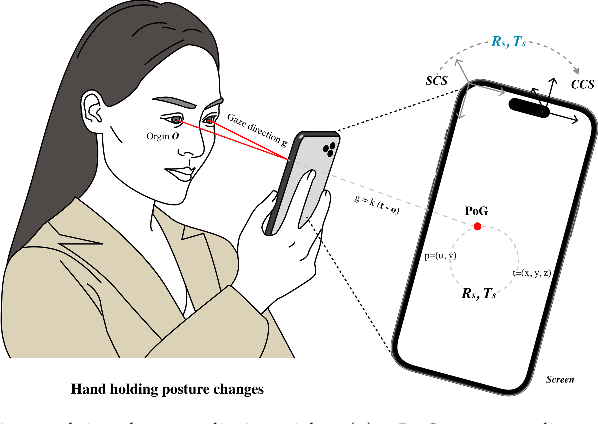
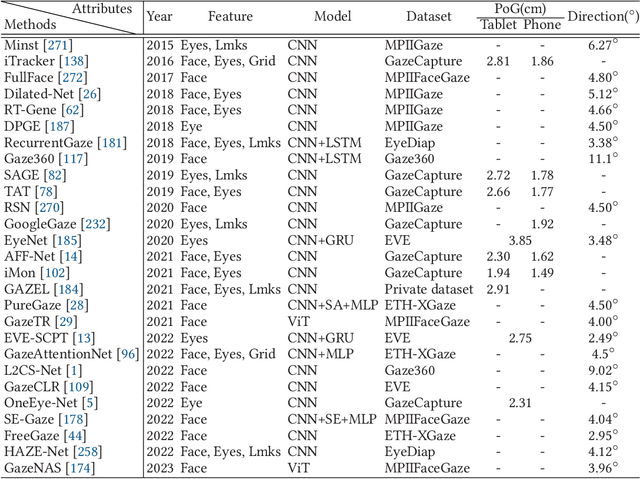
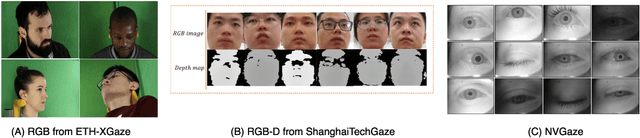
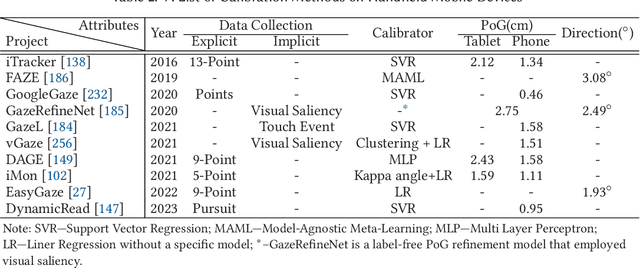
In recent years we have witnessed an increasing number of interactive systems on handheld mobile devices which utilise gaze as a single or complementary interaction modality. This trend is driven by the enhanced computational power of these devices, higher resolution and capacity of their cameras, and improved gaze estimation accuracy obtained from advanced machine learning techniques, especially in deep learning. As the literature is fast progressing, there is a pressing need to review the state of the art, delineate the boundary, and identify the key research challenges and opportunities in gaze estimation and interaction. This paper aims to serve this purpose by presenting an end-to-end holistic view in this area, from gaze capturing sensors, to gaze estimation workflows, to deep learning techniques, and to gaze interactive applications.
* 37 Pages, Paper accepted by ACM Computing Surveys