 Add to Chrome
 Add to Firefox
 Add to Edge
Evidential Rule Learning for Interpretable Classification with Abstention
Aug 06, 2026
Interpretable classification often requires more than accurate predictions for real-life deployment: models should be transparent about the evidence behind their decisions and abstain when they cannot decide reliably. We introduce Fast Evidential Rule Learning (FERL), a method that learns interpretable, accurate fuzzy rule models whose outputs are evidential. Unlike post-hoc calibration, FERL's belief, plausibility, and abstention capabilities arise directly from the fuzzy memberships in a single deterministic pass, with no auxiliary head, held-out set, or repeated inference. Our theoretical analysis further shows that FERL is Lipschitz stable, which means that its evidential outputs vary smoothly with the input. Against state-of-the-art rule learners, FERL is statistically significantly more accurate across a 30 tabular-dataset benchmark ($+2.6\%$ average accuracy over the second best). Its native set predictions attain the best utility-discounted accuracy among credal classifiers ($u_{65}/u_{80}=0.80/0.83$ vs.\ $0.79/0.80$ for the naive credal classifier), at higher set coverage ($0.92$ vs.\ $\le0.82$). FERL also matches dedicated out-of-distribution detectors on tabular near-OOD detection ($77.7$ vs.\ $77.4$ AUROC for the strongest baseline). Under detector-class-disjoint concept-bottleneck evaluation, its it is within $2.3$ AUROC points of the strongest dedicated detector on both CUB and AwA2, while attaining the best AwA2 AUPR-Out ($68.3$) and novel-class rejection ($57.2$), while being able to name which attributes are anomalous.

Interpretable Fuzzy Rule-Based Regression Extension for Ex-Fuzzy Library
Jul 22, 2026Machine learning models achieve high predictive accuracy in regression tasks, but their deployment in safety-critical and regulated domains requires interpretability. While fuzzy rule-based systems offer transparent, linguistically explicit interpretable models, Mamdani-style fuzzy regression remains underrepresented in modern machine learning software libraries. This paper presents an interpretable regression extension for the Ex-Fuzzy library, enabling Mamdani fuzzy inference with scalar consequents learned directly from data. For this, a target-aware partition initialisation strategy based on Fuzzy C-Means clustering is introduced, in which linguistic variables are derived from an augmented input-output space to emphasise output-relevant regions of the feature space. The proposed extension is evaluated on ten regression datasets from the KEEL repository, comparing Gaussian and trapezoidal partition strategies against standard baselines including linear regression, multilayer perceptron, and random forests. Experimental results show that Gaussian partitions consistently outperform uniform trapezoidal partitions, achieving a mean coefficient of determination of approximately 0.86 while producing compact rule bases of 10-15 human-readable rules. The proposed implementation provides a transparent and competitive alternative to black-box regression models, supporting practical interpretability with competitive predictive performance.
Assessing Reliability of Symbol Detection in Concept Bottleneck Models
Jun 15, 2026Concept Bottleneck Models (CBMs) are a relevant tool for explainable Artificial Intelligence because they make their predictions through human-interpretable symbols. However, high task accuracy does not guarantee that these symbols are detected faithfully: jointly trained CBMs may encode task-specific shortcuts in the bottleneck, making their explanations unreliable. In this paper, we study concept-detection reliability by swapping independently trained concept detectors and classification heads that share the same symbolic vocabulary. We use the resulting performance degradation, concept-level metrics, and symbol-wise uncertainty estimates to identify concepts that are especially prone to spurious firing. Finally, we propose a reliability-aware training strategy in which a shared concept detector is optimized with multiple classification heads and penalized for relying on globally or instance-wise unreliable symbols. On CUB-200-2011 with full concept supervision, detectors and heads are almost freely interchangeable (swap drop below one accuracy point, relative retention above $99\%$, and no concept detected below chance), whereas on a controlled synthetic task we show that, as the concept-supervision weight is reduced, models keep near-perfect task accuracy while swapped accuracy and agreement with the ground-truth concepts collapse to chance. Our reliability-aware training substantially mitigates this leakage, roughly doubling swap accuracy in the leaky regime.
Hypernetworks for Dynamic Feature Selection
May 12, 2026Dynamic feature selection (DFS) is a machine learning framework in which features are acquired sequentially for individual samples under budget constraints. The exponential growth in the number of possible feature acquisition paths forces a DFS model to balance fitting specific scenarios against maintaining general performance, even when the feature space is moderate in size. In this paper, we study the structural limitations of existing DFS approaches to achieve an optimal solution. Then, we propose \textsc{Hyper-DFS}, a hypernetwork-based DFS approach that generates feature subset-specific classifier parameters on demand. We show that the use of hypernetworks compared to mask-embedding methods results in a smaller structural complexity bound. We also use a Set Transformer encoding to create a smooth conditioning space for the hypernetwork, so that functionally similar tasks are also geometrically close. In our benchmarks, \textsc{Hyper-DFS} outperforms all state-of-the-art approaches on synthetic and real-life tabular data. It is also competitive or superior across all image datasets tested, and shows substantially stronger zero-shot generalisation to feature subsets never seen during training than existing DFS approaches.
A Neuro-Symbolic System for Interpretable Multimodal Physiological Signals Integration in Human Fatigue Detection
Mar 25, 2026We propose a neuro-symbolic architecture that learns four interpretable physiological concepts, oculomotor dynamics, gaze stability, prefrontal hemodynamics, and multimodal, from eye-tracking and neural hemodynamics, functional near-infrared spectroscopy, (fNIRS) windows using attention-based encoders, and combines them with differentiable approximate reasoning rules using learned weights and soft thresholds, to address both rigid hand-crafted rules and the lack of subject-level alignment diagnostics. We apply this system to fatigue classification from multimodal physiological signals, a domain that requires models that are accurate and interpretable, with internal reasoning that can be inspected for safety-critical use. In leave-one-subject-out evaluation on 18 participants (560 samples), the method achieves 72.1% +/- 12.3% accuracy, comparable to tuned baselines while exposing concept activations and rule firing strengths. Ablations indicate gains from participant-specific calibration (+5.2 pp), a modest drop without the fNIRS concept (-1.2 pp), and slightly better performance with Lukasiewicz operators than product (+0.9 pp). We also introduce concept fidelity, an offline per-subject audit metric from held-out labels, which correlates strongly with per-subject accuracy (r=0.843, p < 0.0001).
Interpreting Contrastive Embeddings in Specific Domains with Fuzzy Rules
Mar 12, 2026Free-style text is still one of the common ways in which data is registered in real environments, like legal procedures and medical records. Because of that, there have been significant efforts in the area of natural language processing to convert these texts into a structured format, which standard machine learning methods can then exploit. One of the most popular methods to embed text into a vectorial representation is the Contrastive Language-Image Pre-training model (CLIP), which was trained using both image and text. Although the representations computed by CLIP have been very successful in zero-show and few-shot learning problems, they still have problems when applied to a particular domain. In this work, we use a fuzzy rule-based classification system along with some standard text procedure techniques to map some of our features of interest to the space created by a CLIP model. Then, we discuss the rules and associations obtained and the importance of each feature considered. We apply this approach in two different data domains, clinical reports and film reviews, and compare the results obtained individually and when considering both. Finally, we discuss the limitations of this approach and how it could be further improved.
A Fast Interpretable Fuzzy Tree Learner
Dec 12, 2025Fuzzy rule-based systems have been mostly used in interpretable decision-making because of their interpretable linguistic rules. However, interpretability requires both sensible linguistic partitions and small rule-base sizes, which are not guaranteed by many existing fuzzy rule-mining algorithms. Evolutionary approaches can produce high-quality models but suffer from prohibitive computational costs, while neural-based methods like ANFIS have problems retaining linguistic interpretations. In this work, we propose an adaptation of classical tree-based splitting algorithms from crisp rules to fuzzy trees, combining the computational efficiency of greedy algoritms with the interpretability advantages of fuzzy logic. This approach achieves interpretable linguistic partitions and substantially improves running time compared to evolutionary-based approaches while maintaining competitive predictive performance. Our experiments on tabular classification benchmarks proof that our method achieves comparable accuracy to state-of-the-art fuzzy classifiers with significantly lower computational cost and produces more interpretable rule bases with constrained complexity. Code is available in: https://github.com/Fuminides/fuzzy_greedy_tree_public
Crisp complexity of fuzzy classifiers
Apr 22, 2025Rule-based systems are a very popular form of explainable AI, particularly in the fuzzy community, where fuzzy rules are widely used for control and classification problems. However, fuzzy rule-based classifiers struggle to reach bigger traction outside of fuzzy venues, because users sometimes do not know about fuzzy and because fuzzy partitions are not so easy to interpret in some situations. In this work, we propose a methodology to reduce fuzzy rule-based classifiers to crisp rule-based classifiers. We study different possible crisp descriptions and implement an algorithm to obtain them. Also, we analyze the complexity of the resulting crisp classifiers. We believe that our results can help both fuzzy and non-fuzzy practitioners understand better the way in which fuzzy rule bases partition the feature space and how easily one system can be translated to another and vice versa. Our complexity metric can also help to choose between different fuzzy classifiers based on what the equivalent crisp partitions look like.
Reliable Classification with Conformal Learning and Interval-Type 2 Fuzzy Sets
Apr 21, 2025Classical machine learning classifiers tend to be overconfident can be unreliable outside of the laboratory benchmarks. Properly assessing the reliability of the output of the model per sample is instrumental for real-life scenarios where these systems are deployed. Because of this, different techniques have been employed to properly quantify the quality of prediction for a given model. These are most commonly Bayesian statistics and, more recently, conformal learning. Given a calibration set, conformal learning can produce outputs that are guaranteed to cover the target class with a desired significance level, and are more reliable than the standard confidence intervals used by Bayesian methods. In this work, we propose to use conformal learning with fuzzy rule-based systems in classification and show some metrics of their performance. Then, we discuss how the use of type 2 fuzzy sets can improve the quality of the output of the system compared to both fuzzy and crisp rules. Finally, we also discuss how the fine-tuning of the system can be adapted to improve the quality of the conformal prediction.
Compact Rule-Based Classifier Learning via Gradient Descent
Feb 03, 2025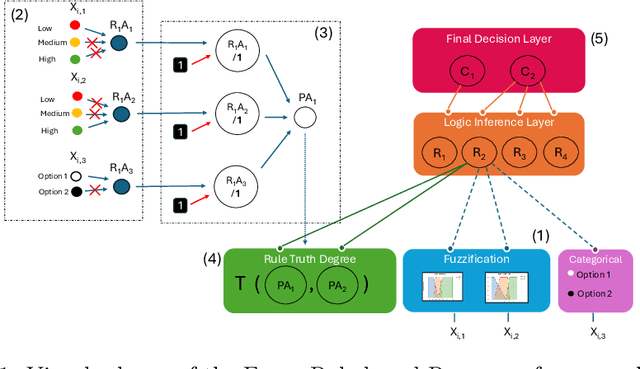

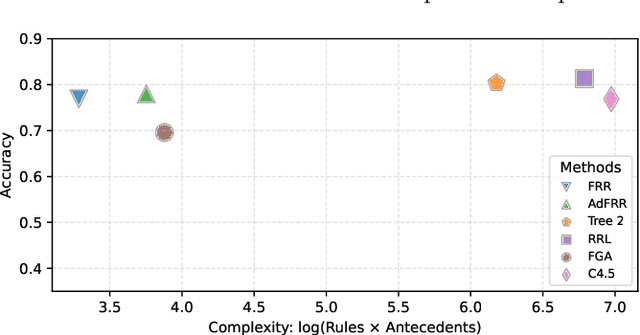
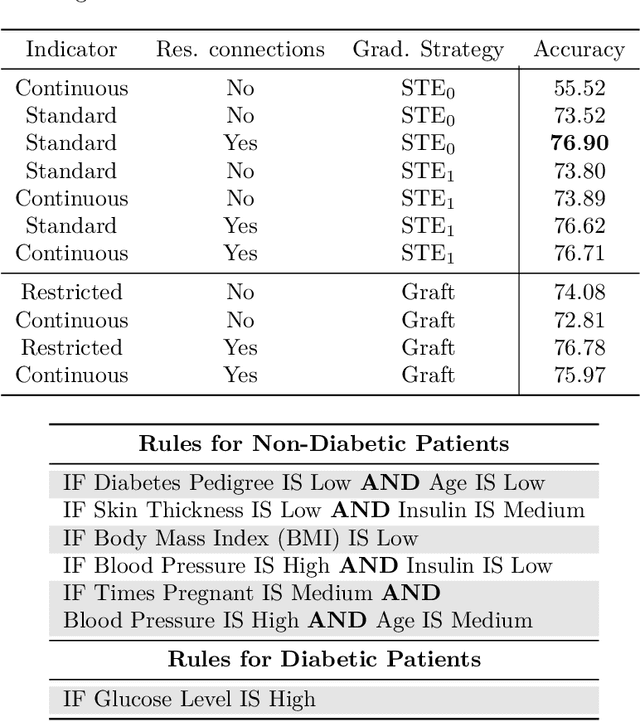
Rule-based models play a crucial role in scenarios that require transparency and accountable decision-making. However, they primarily consist of discrete parameters and structures, which presents challenges for scalability and optimization. In this work, we introduce a new rule-based classifier trained using gradient descent, in which the user can control the maximum number and length of the rules. For numerical partitions, the user can also control the partitions used with fuzzy sets, which also helps keep the number of partitions small. We perform a series of exhaustive experiments on $40$ datasets to show how this classifier performs in terms of accuracy and rule base size. Then, we compare our results with a genetic search that fits an equivalent classifier and with other explainable and non-explainable state-of-the-art classifiers. Our results show how our method can obtain compact rule bases that use significantly fewer patterns than other rule-based methods and perform better than other explainable classifiers.