 Add to Chrome
 Add to Firefox
 Add to Edge
A Neuro-Symbolic System for Interpretable Multimodal Physiological Signals Integration in Human Fatigue Detection
Mar 25, 2026
We propose a neuro-symbolic architecture that learns four interpretable physiological concepts, oculomotor dynamics, gaze stability, prefrontal hemodynamics, and multimodal, from eye-tracking and neural hemodynamics, functional near-infrared spectroscopy, (fNIRS) windows using attention-based encoders, and combines them with differentiable approximate reasoning rules using learned weights and soft thresholds, to address both rigid hand-crafted rules and the lack of subject-level alignment diagnostics. We apply this system to fatigue classification from multimodal physiological signals, a domain that requires models that are accurate and interpretable, with internal reasoning that can be inspected for safety-critical use. In leave-one-subject-out evaluation on 18 participants (560 samples), the method achieves 72.1% +/- 12.3% accuracy, comparable to tuned baselines while exposing concept activations and rule firing strengths. Ablations indicate gains from participant-specific calibration (+5.2 pp), a modest drop without the fNIRS concept (-1.2 pp), and slightly better performance with Lukasiewicz operators than product (+0.9 pp). We also introduce concept fidelity, an offline per-subject audit metric from held-out labels, which correlates strongly with per-subject accuracy (r=0.843, p < 0.0001).

Interpreting Contrastive Embeddings in Specific Domains with Fuzzy Rules
Mar 12, 2026Free-style text is still one of the common ways in which data is registered in real environments, like legal procedures and medical records. Because of that, there have been significant efforts in the area of natural language processing to convert these texts into a structured format, which standard machine learning methods can then exploit. One of the most popular methods to embed text into a vectorial representation is the Contrastive Language-Image Pre-training model (CLIP), which was trained using both image and text. Although the representations computed by CLIP have been very successful in zero-show and few-shot learning problems, they still have problems when applied to a particular domain. In this work, we use a fuzzy rule-based classification system along with some standard text procedure techniques to map some of our features of interest to the space created by a CLIP model. Then, we discuss the rules and associations obtained and the importance of each feature considered. We apply this approach in two different data domains, clinical reports and film reviews, and compare the results obtained individually and when considering both. Finally, we discuss the limitations of this approach and how it could be further improved.
Fuzzy Norm-Explicit Product Quantization for Recommender Systems
Dec 08, 2024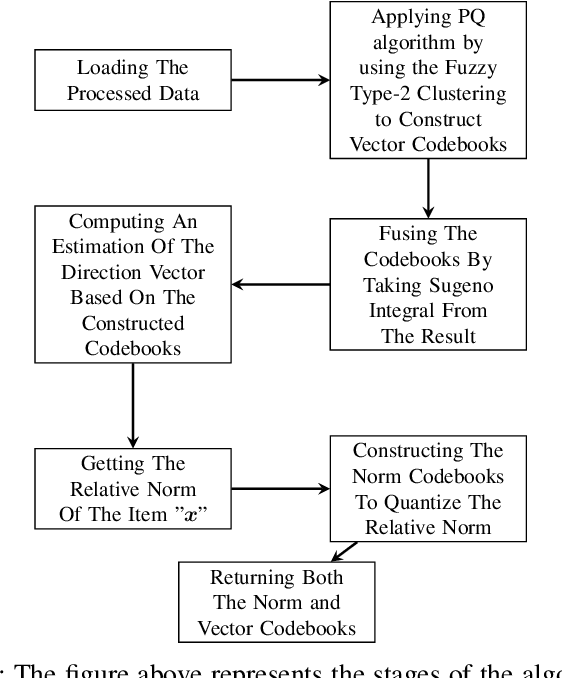
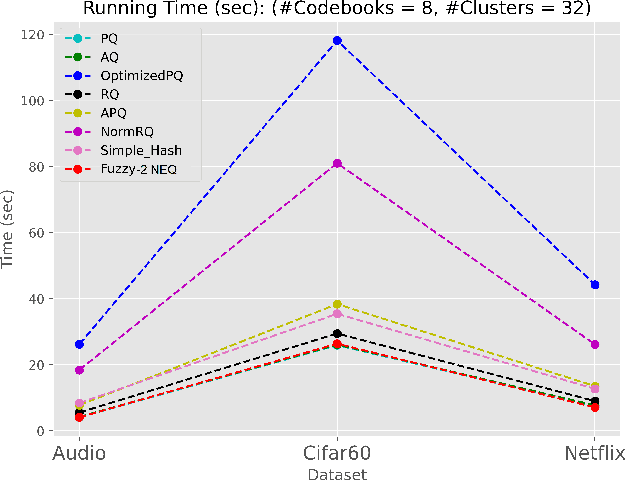
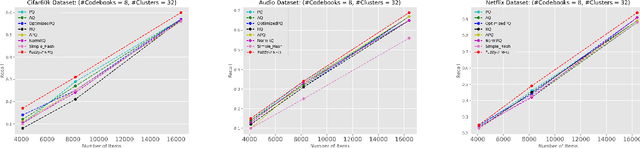
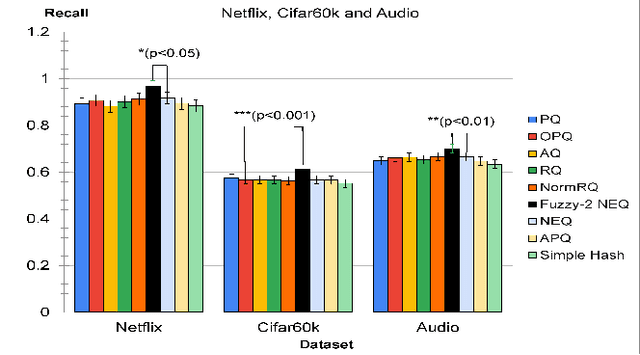
As the data resources grow, providing recommendations that best meet the demands has become a vital requirement in business and life to overcome the information overload problem. However, building a system suggesting relevant recommendations has always been a point of debate. One of the most cost-efficient techniques in terms of producing relevant recommendations at a low complexity is Product Quantization (PQ). PQ approaches have continued developing in recent years. This system's crucial challenge is improving product quantization performance in terms of recall measures without compromising its complexity. This makes the algorithm suitable for problems that require a greater number of potentially relevant items without disregarding others, at high-speed and low-cost to keep up with traffic. This is the case of online shops where the recommendations for the purpose are important, although customers can be susceptible to scoping other products. This research proposes a fuzzy approach to perform norm-based product quantization. Type-2 Fuzzy sets (T2FSs) define the codebook allowing sub-vectors (T2FSs) to be associated with more than one element of the codebook, and next, its norm calculus is resolved by means of integration. Our method finesses the recall measure up, making the algorithm suitable for problems that require querying at most possible potential relevant items without disregarding others. The proposed method outperforms all PQ approaches such as NEQ, PQ, and RQ up to +6%, +5%, and +8% by achieving a recall of 94%, 69%, 59% in Netflix, Audio, Cifar60k datasets, respectively. More and over, computing time and complexity nearly equals the most computationally efficient existing PQ method in the state-of-the-art.