 Add to Chrome
 Add to Firefox
 Add to Edge
Wireless communication empowers online scheduling of partially-observable transportation multi-robot systems in a smart factory
Mar 25, 2026
Achieving agile and reconfigurable production flows in smart factories depends on online multi-robot task assignment (MRTA), which requires online collision-free and congestion-free route scheduling of transportation multi-robot systems (T-MRS), e.g., collaborative automatic guided vehicles (AGVs). Due to the real-time operational requirements and dynamic interactions between T-MRS and production MRS, online scheduling under partial observability in dynamic factory environments remains a significant and under-explored challenge. This paper proposes a novel communication-enabled online scheduling framework that explicitly couples wireless machine-to-machine (M2M) networking with route scheduling, enabling AGVs to exchange intention information, e.g., planned routes, to overcome partial observations and assist complex computation of online scheduling. Specifically, we determine intelligent AGVs' intention and sensor data as new M2M traffic and tailor the retransmission-free multi-link transmission networking to meet real-time operation demands. This scheduling-oriented networking is then integrated with a simulated annealing-based MRTA scheme and a congestion-aware A*-based route scheduling method. The integrated communication and scheduling scheme allows AGVs to dynamically adjust collision-free and congestion-free routes with reduced computational overhead. Numerical experiments shows the impacts from wireless communication on the performance of T-MRS and suggest that the proposed integrated scheme significantly enhances scheduling efficiency compared to other baselines, even under high AGV load conditions and limited channel resources. Moreover, the results reveal that the scheduling-oriented wireless M2M communication design fundamentally differs from human-to-human communications, implying new technological opportunities in a wireless networked smart factory.

Tracking Transforming Objects: A Benchmark
Apr 28, 2024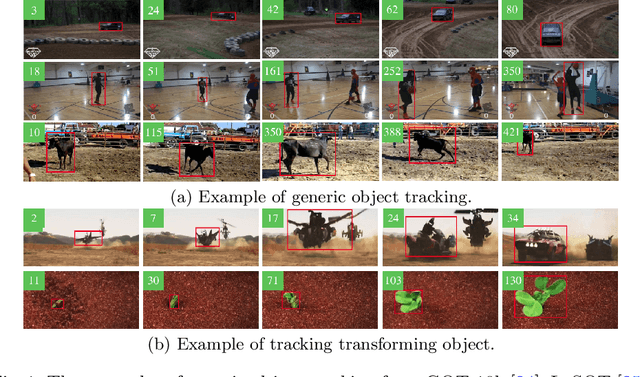
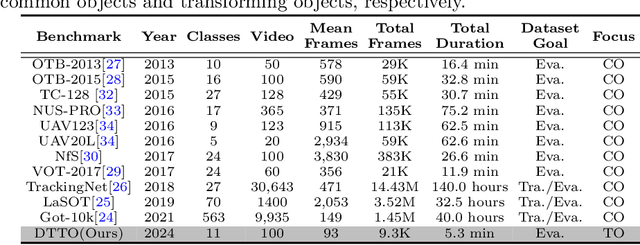
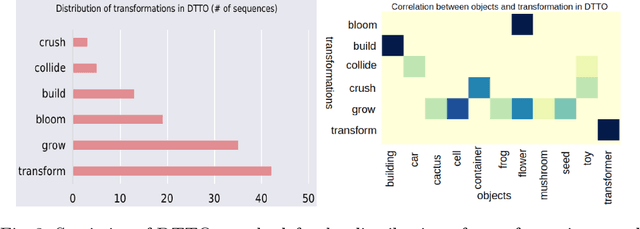
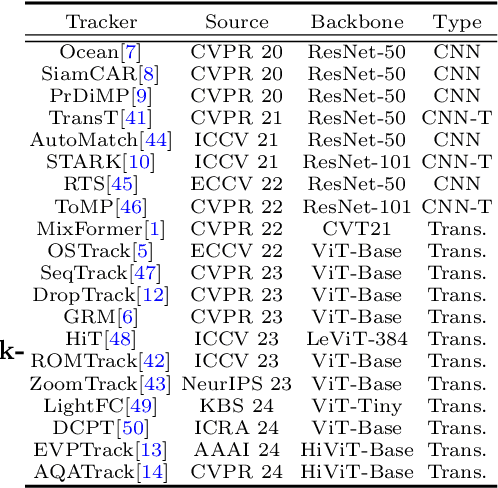
Tracking transforming objects holds significant importance in various fields due to the dynamic nature of many real-world scenarios. By enabling systems accurately represent transforming objects over time, tracking transforming objects facilitates advancements in areas such as autonomous systems, human-computer interaction, and security applications. Moreover, understanding the behavior of transforming objects provides valuable insights into complex interactions or processes, contributing to the development of intelligent systems capable of robust and adaptive perception in dynamic environments. However, current research in the field mainly focuses on tracking generic objects. In this study, we bridge this gap by collecting a novel dedicated Dataset for Tracking Transforming Objects, called DTTO, which contains 100 sequences, amounting to approximately 9.3K frames. We provide carefully hand-annotated bounding boxes for each frame within these sequences, making DTTO the pioneering benchmark dedicated to tracking transforming objects. We thoroughly evaluate 20 state-of-the-art trackers on the benchmark, aiming to comprehend the performance of existing methods and provide a comparison for future research on DTTO. With the release of DTTO, our goal is to facilitate further research and applications related to tracking transforming objects.