 Add to Chrome
 Add to Firefox
 Add to Edge
Wireless communication empowers online scheduling of partially-observable transportation multi-robot systems in a smart factory
Mar 25, 2026
Achieving agile and reconfigurable production flows in smart factories depends on online multi-robot task assignment (MRTA), which requires online collision-free and congestion-free route scheduling of transportation multi-robot systems (T-MRS), e.g., collaborative automatic guided vehicles (AGVs). Due to the real-time operational requirements and dynamic interactions between T-MRS and production MRS, online scheduling under partial observability in dynamic factory environments remains a significant and under-explored challenge. This paper proposes a novel communication-enabled online scheduling framework that explicitly couples wireless machine-to-machine (M2M) networking with route scheduling, enabling AGVs to exchange intention information, e.g., planned routes, to overcome partial observations and assist complex computation of online scheduling. Specifically, we determine intelligent AGVs' intention and sensor data as new M2M traffic and tailor the retransmission-free multi-link transmission networking to meet real-time operation demands. This scheduling-oriented networking is then integrated with a simulated annealing-based MRTA scheme and a congestion-aware A*-based route scheduling method. The integrated communication and scheduling scheme allows AGVs to dynamically adjust collision-free and congestion-free routes with reduced computational overhead. Numerical experiments shows the impacts from wireless communication on the performance of T-MRS and suggest that the proposed integrated scheme significantly enhances scheduling efficiency compared to other baselines, even under high AGV load conditions and limited channel resources. Moreover, the results reveal that the scheduling-oriented wireless M2M communication design fundamentally differs from human-to-human communications, implying new technological opportunities in a wireless networked smart factory.

Predicting the Path Loss of Wireless Channel Models Using Machine Learning Techniques in MmWave Urban Communications
May 02, 2020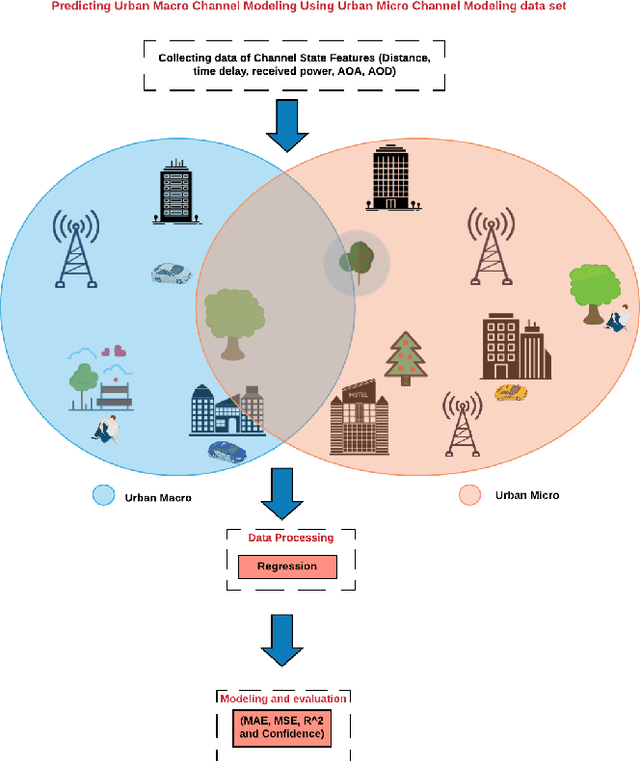
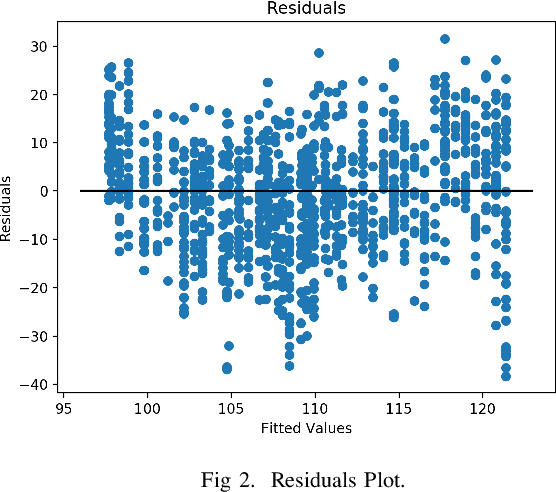
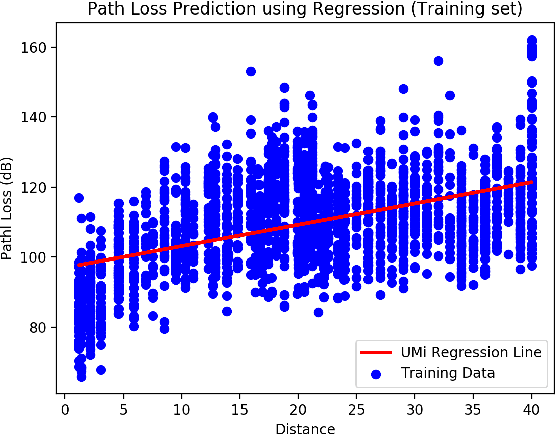
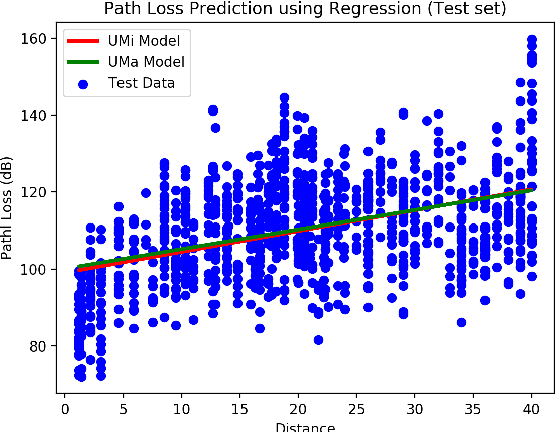
The classic wireless communication channel modeling is performed using Deterministic and Stochastic channel methodologies. Machine learning (ML) emerges to revolutionize system design for 5G and beyond. ML techniques such as supervise leaning methods will be used to predict the wireless channel path loss of a variate of environments base on a certain dataset. The propagation signal of communication systems fundamentals is focusing on channel modeling particularly for new frequency bands such as MmWave. Machine learning can facilitate rapid channel modeling for 5G and beyond wireless communication systems due to the availability of partially relevant channel measurement data and model. When irregularity of the wireless channels lead to a complex methodology to achieve accurate models, appropriate machine learning methodology explores to reduce the complexity and increase the accuracy. In this paper, we demonstrate alternative procedures beyond traditional channel modeling to enhance the path loss models using machine learning techniques, to alleviate the dilemma of channel complexity and time-consuming process that the measurements were taken. This demonstrated regression uses the measurement data of a certain scenario to successfully assist the prediction of path loss model of a different operating environment.
Thirty Years of Machine Learning:The Road to Pareto-Optimal Next-Generation Wireless Networks
Jan 24, 2019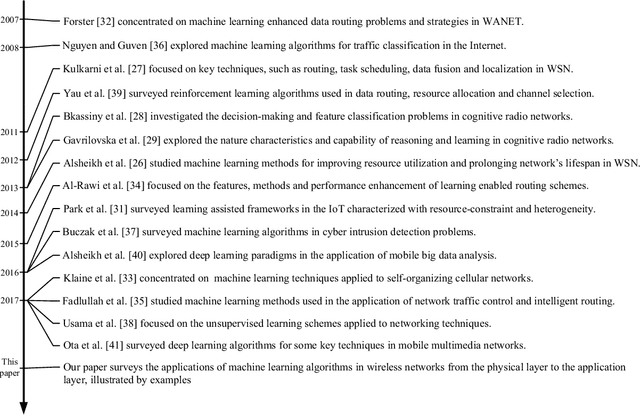
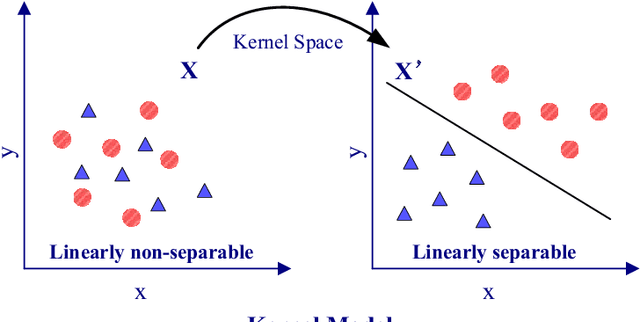
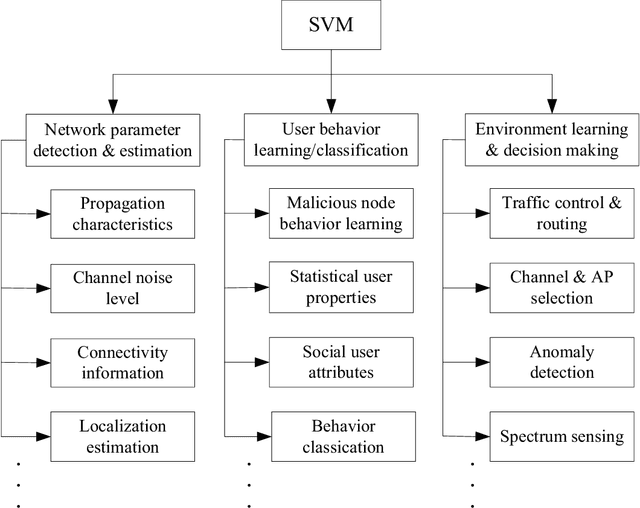
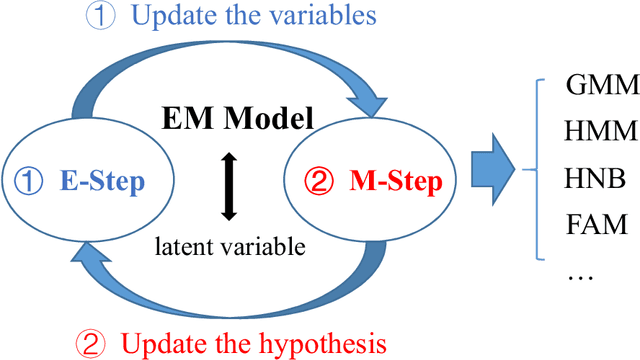
Next-generation wireless networks (NGWN) have a substantial potential in terms of supporting a broad range of complex compelling applications both in military and civilian fields, where the users are able to enjoy high-rate, low-latency, low-cost and reliable information services. Achieving this ambitious goal requires new radio techniques for adaptive learning and intelligent decision making because of the complex heterogeneous nature of the network structures and wireless services. Machine learning algorithms have great success in supporting big data analytics, efficient parameter estimation and interactive decision making. Hence, in this article, we review the thirty-year history of machine learning by elaborating on supervised learning, unsupervised learning, reinforcement learning and deep learning, respectively. Furthermore, we investigate their employment in the compelling applications of NGWNs, including heterogeneous networks (HetNets), cognitive radios (CR), Internet of things (IoT), machine to machine networks (M2M), and so on. This article aims for assisting the readers in clarifying the motivation and methodology of the various machine learning algorithms, so as to invoke them for hitherto unexplored services as well as scenarios of future wireless networks.