 Add to Chrome
 Add to Firefox
 Add to Edge
FSS-Net: Frequency-Spatial Synergy Network with Wavelet Attention for Carotid Artery Ultrasound Segmentation
Jun 09, 2026
Accurate segmentation of carotid arteries in ultrasound imaging is critical for stroke risk assessment. However, speckle noise, low contrast, and blurred boundaries remain major challenges. In this paper, we propose a Frequency-Spatial Synergy Network (FSS-Net) to achieve noise-robust and high-precision carotid artery segmentation. The network integrates wavelet transform, multi-domain attention, and edge enhancement into a unified encoder-decoder architecture. Specifically, a Channel-Spatial-Wavelet Attention (CSWA) module is designed to suppress noise and purify semantic features in the frequency domain. A Wavelet-Enhanced Bottleneck (WEB) module is introduced to capture long-range global dependencies efficiently. Furthermore, a Laplacian-Guided Adaptive Edge Fusion (LAEF) module compensates high-frequency details and maintains boundary continuity. Extensive experiments on carotid ultrasound datasets show that FSS-Net achieves a Dice score (DSC) of 96.46% and strong robustness under low SNR conditions, outperforming several state-of-the-art methods. This method realizes accurate segmentation of carotid artery in ultrasonic imaging, effectively identifies carotid atherosclerotic plaque, and is verified by other task (such as segmentation of breast cancer), suggesting that it has good clinical application potential in identifying abnormal tissue masses in ultrasonic images.

Ultrasound-QBench: Can LLMs Aid in Quality Assessment of Ultrasound Imaging?
Jan 06, 2025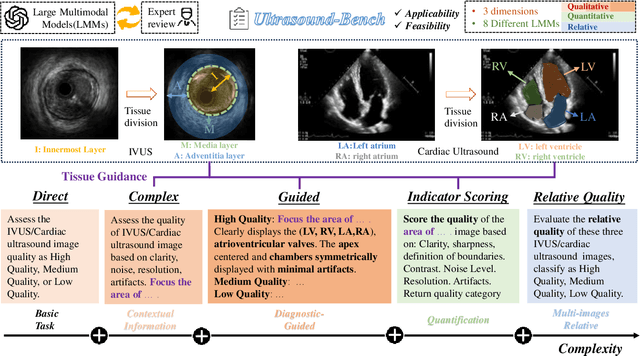
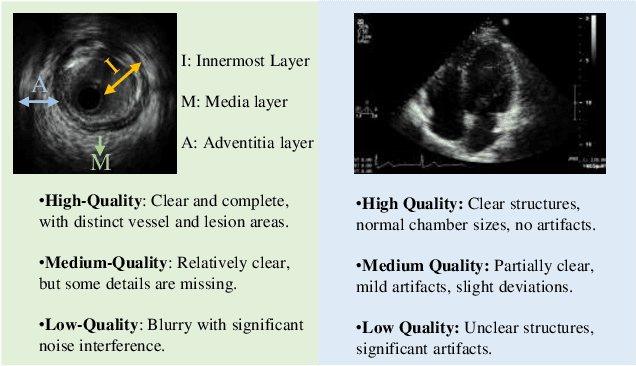
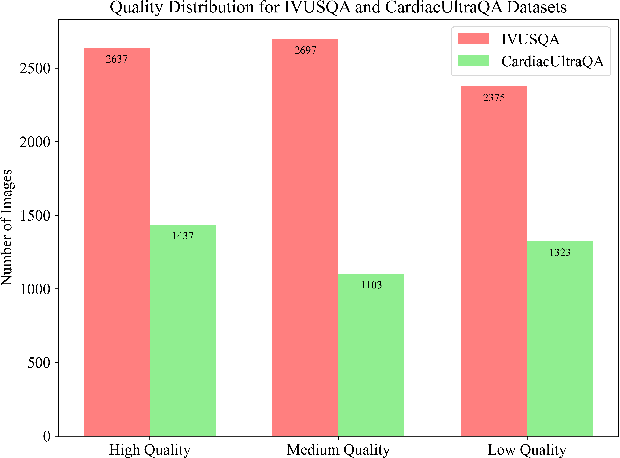
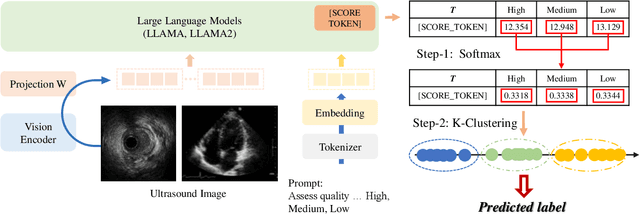
With the dramatic upsurge in the volume of ultrasound examinations, low-quality ultrasound imaging has gradually increased due to variations in operator proficiency and imaging circumstances, imposing a severe burden on diagnosis accuracy and even entailing the risk of restarting the diagnosis in critical cases. To assist clinicians in selecting high-quality ultrasound images and ensuring accurate diagnoses, we introduce Ultrasound-QBench, a comprehensive benchmark that systematically evaluates multimodal large language models (MLLMs) on quality assessment tasks of ultrasound images. Ultrasound-QBench establishes two datasets collected from diverse sources: IVUSQA, consisting of 7,709 images, and CardiacUltraQA, containing 3,863 images. These images encompassing common ultrasound imaging artifacts are annotated by professional ultrasound experts and classified into three quality levels: high, medium, and low. To better evaluate MLLMs, we decompose the quality assessment task into three dimensionalities: qualitative classification, quantitative scoring, and comparative assessment. The evaluation of 7 open-source MLLMs as well as 1 proprietary MLLMs demonstrates that MLLMs possess preliminary capabilities for low-level visual tasks in ultrasound image quality classification. We hope this benchmark will inspire the research community to delve deeper into uncovering and enhancing the untapped potential of MLLMs for medical imaging tasks.