 Add to Chrome
 Add to Firefox
 Add to Edge
DP^2-VL: Private Photo Dataset Protection by Data Poisoning for Vision-Language Models
Mar 25, 2026
Recent advances in visual-language alignment have endowed vision-language models (VLMs) with fine-grained image understanding capabilities. However, this progress also introduces new privacy risks. This paper first proposes a novel privacy threat model named identity-affiliation learning: an attacker fine-tunes a VLM using only a few private photos of a target individual, thereby embedding associations between the target facial identity and their private property and social relationships into the model's internal representations. Once deployed via public APIs, this model enables unauthorized exposure of the target user's private information upon input of their photos. To benchmark VLMs' susceptibility to such identity-affiliation leakage, we introduce the first identity-affiliation dataset comprising seven typical scenarios appearing in private photos. Each scenario is instantiated with multiple identity-centered photo-description pairs. Experimental results demonstrate that mainstream VLMs like LLaVA, Qwen-VL, and MiniGPT-v2, can recognize facial identities and infer identity-affiliation relationships by fine-tuning on small-scale private photographic dataset, and even on synthetically generated datasets. To mitigate this privacy risk, we propose DP2-VL, the first Dataset Protection framework for private photos that leverages Data Poisoning. Though optimizing imperceptible perturbations by pushing the original representations toward an antithetical region, DP2-VL induces a dataset-level shift in the embedding space of VLMs'encoders. This shift separates protected images from clean inference images, causing fine-tuning on the protected set to overfit. Extensive experiments demonstrate that DP2-VL achieves strong generalization across models, robustness to diverse post-processing operations, and consistent effectiveness across varying protection ratios.

Ultrasound-QBench: Can LLMs Aid in Quality Assessment of Ultrasound Imaging?
Jan 06, 2025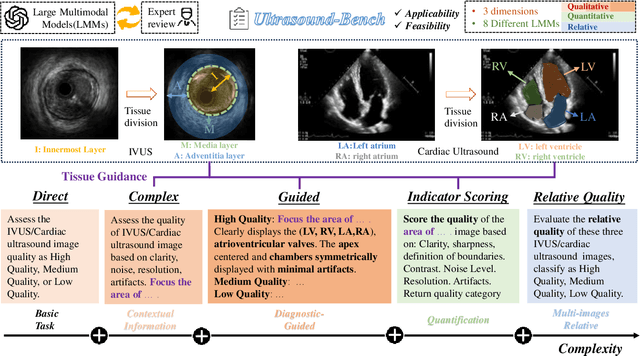
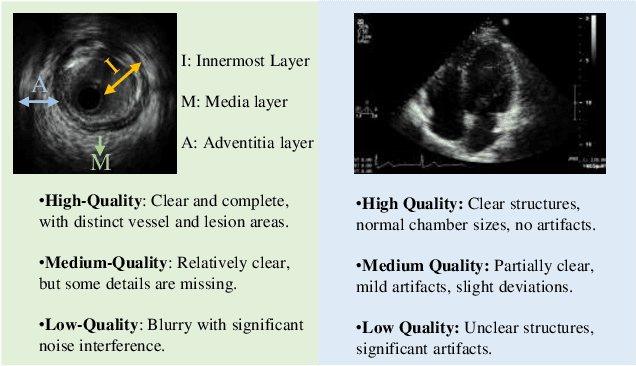
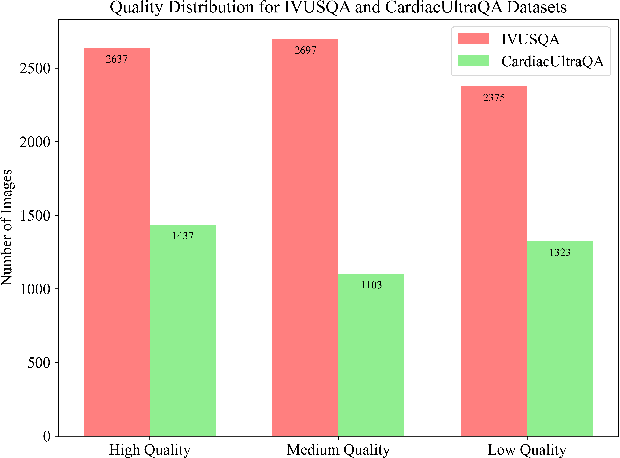
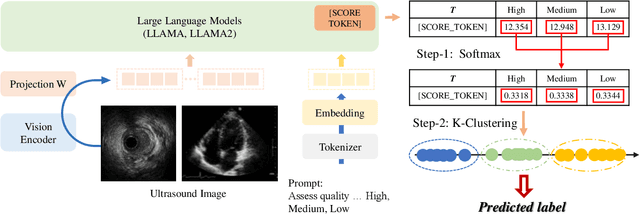
With the dramatic upsurge in the volume of ultrasound examinations, low-quality ultrasound imaging has gradually increased due to variations in operator proficiency and imaging circumstances, imposing a severe burden on diagnosis accuracy and even entailing the risk of restarting the diagnosis in critical cases. To assist clinicians in selecting high-quality ultrasound images and ensuring accurate diagnoses, we introduce Ultrasound-QBench, a comprehensive benchmark that systematically evaluates multimodal large language models (MLLMs) on quality assessment tasks of ultrasound images. Ultrasound-QBench establishes two datasets collected from diverse sources: IVUSQA, consisting of 7,709 images, and CardiacUltraQA, containing 3,863 images. These images encompassing common ultrasound imaging artifacts are annotated by professional ultrasound experts and classified into three quality levels: high, medium, and low. To better evaluate MLLMs, we decompose the quality assessment task into three dimensionalities: qualitative classification, quantitative scoring, and comparative assessment. The evaluation of 7 open-source MLLMs as well as 1 proprietary MLLMs demonstrates that MLLMs possess preliminary capabilities for low-level visual tasks in ultrasound image quality classification. We hope this benchmark will inspire the research community to delve deeper into uncovering and enhancing the untapped potential of MLLMs for medical imaging tasks.