 Add to Chrome
 Add to Firefox
 Add to Edge
Is Clinical Text Enough? A Multimodal Study on Mortality Prediction in Heart Failure Patients
Apr 02, 2026
Accurate short-term mortality prediction in heart failure (HF) remains challenging, particularly when relying on structured electronic health record (EHR) data alone. We evaluate transformer-based models on a French HF cohort, comparing text-only, structured-only, multimodal, and LLM-based approaches. Our results show that enriching clinical text with entity-level representations improves prediction over CLS embeddings alone, and that supervised multimodal fusion of text and structured variables achieves the best overall performance. In contrast, large language models perform inconsistently across modalities and decoding strategies, with text-only prompts outperforming structured or multimodal inputs. These findings highlight that entity-aware multimodal transformers offer the most reliable solution for short-term HF outcome prediction, while current LLM prompting remains limited for clinical decision support.

Who Judges the Judge? Evaluating LLM-as-a-Judge for French Medical open-ended QA
Mar 04, 2026Automatic evaluation of medical open-ended question answering (OEQA) remains challenging due to the need for expert annotations. We evaluate whether large language models (LLMs) can act as judges of semantic equivalence in French medical OEQA, comparing closed-access, general-purpose, and biomedical domain-adapted models. Our results show that LLM-based judgments are strongly influenced by the model that generated the answer, with agreement varying substantially across generators. Domain-adapted and large general-purpose models achieve the highest alignment with expert annotations. We further show that lightweight adaptation of a compact model using supervised fine-tuning (SFT) and Group Relative Policy Optimization (GRPO) substantially improves performance and reduces generator sensitivity, even with limited data. Overall, our findings highlight the need for generator-aware evaluation and suggest that carefully adapted small models can support scalable evaluation in low-resource medical settings.
Summarization for Generative Relation Extraction in the Microbiome Domain
Jun 10, 2025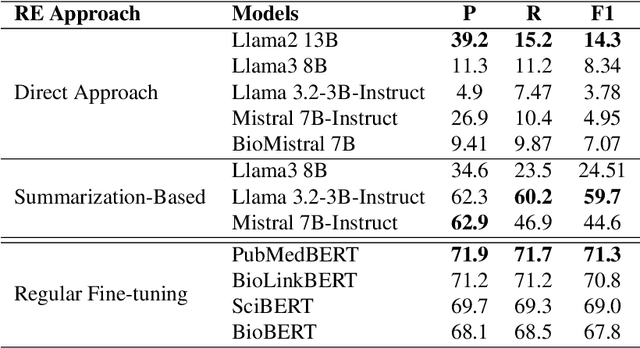
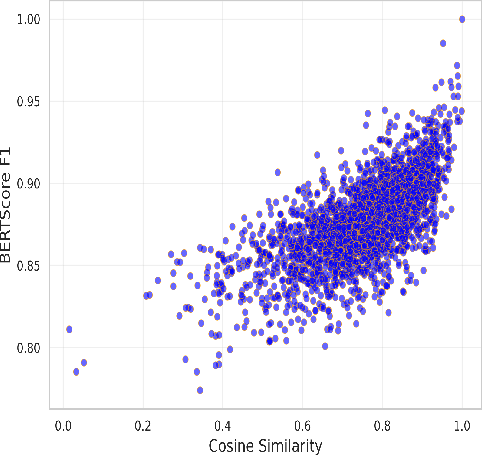

We explore a generative relation extraction (RE) pipeline tailored to the study of interactions in the intestinal microbiome, a complex and low-resource biomedical domain. Our method leverages summarization with large language models (LLMs) to refine context before extracting relations via instruction-tuned generation. Preliminary results on a dedicated corpus show that summarization improves generative RE performance by reducing noise and guiding the model. However, BERT-based RE approaches still outperform generative models. This ongoing work demonstrates the potential of generative methods to support the study of specialized domains in low-resources setting.
DrBenchmark: A Large Language Understanding Evaluation Benchmark for French Biomedical Domain
Feb 20, 2024
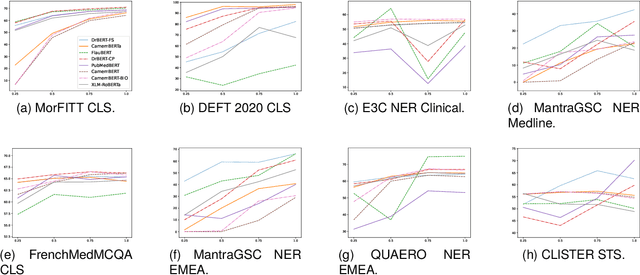

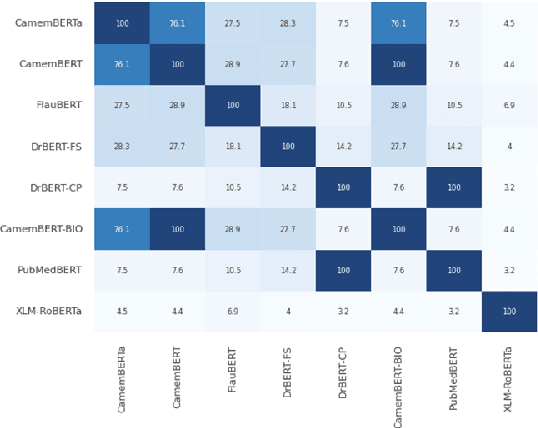
The biomedical domain has sparked a significant interest in the field of Natural Language Processing (NLP), which has seen substantial advancements with pre-trained language models (PLMs). However, comparing these models has proven challenging due to variations in evaluation protocols across different models. A fair solution is to aggregate diverse downstream tasks into a benchmark, allowing for the assessment of intrinsic PLMs qualities from various perspectives. Although still limited to few languages, this initiative has been undertaken in the biomedical field, notably English and Chinese. This limitation hampers the evaluation of the latest French biomedical models, as they are either assessed on a minimal number of tasks with non-standardized protocols or evaluated using general downstream tasks. To bridge this research gap and account for the unique sensitivities of French, we present the first-ever publicly available French biomedical language understanding benchmark called DrBenchmark. It encompasses 20 diversified tasks, including named-entity recognition, part-of-speech tagging, question-answering, semantic textual similarity, and classification. We evaluate 8 state-of-the-art pre-trained masked language models (MLMs) on general and biomedical-specific data, as well as English specific MLMs to assess their cross-lingual capabilities. Our experiments reveal that no single model excels across all tasks, while generalist models are sometimes still competitive.
Building a Corpus for Biomedical Relation Extraction of Species Mentions
Jun 14, 2023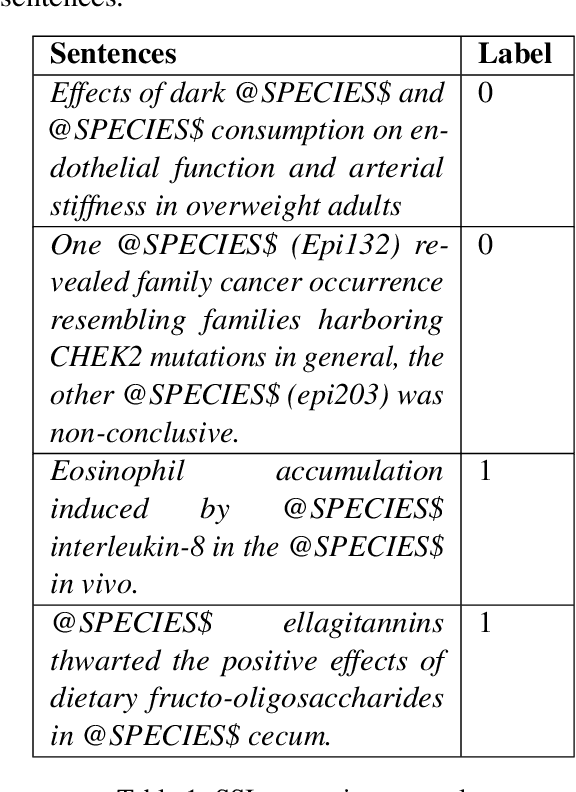
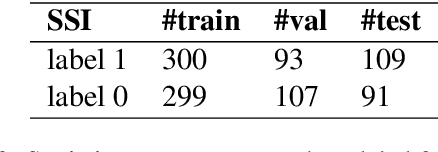
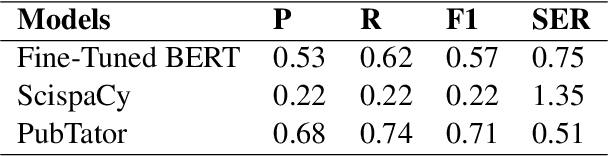
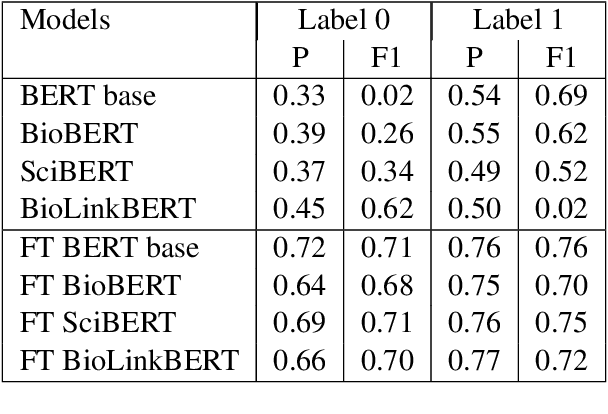
We present a manually annotated corpus, Species-Species Interaction, for extracting meaningful binary relations between species, in biomedical texts, at sentence level, with a focus on the gut microbiota. The corpus leverages PubTator to annotate species in full-text articles after evaluating different Named Entity Recognition species taggers. Our first results are promising for extracting relations between species using BERT and its biomedical variants.