 Add to Chrome
 Add to Firefox
 Add to Edge
To Reason or Not to: Selective Chain-of-Thought in Medical Question Answering
Feb 23, 2026
Objective: To improve the efficiency of medical question answering (MedQA) with large language models (LLMs) by avoiding unnecessary reasoning while maintaining accuracy. Methods: We propose Selective Chain-of-Thought (Selective CoT), an inference-time strategy that first predicts whether a question requires reasoning and generates a rationale only when needed. Two open-source LLMs (Llama-3.1-8B and Qwen-2.5-7B) were evaluated on four biomedical QA benchmarks-HeadQA, MedQA-USMLE, MedMCQA, and PubMedQA. Metrics included accuracy, total generated tokens, and inference time. Results: Selective CoT reduced inference time by 13-45% and token usage by 8-47% with minimal accuracy loss ($\leq$4\%). In some model-task pairs, it achieved both higher accuracy and greater efficiency than standard CoT. Compared with fixed-length CoT, Selective CoT reached similar or superior accuracy at substantially lower computational cost. Discussion: Selective CoT dynamically balances reasoning depth and efficiency by invoking explicit reasoning only when beneficial, reducing redundancy on recall-type questions while preserving interpretability. Conclusion: Selective CoT provides a simple, model-agnostic, and cost-effective approach for medical QA, aligning reasoning effort with question complexity to enhance real-world deployability of LLM-based clinical systems.

Efficient CNN-LSTM based Parameter Estimation of Levy Driven Stochastic Differential Equations
Mar 07, 2024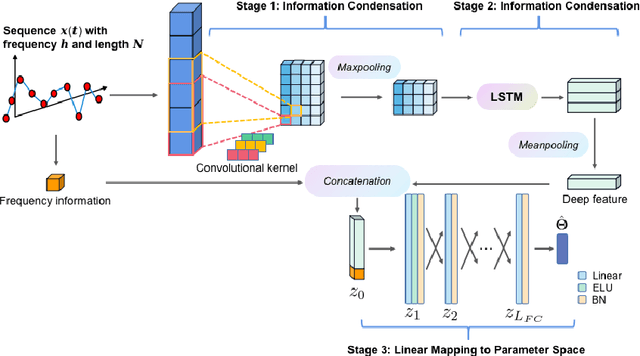
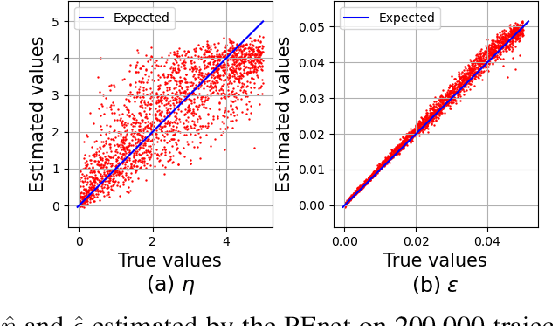
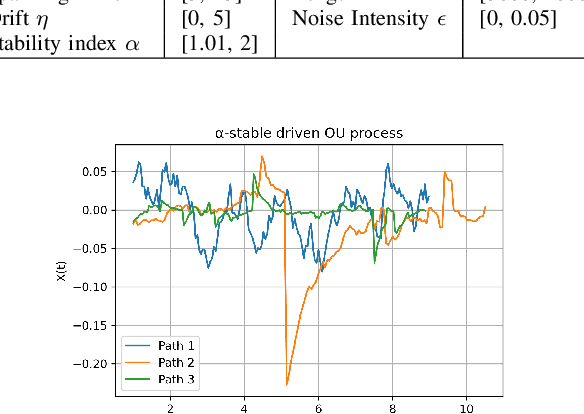
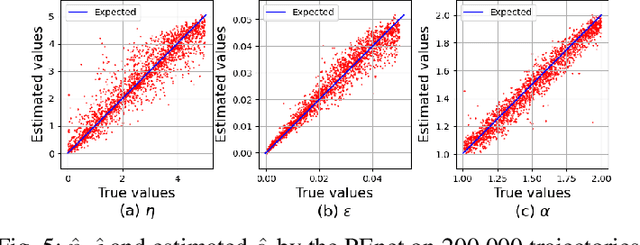
This study addresses the challenges in parameter estimation of stochastic differential equations driven by non-Gaussian noises, which are critical in understanding dynamic phenomena such as price fluctuations and the spread of infectious diseases. Previous research highlighted the potential of LSTM networks in estimating parameters of alpha stable Levy driven SDEs but faced limitations including high time complexity and constraints of the LSTM chaining property. To mitigate these issues, we introduce the PEnet, a novel CNN-LSTM-based three-stage model that offers an end to end approach with superior accuracy and adaptability to varying data structures, enhanced inference speed for long sequence observations through initial data feature condensation by CNN, and high generalization capability, allowing its application to various complex SDE scenarios. Experiments on synthetic datasets confirm PEnet significant advantage in estimating SDE parameters associated with noise characteristics, establishing it as a competitive method for SDE parameter estimation in the presence of Levy noise.