 Add to Chrome
 Add to Firefox
 Add to Edge
Towards Reliable Social A/B Testing: Spillover-Contained Clustering with Robust Post-Experiment Analysis
Feb 09, 2026
A/B testing is the foundation of decision-making in online platforms, yet social products often suffer from network interference: user interactions cause treatment effects to spill over into the control group. Such spillovers bias causal estimates and undermine experimental conclusions. Existing approaches face key limitations: user-level randomization ignores network structure, while cluster-based methods often rely on general-purpose clustering that is not tailored for spillover containment and has difficulty balancing unbiasedness and statistical power at scale. We propose a spillover-contained experimentation framework with two stages. In the pre-experiment stage, we build social interaction graphs and introduce a Balanced Louvain algorithm that produces stable, size-balanced clusters while minimizing cross-cluster edges, enabling reliable cluster-based randomization. In the post-experiment stage, we develop a tailored CUPAC estimator that leverages pre-experiment behavioral covariates to reduce the variance induced by cluster-level assignment, thereby improving statistical power. Together, these components provide both structural spillover containment and robust statistical inference. We validate our approach through large-scale social sharing experiments on Kuaishou, a platform serving hundreds of millions of users. Results show that our method substantially reduces spillover and yields more accurate assessments of social strategies than traditional user-level designs, establishing a reliable and scalable framework for networked A/B testing.

Rethinking Efficiency and Redundancy in Training Large-scale Graphs
Sep 02, 2022
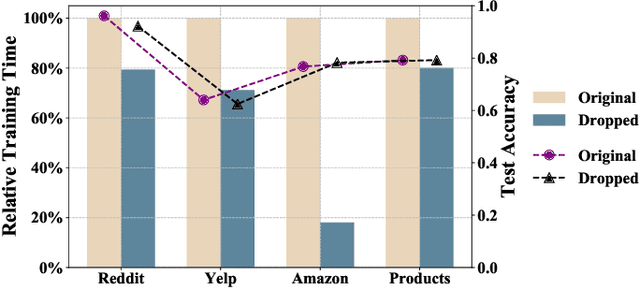
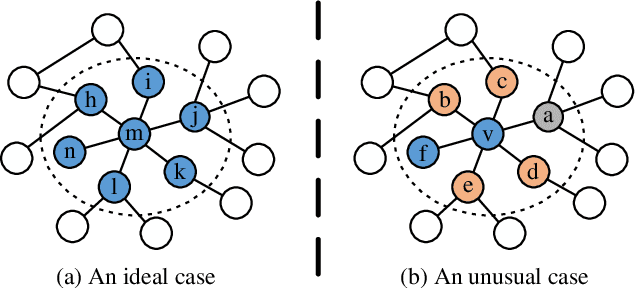
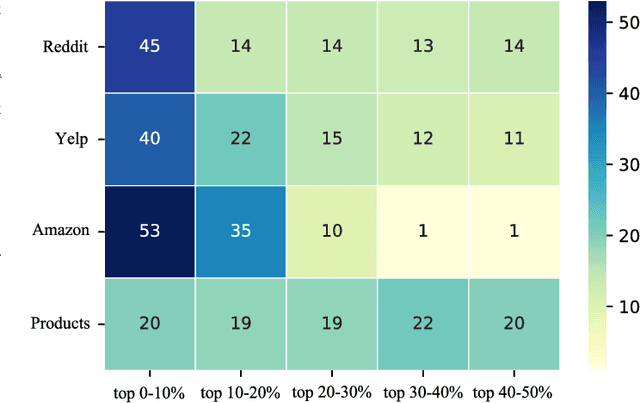
Large-scale graphs are ubiquitous in real-world scenarios and can be trained by Graph Neural Networks (GNNs) to generate representation for downstream tasks. Given the abundant information and complex topology of a large-scale graph, we argue that redundancy exists in such graphs and will degrade the training efficiency. Unfortunately, the model scalability severely restricts the efficiency of training large-scale graphs via vanilla GNNs. Despite recent advances in sampling-based training methods, sampling-based GNNs generally overlook the redundancy issue. It still takes intolerable time to train these models on large-scale graphs. Thereby, we propose to drop redundancy and improve efficiency of training large-scale graphs with GNNs, by rethinking the inherent characteristics in a graph. In this paper, we pioneer to propose a once-for-all method, termed DropReef, to drop the redundancy in large-scale graphs. Specifically, we first conduct preliminary experiments to explore potential redundancy in large-scale graphs. Next, we present a metric to quantify the neighbor heterophily of all nodes in a graph. Based on both experimental and theoretical analysis, we reveal the redundancy in a large-scale graph, i.e., nodes with high neighbor heterophily and a great number of neighbors. Then, we propose DropReef to detect and drop the redundancy in large-scale graphs once and for all, helping reduce the training time while ensuring no sacrifice in the model accuracy. To demonstrate the effectiveness of DropReef, we apply it to recent state-of-the-art sampling-based GNNs for training large-scale graphs, owing to the high precision of such models. With DropReef leveraged, the training efficiency of models can be greatly promoted. DropReef is highly compatible and is offline performed, benefiting the state-of-the-art sampling-based GNNs in the present and future to a significant extent.