 Add to Chrome
 Add to Firefox
 Add to Edge
Towards Reliable Social A/B Testing: Spillover-Contained Clustering with Robust Post-Experiment Analysis
Feb 09, 2026
A/B testing is the foundation of decision-making in online platforms, yet social products often suffer from network interference: user interactions cause treatment effects to spill over into the control group. Such spillovers bias causal estimates and undermine experimental conclusions. Existing approaches face key limitations: user-level randomization ignores network structure, while cluster-based methods often rely on general-purpose clustering that is not tailored for spillover containment and has difficulty balancing unbiasedness and statistical power at scale. We propose a spillover-contained experimentation framework with two stages. In the pre-experiment stage, we build social interaction graphs and introduce a Balanced Louvain algorithm that produces stable, size-balanced clusters while minimizing cross-cluster edges, enabling reliable cluster-based randomization. In the post-experiment stage, we develop a tailored CUPAC estimator that leverages pre-experiment behavioral covariates to reduce the variance induced by cluster-level assignment, thereby improving statistical power. Together, these components provide both structural spillover containment and robust statistical inference. We validate our approach through large-scale social sharing experiments on Kuaishou, a platform serving hundreds of millions of users. Results show that our method substantially reduces spillover and yields more accurate assessments of social strategies than traditional user-level designs, establishing a reliable and scalable framework for networked A/B testing.

Temporal-wise Attention Spiking Neural Networks for Event Streams Classification
Jul 25, 2021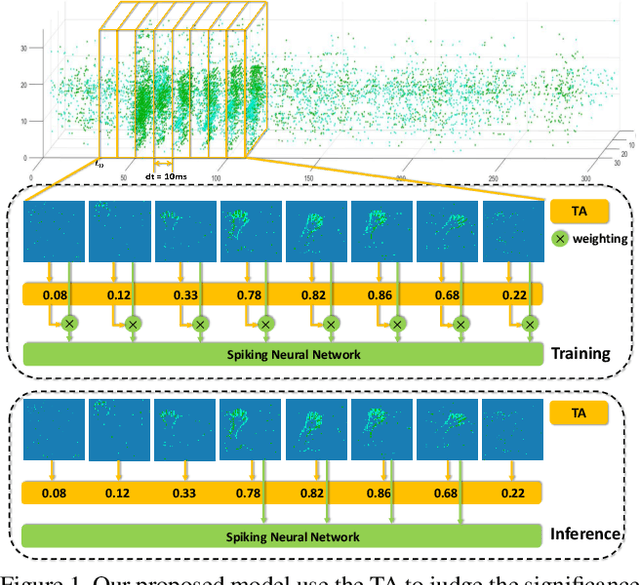
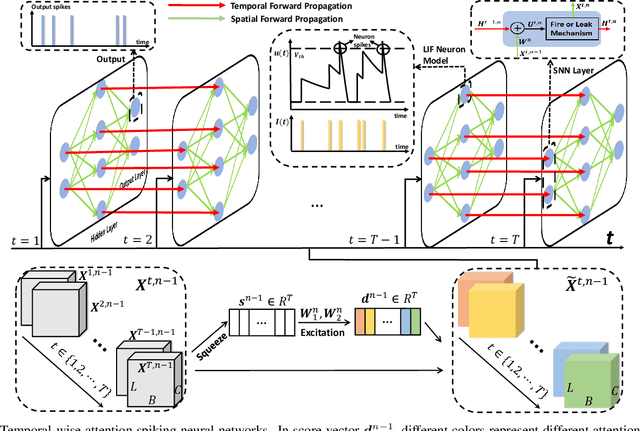
How to effectively and efficiently deal with spatio-temporal event streams, where the events are generally sparse and non-uniform and have the microsecond temporal resolution, is of great value and has various real-life applications. Spiking neural network (SNN), as one of the brain-inspired event-triggered computing models, has the potential to extract effective spatio-temporal features from the event streams. However, when aggregating individual events into frames with a new higher temporal resolution, existing SNN models do not attach importance to that the serial frames have different signal-to-noise ratios since event streams are sparse and non-uniform. This situation interferes with the performance of existing SNNs. In this work, we propose a temporal-wise attention SNN (TA-SNN) model to learn frame-based representation for processing event streams. Concretely, we extend the attention concept to temporal-wise input to judge the significance of frames for the final decision at the training stage, and discard the irrelevant frames at the inference stage. We demonstrate that TA-SNN models improve the accuracy of event streams classification tasks. We also study the impact of multiple-scale temporal resolutions for frame-based representation. Our approach is tested on three different classification tasks: gesture recognition, image classification, and spoken digit recognition. We report the state-of-the-art results on these tasks, and get the essential improvement of accuracy (almost 19\%) for gesture recognition with only 60 ms.