 Add to Chrome
 Add to Firefox
 Add to Edge
VidForensics-M1: Meta-Detection Reinforcement Learning with Verifiable Temporal Grounding for AI-Generated Video Forensics
Aug 11, 2026
Recent advances in video generation models have significantly improved the realism of synthetic videos, blurring the boundary between generated and authentic content and raising concerns about misinformation. Existing MLLM-based detectors mainly rely on supervised fine-tuning or label-level reinforcement learning, where coarse supervision limits generalization to unseen scenarios and emerging video generators. To overcome these limitations, we are the first to introduce \textbf{meta-detection} into AI-generated video detection, enabling reliable forgery detection by jointly optimizing predicted labels and supporting evidence within reinforcement learning. This paradigm requires reliable evidence signals and effective mechanisms to integrate them into label-level optimization. Textual rationales provide semantic descriptions of forgery artifacts, but their generation and verification depend on external models, making supervision vulnerable to hallucinations and semantic biases. In contrast, temporal grounding provides more objective and verifiable evidence, as manipulated intervals can be precisely controlled during forgery construction. Based on this insight, we propose an automated data construction pipeline that generates paired real-fake videos by replacing temporal segments with boundary-frame-conditioned video generation models. Furthermore, we introduce \textbf{Evidence-Guided Reward Redistribution}, which performs evidence-aware credit assignment by redistributing rewards among label-correct responses according to evidence quality. This preserves reliable label supervision while encouraging detectors to acquire fine-grained and verifiable forgery localization capabilities. Extensive experiments demonstrate that \textbf{VidForensics-M1} effectively leverages verifiable temporal evidence to achieve robust and generalizable AI-generated video detection.

Uncovering What, Why and How: A Comprehensive Benchmark for Causation Understanding of Video Anomaly
Apr 30, 2024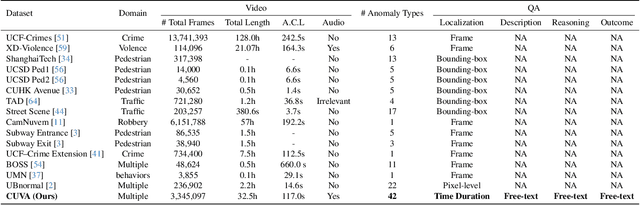
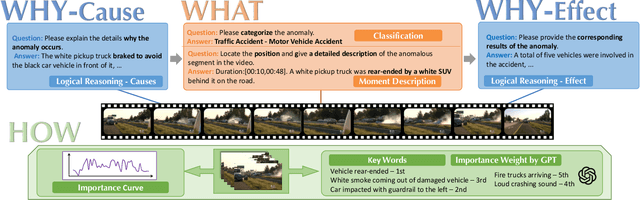
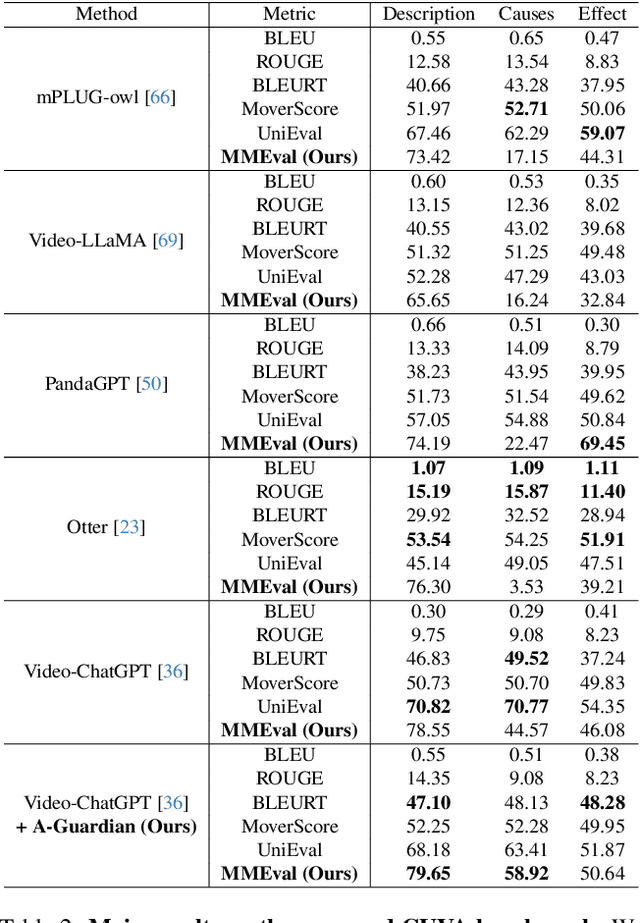

Video anomaly understanding (VAU) aims to automatically comprehend unusual occurrences in videos, thereby enabling various applications such as traffic surveillance and industrial manufacturing. While existing VAU benchmarks primarily concentrate on anomaly detection and localization, our focus is on more practicality, prompting us to raise the following crucial questions: "what anomaly occurred?", "why did it happen?", and "how severe is this abnormal event?". In pursuit of these answers, we present a comprehensive benchmark for Causation Understanding of Video Anomaly (CUVA). Specifically, each instance of the proposed benchmark involves three sets of human annotations to indicate the "what", "why" and "how" of an anomaly, including 1) anomaly type, start and end times, and event descriptions, 2) natural language explanations for the cause of an anomaly, and 3) free text reflecting the effect of the abnormality. In addition, we also introduce MMEval, a novel evaluation metric designed to better align with human preferences for CUVA, facilitating the measurement of existing LLMs in comprehending the underlying cause and corresponding effect of video anomalies. Finally, we propose a novel prompt-based method that can serve as a baseline approach for the challenging CUVA. We conduct extensive experiments to show the superiority of our evaluation metric and the prompt-based approach. Our code and dataset are available at https://github.com/fesvhtr/CUVA.