 Add to Chrome
 Add to Firefox
 Add to Edge
OptiLeak: Efficient Prompt Reconstruction via Reinforcement Learning in Multi-tenant LLM Services
Feb 24, 2026
Multi-tenant LLM serving frameworks widely adopt shared Key-Value caches to enhance efficiency. However, this creates side-channel vulnerabilities enabling prompt leakage attacks. Prior studies identified these attack surfaces yet focused on expanding attack vectors rather than optimizing attack performance, reporting impractically high attack costs that underestimate the true privacy risk. We propose OptiLeak, a reinforcement learning-enhanced framework that maximizes prompt reconstruction efficiency through two-stage fine-tuning. Our key insight is that domain-specific ``hard tokens'' -- terms difficult to predict yet carrying sensitive information -- can be automatically identified via likelihood ranking and used to construct preference pairs for Direct Preference Optimization, eliminating manual annotation. This enables effective preference alignment while avoiding the overfitting issues of extended supervised fine-tuning. Evaluated on three benchmarks spanning medical and financial domains, OptiLeak achieves up to $12.48\times$ reduction in average requests per token compared to baseline approaches, with consistent improvements across model scales from 3B to 14B parameters. Our findings demonstrate that cache-based prompt leakage poses a more severe threat than previously reported, underscoring the need for robust cache isolation in production deployments.

Supervised Feature Selection with Neuron Evolution in Sparse Neural Networks
Mar 14, 2023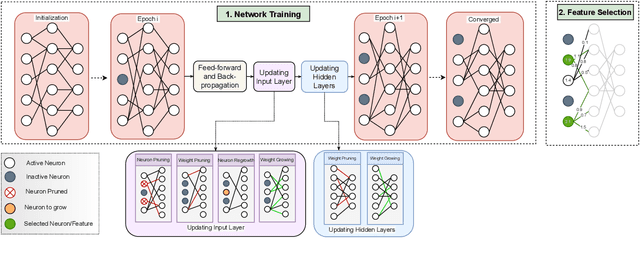
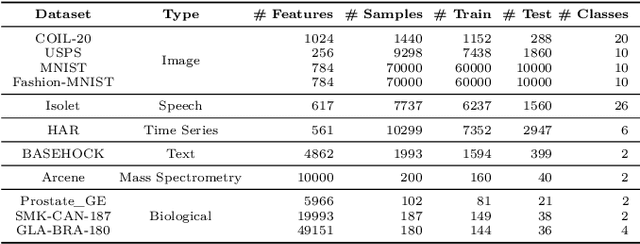
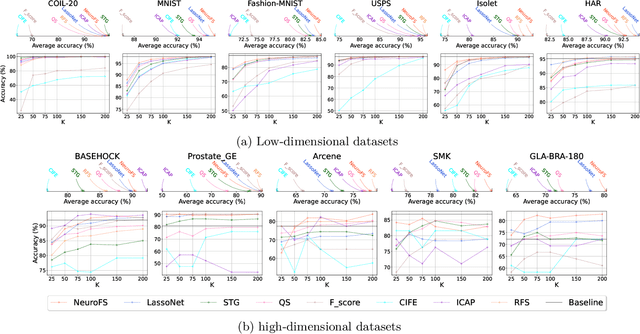

Feature selection that selects an informative subset of variables from data not only enhances the model interpretability and performance but also alleviates the resource demands. Recently, there has been growing attention on feature selection using neural networks. However, existing methods usually suffer from high computational costs when applied to high-dimensional datasets. In this paper, inspired by evolution processes, we propose a novel resource-efficient supervised feature selection method using sparse neural networks, named \enquote{NeuroFS}. By gradually pruning the uninformative features from the input layer of a sparse neural network trained from scratch, NeuroFS derives an informative subset of features efficiently. By performing several experiments on $11$ low and high-dimensional real-world benchmarks of different types, we demonstrate that NeuroFS achieves the highest ranking-based score among the considered state-of-the-art supervised feature selection models. The code is available on GitHub.