 Add to Chrome
 Add to Firefox
 Add to Edge
From World Action Models to Embodied Brains: A Roadmap for Open-World Physical Intelligence
Jul 13, 2026
Artificial general intelligence ultimately requires agents that can reason and act in the physical world. Action models, vision-language-action policies, and world models have advanced this goal, while World Action Models (WAMs) are particularly promising because they connect candidate interventions with predicted consequences. However, progress remains fragmented: models use incompatible action spaces and prediction targets, datasets and tasks follow different conventions, and runtime systems expose limited interfaces for reuse and evaluation. We review the evolution toward WAMs and organize these limitations into three coupled gaps: model roles and representations, objectives and standardization, and system composition. Building on this analysis, we propose a co-evolution roadmap for physical intelligence centered on the \emph{embodied brain}, a long-term model target for integrating multimodal context, comparing candidate interventions, and issuing state-transition or capability requests rather than direct actuator commands. WAMs provide promising prototypes for its predictive functions, while a physical harness grounds model outputs through tools, controllers, verification, and trace logging. Shared contracts align heterogeneous models, data, tasks, and embodiments, and closed-loop post-training converts verified interaction into reusable experience. Together, these components define a modular physical-intelligence stack for adaptive and self-improving embodied agents.

Skill-Evolving Grounded Reasoning for Free-Text Promptable 3D Medical Image Segmentation
Mar 09, 2026Free-text promptable 3D medical image segmentation offers an intuitive and clinically flexible interaction paradigm. However, current methods are highly sensitive to linguistic variability: minor changes in phrasing can cause substantial performance degradation despite identical clinical intent. Existing approaches attempt to improve robustness through stronger vision-language fusion or larger vocabularies, yet they lack mechanisms to consistently align ambiguous free-form expressions with anatomically grounded representations. We propose Skill-Evolving grounded Reasoning (SEER), a novel framework for free-text promptable 3D medical image segmentation that explicitly bridges linguistic variability and anatomical precision through a reasoning-driven design. First, we curate the SEER-Trace dataset, which pairs raw clinical requests with image-grounded, skill-tagged reasoning traces, establishing a reproducible benchmark. Second, SEER constructs an evidence-aligned target representation via a vision-language reasoning chain that verifies clinical intent against image-derived anatomical evidence, thereby enforcing semantic consistency before voxel-level decoding. Third, we introduce SEER-Loop, a dynamic skill-evolving strategy that distills high-reward reasoning trajectories into reusable skill artifacts and progressively integrates them into subsequent inference, enabling structured self-refinement and improved robustness to diverse linguistic expressions. Extensive experiments demonstrate superior performance of SEER over state-of-the-art baselines. Under linguistic perturbations, SEER reduces performance variance by 81.94% and improves worst-case Dice by 18.60%.
Technical Report of TeleChat2, TeleChat2.5 and T1
Jul 24, 2025
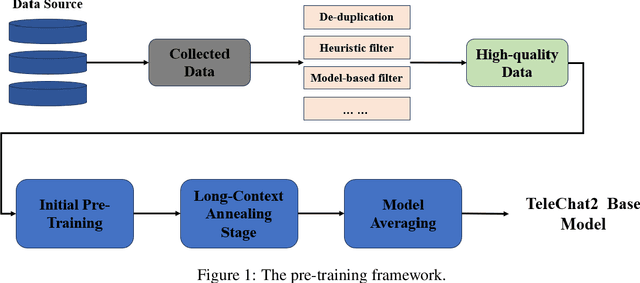
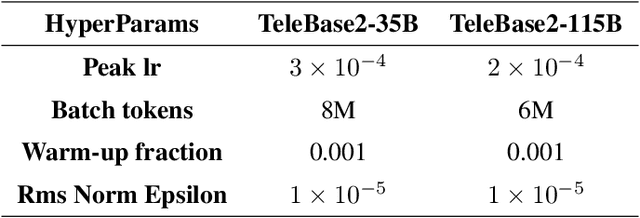
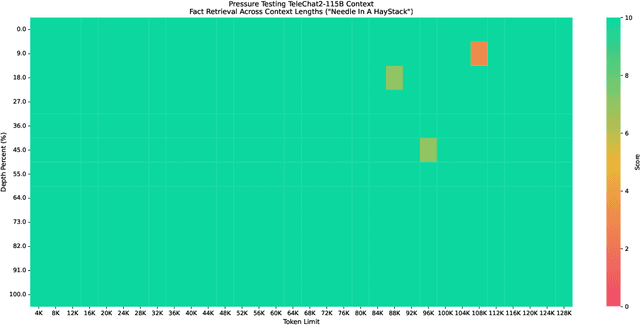
We introduce the latest series of TeleChat models: \textbf{TeleChat2}, \textbf{TeleChat2.5}, and \textbf{T1}, offering a significant upgrade over their predecessor, TeleChat. Despite minimal changes to the model architecture, the new series achieves substantial performance gains through enhanced training strategies in both pre-training and post-training stages. The series begins with \textbf{TeleChat2}, which undergoes pretraining on 10 trillion high-quality and diverse tokens. This is followed by Supervised Fine-Tuning (SFT) and Direct Preference Optimization (DPO) to further enhance its capabilities. \textbf{TeleChat2.5} and \textbf{T1} expand the pipeline by incorporating a continual pretraining phase with domain-specific datasets, combined with reinforcement learning (RL) to improve performance in code generation and mathematical reasoning tasks. The \textbf{T1} variant is designed for complex reasoning, supporting long Chain-of-Thought (CoT) reasoning and demonstrating substantial improvements in mathematics and coding. In contrast, \textbf{TeleChat2.5} prioritizes speed, delivering rapid inference. Both flagship models of \textbf{T1} and \textbf{TeleChat2.5} are dense Transformer-based architectures with 115B parameters, showcasing significant advancements in reasoning and general task performance compared to the original TeleChat. Notably, \textbf{T1-115B} outperform proprietary models such as OpenAI's o1-mini and GPT-4o. We publicly release \textbf{TeleChat2}, \textbf{TeleChat2.5} and \textbf{T1}, including post-trained versions with 35B and 115B parameters, to empower developers and researchers with state-of-the-art language models tailored for diverse applications.