 Add to Chrome
 Add to Firefox
 Add to Edge
Simple-OPD: Demystifying Warm-up for On-policy Distillation
Aug 07, 2026
On-policy distillation (OPD) trains a student on its own rollouts with token-level supervision from teacher models, but its effectiveness can depend strongly on the warm-up stage before OPD. In this paper, we demystify warm-up for OPD from both data and training perspectives. For data, we find that effective warm-up relies on teacher-compatible chain-of-thought supervision, and that even incorrect teacher rollouts can provide comparable benefits to correct ones. This suggests that warm-up primarily transfers a teacher-compatible thinking pattern rather than merely correct answers. For training, we show that low-rank adaptation (LoRA) with a near-saturation training duration better balances in-domain adaptation and out-of-distribution generalization than full-parameter SFT. Based on these findings, we propose Simple-OPD, a plug-and-play initialization method that warms up the student on teacher-generated CoT with LoRA before OPD. Experiments across diverse settings demonstrate the effectiveness and robustness of Simple-OPD.

Internalize the Temperature: On-Policy Self-Distillation as Policy Reheater for Reinforcement Learning
May 30, 2026Reinforcement learning from verifiable rewards improves the reasoning ability of large language models, but often suffers from entropy collapse, in which increasingly concentrated policies reduce rollout diversity and useful learning signals. Existing remedies either constrain the RL objective (e.g., entropy regularization) or adjust sampling temperature during rollout collection, but these interventions remain external to the model parameters. We propose Temperature-Scaled On-Policy Self-Distillation (TS-OPSD), a lightweight policy reheating method that internalizes the exploratory effect of temperature into model parameters. Starting from an entropy-collapsed RL checkpoint, TS-OPSD constructs a self-teacher by applying high-temperature scaling to the model's own logits, then distills the resulting smoother distribution back into the student. This policy reheating requires no external teacher, privileged data, or additional inference cost. Experiments on Qwen3-4B-Base and Qwen3-8B-Base show that policy reheating yields a stronger initialization for continued RL than both standard continued RL and rollout-level temperature reheating. Further analyses show that TS-OPSD mainly reduces output sharpness while preserving intermediate representations, top candidate sets, and reasoning capability. These results suggest that entropy restoration can serve as a simple post-collapse intervention for extending reasoning-oriented RL.
S2J: Bridging the Gap Between Solving and Judging Ability in Generative Reward Models
Sep 26, 2025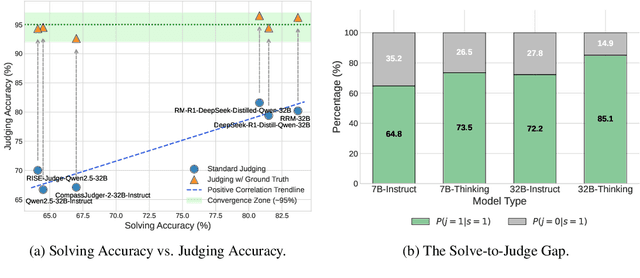
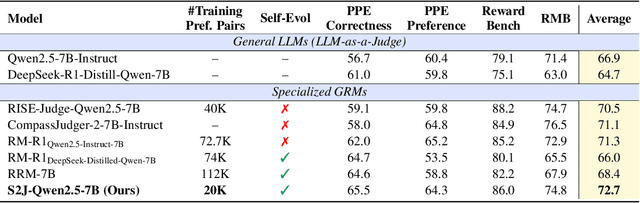
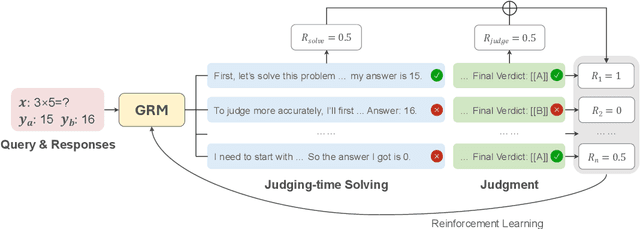
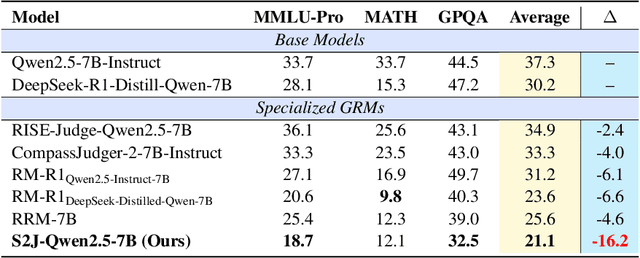
With the rapid development of large language models (LLMs), generative reward models (GRMs) have been widely adopted for reward modeling and evaluation. Previous studies have primarily focused on training specialized GRMs by optimizing them on preference datasets with the judgment correctness as supervision. While it's widely accepted that GRMs with stronger problem-solving capabilities typically exhibit superior judgment abilities, we first identify a significant solve-to-judge gap when examining individual queries. Specifically, the solve-to-judge gap refers to the phenomenon where GRMs struggle to make correct judgments on some queries (14%-37%), despite being fully capable of solving them. In this paper, we propose the Solve-to-Judge (S2J) approach to address this problem. Specifically, S2J simultaneously leverages both the solving and judging capabilities on a single GRM's output for supervision, explicitly linking the GRM's problem-solving and evaluation abilities during model optimization, thereby narrowing the gap. Our comprehensive experiments demonstrate that S2J effectively reduces the solve-to-judge gap by 16.2%, thereby enhancing the model's judgment performance by 5.8%. Notably, S2J achieves state-of-the-art (SOTA) performance among GRMs built on the same base model while utilizing a significantly smaller training dataset. Moreover, S2J accomplishes this through self-evolution without relying on more powerful external models for distillation.