 Add to Chrome
 Add to Firefox
 Add to Edge
LEO Constellations as a Decentralized GNSS Network: Optimizing PNT Corrections in Space
Dec 24, 2025
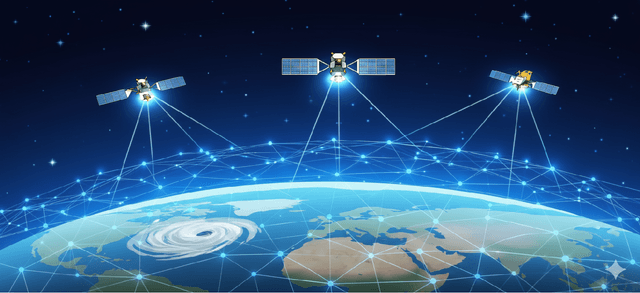
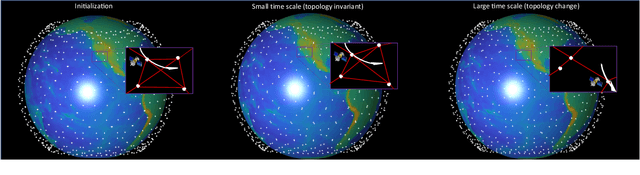
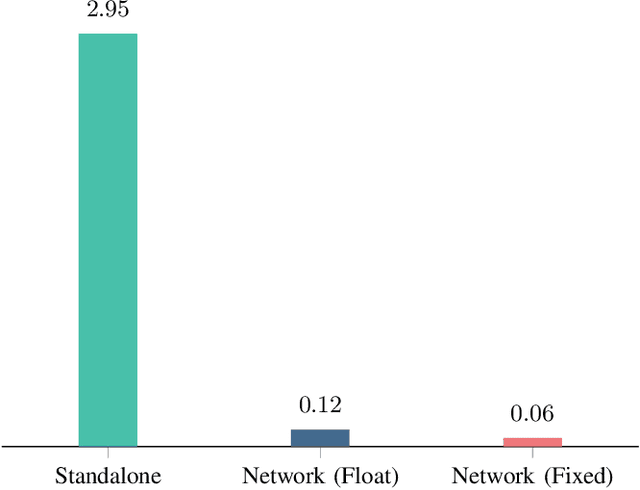
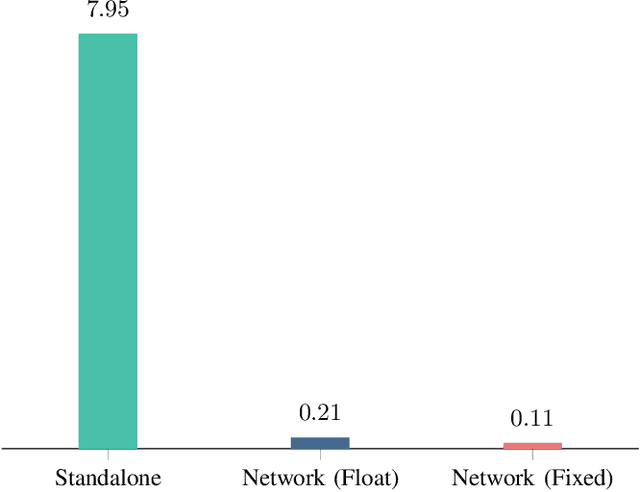
With the rapid expansion of low Earth orbit (LEO) constellations, thousands of satellites are now in operation, many equipped with onboard GNSS receivers capable of continuous orbit determination and time synchronization. This development is creating an unprecedented spaceborne GNSS network, offering new opportunities for network-driven precise LEO orbit and clock estimation. Yet, current onboard GNSS processing is largely standalone and often insufficient for high-precision applications, while centralized fusion is challenging due to computational bottlenecks and the lack of in-orbit infrastructure. In this work, we report a decentralized GNSS network over large-scale LEO constellations, where each satellite processes its own measurements while exchanging compact information with neighboring nodes to enable precise orbit and time determination. We model the moving constellation as a dynamic graph and tailor a momentum-accelerated gradient tracking (GT) method to ensure steady convergence despite topology changes. Numerical simulations with constellations containing hundreds of satellites show that the proposed method matches the accuracy of an ideal centralized benchmark, while substantially reducing communication burdens. Ultimately, this framework supports the development of autonomous and self-organizing space systems, enabling high-precision navigation with reduced dependence on continuous ground contact.

Decentralized GNSS at Global Scale via Graph-Aware Diffusion Adaptation
Dec 23, 2025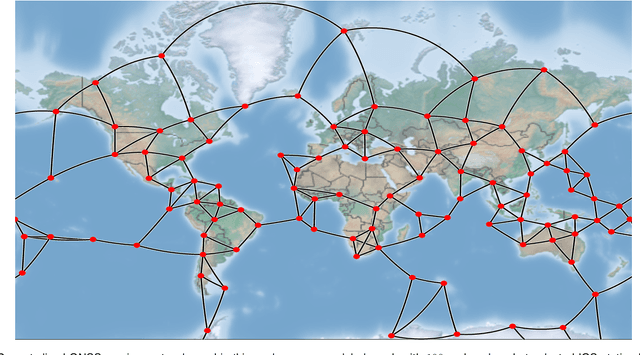
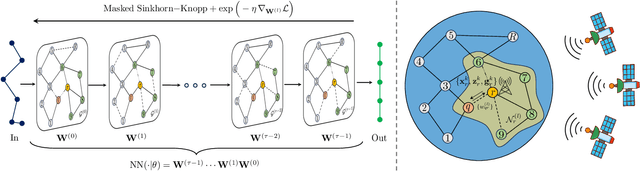
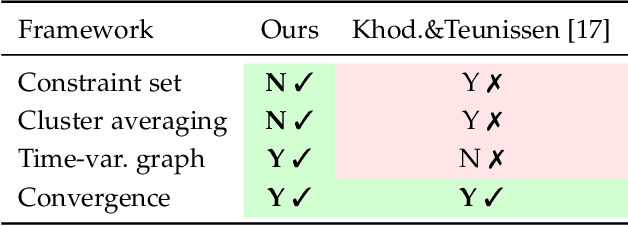
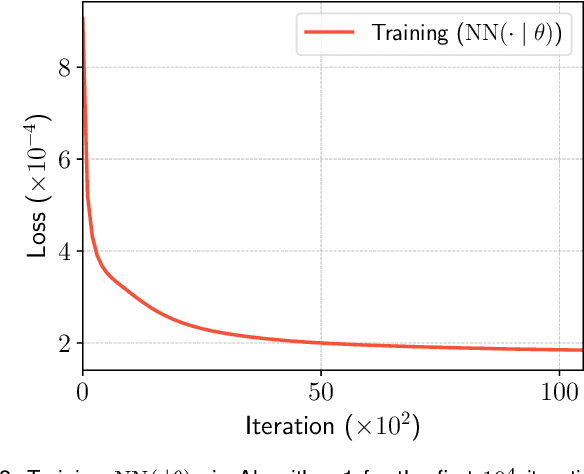
Network-based Global Navigation Satellite Systems (GNSS) underpin critical infrastructure and autonomous systems, yet typically rely on centralized processing hubs that limit scalability, resilience, and latency. Here we report a global-scale, decentralized GNSS architecture spanning hundreds of ground stations. By modeling the receiver network as a time-varying graph, we employ a deep linear neural network approach to learn topology-aware mixing schedules that optimize information exchange. This enables a gradient tracking diffusion strategy wherein stations execute local inference and exchange succinct messages to achieve two concurrent objectives: centimeter-level self-localization and network-wide consensus on satellite correction products. The consensus products are broadcast to user receivers as corrections, supporting precise point positioning (PPP) and precise point positioning-real-time kinematic (PPP-RTK). Numerical results demonstrate that our method matches the accuracy of centralized baselines while significantly outperforming existing decentralized methods in convergence speed and communication overhead. By reframing decentralized GNSS as a networked signal processing problem, our results pave the way for integrating decentralized optimization, consensus-based inference, and graph-aware learning as effective tools in operational satellite navigation.
Decentralized Cooperative Beamforming for Networked LEO Satellites with Statistical CSI
Dec 21, 2025Inter-satellite-link-enabled low-Earth-orbit (LEO) satellite constellations are evolving toward networked architectures that support constellation-level cooperation, enabling multiple satellites to jointly serve user terminals through cooperative beamforming. While such cooperation can substantially enhance link budgets and achievable rates, its practical realization is challenged by the scalability limitations of centralized beamforming designs and the stringent computational and signaling constraints of large LEO constellations. This paper develops a fully decentralized cooperative beamforming framework for networked LEO satellite downlinks. Using an ergodic-rate-based formulation, we first derive a centralized weighted minimum mean squared error (WMMSE) solution as a performance benchmark. Building on this formulation, we propose a topology-agnostic decentralized beamforming algorithm by localizing the benchmark and exchanging a set of globally coupled variables whose dimensions are independent of the antenna number and enforcing consensus over arbitrary connected inter-satellite networks. The resulting algorithm admits fully parallel execution across satellites. To further enhance scalability, we eliminate the consensus-related auxiliary variables in closed form and derive a low-complexity per-satellite update rule that is optimal to local iteration and admits a quasi-closed-form solution via scalar line search. Simulation results show that the proposed decentralized schemes closely approach centralized performance under practical inter-satellite topologies, while significantly reducing computational complexity and signaling overhead, enabling scalable cooperative beamforming for large LEO constellations.
Content-Aware Radiance Fields: Aligning Model Complexity with Scene Intricacy Through Learned Bitwidth Quantization
Oct 25, 2024The recent popular radiance field models, exemplified by Neural Radiance Fields (NeRF), Instant-NGP and 3D Gaussian Splat?ting, are designed to represent 3D content by that training models for each individual scene. This unique characteristic of scene representation and per-scene training distinguishes radiance field models from other neural models, because complex scenes necessitate models with higher representational capacity and vice versa. In this paper, we propose content?aware radiance fields, aligning the model complexity with the scene intricacies through Adversarial Content-Aware Quantization (A-CAQ). Specifically, we make the bitwidth of parameters differentiable and train?able, tailored to the unique characteristics of specific scenes and requirements. The proposed framework has been assessed on Instant-NGP, a well-known NeRF variant and evaluated using various datasets. Experimental results demonstrate a notable reduction in computational complexity, while preserving the requisite reconstruction and rendering quality, making it beneficial for practical deployment of radiance fields models. Codes are available at https://github.com/WeihangLiu2024/Content_Aware_NeRF.