 Add to Chrome
 Add to Firefox
 Add to Edge
Recognize Your Orchestrator: An Entropy Dynamics Perspective for LLM Multi-Agent Systems
May 31, 2026
The transition from single-turn models to Multi-Agent Systems (MAS) promises enhanced problem-solving capabilities, yet the centralized orchestration topology remains a critical point of fragility. To analyze this, we propose a Mean-Field Entropy Dynamics framework, modeling the orchestration process as a system governed by the competing forces of task resolution and cumulative context loading. To facilitate validation, we introduce Inverse Workflow Generation (IWG), a multi-agent pipeline that synthesizes process-verifiable, high-complexity benchmarks with dense intermediate checkpoints. We demonstrate that our entropy dynamics model fits empirical trajectories, providing physically interpretable parameters that quantify system stability and performance collapse. Crucially, our analysis uncovers a ``Reasoning Trap": while reasoning-heavy models excel in isolated tasks, they frequently fail as orchestrators due to context squeezing. Elucidating the physical mechanisms underlying the Orchestrator and quantifying systemic uncertainty offers insights for the MASs' architectural design.

WebNavigator: Global Web Navigation via Interaction Graph Retrieval
Mar 20, 2026Despite significant advances in autonomous web navigation, current methods remain far from human-level performance in complex web environments. We argue that this limitation stems from Topological Blindness, where agents are forced to explore via trial-and-error without access to the global topological structure of the environment. To overcome this limitation, we introduce WebNavigator, which reframes web navigation from probabilistic exploration into deterministic retrieval and pathfinding. WebNavigator constructs Interaction Graphs via zero-token cost heuristic exploration offline and implements a Retrieve-Reason-Teleport workflow for global navigation online. WebNavigator achieves state-of-the-art performance on WebArena and OnlineMind2Web. On WebArena multi-site tasks, WebNavigator achieves a 72.9\% success rate, more than doubling the performance of enterprise-level agents. This work reveals that Topological Blindness, rather than model reasoning capabilities alone, is an underestimated bottleneck in autonomous web navigation.
RAGLAB: A Modular and Research-Oriented Unified Framework for Retrieval-Augmented Generation
Aug 21, 2024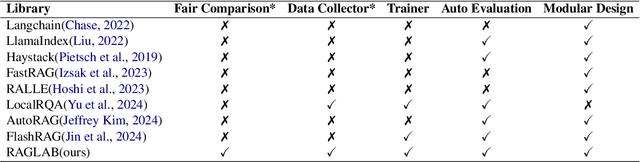
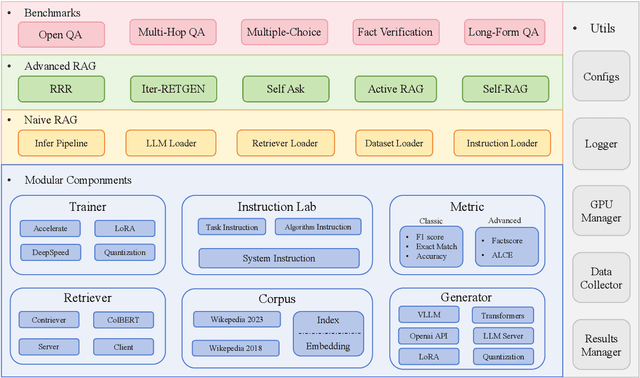
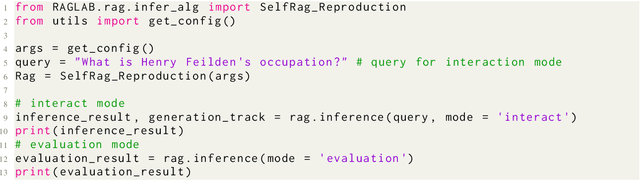

Large Language Models (LLMs) demonstrate human-level capabilities in dialogue, reasoning, and knowledge retention. However, even the most advanced LLMs face challenges such as hallucinations and real-time updating of their knowledge. Current research addresses this bottleneck by equipping LLMs with external knowledge, a technique known as Retrieval Augmented Generation (RAG). However, two key issues constrained the development of RAG. First, there is a growing lack of comprehensive and fair comparisons between novel RAG algorithms. Second, open-source tools such as LlamaIndex and LangChain employ high-level abstractions, which results in a lack of transparency and limits the ability to develop novel algorithms and evaluation metrics. To close this gap, we introduce RAGLAB, a modular and research-oriented open-source library. RAGLAB reproduces 6 existing algorithms and provides a comprehensive ecosystem for investigating RAG algorithms. Leveraging RAGLAB, we conduct a fair comparison of 6 RAG algorithms across 10 benchmarks. With RAGLAB, researchers can efficiently compare the performance of various algorithms and develop novel algorithms.