 Add to Chrome
 Add to Firefox
 Add to Edge
WebNavigator: Global Web Navigation via Interaction Graph Retrieval
Mar 20, 2026
Despite significant advances in autonomous web navigation, current methods remain far from human-level performance in complex web environments. We argue that this limitation stems from Topological Blindness, where agents are forced to explore via trial-and-error without access to the global topological structure of the environment. To overcome this limitation, we introduce WebNavigator, which reframes web navigation from probabilistic exploration into deterministic retrieval and pathfinding. WebNavigator constructs Interaction Graphs via zero-token cost heuristic exploration offline and implements a Retrieve-Reason-Teleport workflow for global navigation online. WebNavigator achieves state-of-the-art performance on WebArena and OnlineMind2Web. On WebArena multi-site tasks, WebNavigator achieves a 72.9\% success rate, more than doubling the performance of enterprise-level agents. This work reveals that Topological Blindness, rather than model reasoning capabilities alone, is an underestimated bottleneck in autonomous web navigation.

GePBench: Evaluating Fundamental Geometric Perception for Multimodal Large Language Models
Dec 30, 2024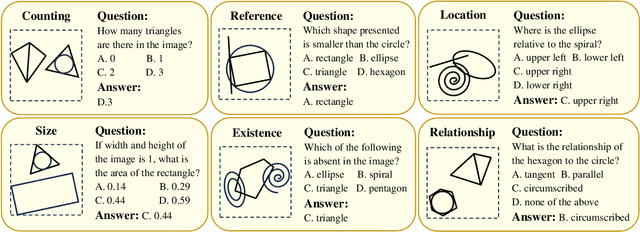
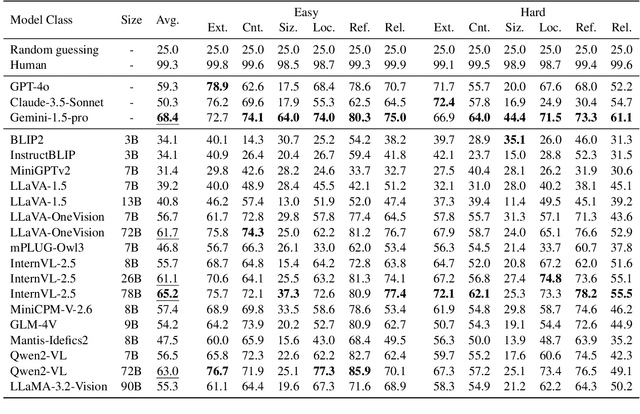
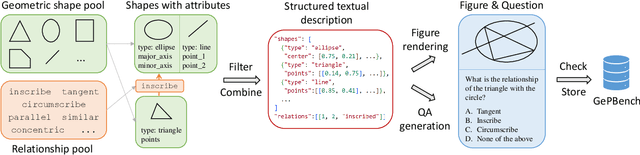
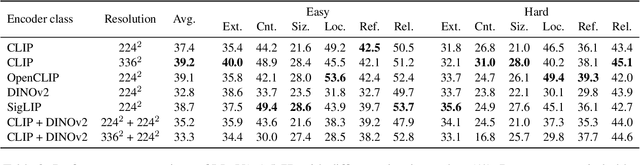
Multimodal large language models (MLLMs) have achieved significant advancements in integrating visual and linguistic understanding. While existing benchmarks evaluate these models in context-rich, real-life scenarios, they often overlook fundamental perceptual skills essential for environments deviating from everyday realism. In particular, geometric perception, the ability to interpret spatial relationships and abstract visual patterns, remains underexplored. To address this limitation, we introduce GePBench, a novel benchmark designed to assess the geometric perception capabilities of MLLMs. Results from extensive evaluations reveal that current state-of-the-art MLLMs exhibit significant deficiencies in such tasks. Additionally, we demonstrate that models trained with data sourced from GePBench show notable improvements on a wide range of downstream tasks, underscoring the importance of geometric perception as a foundation for advanced multimodal applications. Our code and datasets will be publicly available.