 Add to Chrome
 Add to Firefox
 Add to Edge
A Synthetic-Driven Vision System for Assembly Step Recognition
Jun 30, 2026
Quality control in industrial assembly is essential, and real-time monitoring of the assembly process is crucial for preventing costly defects and ensuring production reliability. Vision-based automated inspection offers a powerful solution for such real-time monitoring. However, due to the specialized industrial components and processes, training these models typically relies on task-specific real-world data, which is costly and labor-intensive to collect and annotate. In this paper, we propose a system that automatically generates realistic assembly sequences and further trains real-time inspection models using the synthetic data. It can be efficiently applied to a given task within an hour, requiring only CAD models and simple step descriptions. Focusing on practical challenges, our system integrates a physics-based motion generation module to capture the variance of different human assembly, designs domain-randomized rendering to deal with the environmental complexity and variation, and employs an object-detection-based step recognition module for robust sim-to-real transfer, leading to 92.4% accuracy on a real-world assembly case with 46.7%, 15.8% and 61.2% performance improvement, respectively. Overall, our system provides a practical solution for industrial assembly inspection without requiring expensive real-world data collection and annotation, with the effectiveness validated on real industrial assembly tasks.

Dynamic Control Barrier Function-based Model Predictive Control to Safety-Critical Obstacle-Avoidance of Mobile Robot
Sep 18, 2022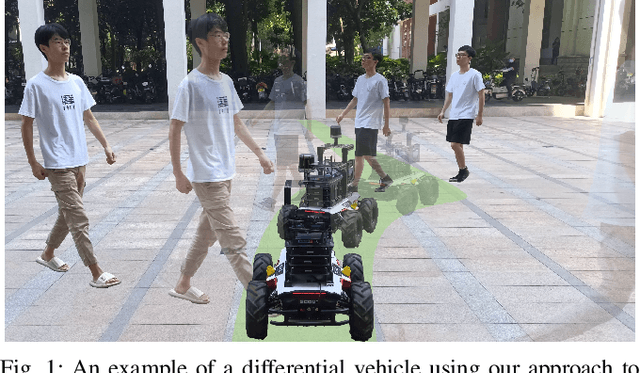
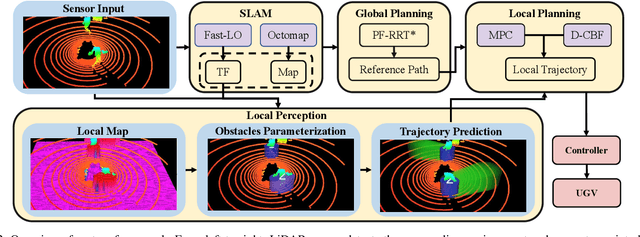
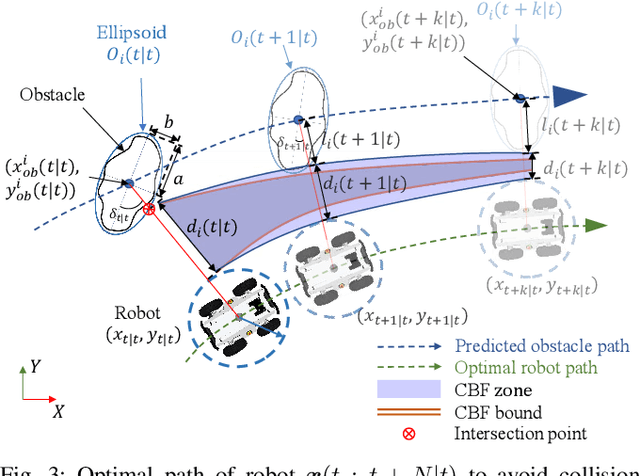
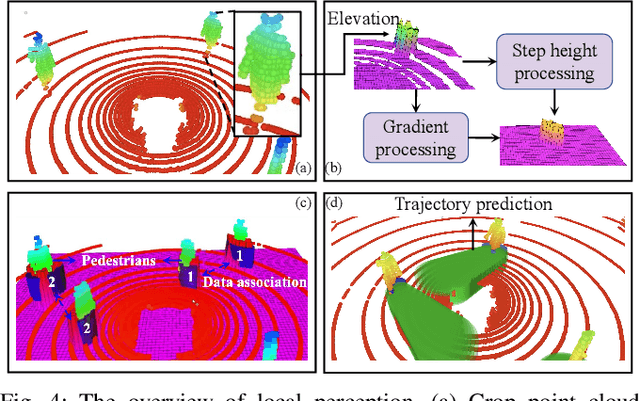
This paper presents an efficient and safe method to avoid static and dynamic obstacles based on LiDAR. First, point cloud is used to generate a real-time local grid map for obstacle detection. Then, obstacles are clustered by DBSCAN algorithm and enclosed with minimum bounding ellipses (MBEs). In addition, data association is conducted to match each MBE with the obstacle in the current frame. Considering MBE as an observation, Kalman filter (KF) is used to estimate and predict the motion state of the obstacle. In this way, the trajectory of each obstacle in the forward time domain can be parameterized as a set of ellipses. Due to the uncertainty of the MBE, the semi-major and semi-minor axes of the parameterized ellipse are extended to ensure safety. We extend the traditional Control Barrier Function (CBF) and propose Dynamic Control Barrier Function (D-CBF). We combine D-CBF with Model Predictive Control (MPC) to implement safety-critical dynamic obstacle avoidance. Experiments in simulated and real scenarios are conducted to verify the effectiveness of our algorithm. The source code is released for the reference of the community.