 Add to Chrome
 Add to Firefox
 Add to Edge
NPSolver: Neural Poisson Solver with Iterative Physics Supervision
May 25, 2026
Efficiently solving Poisson equations on complex, irregular domains remains a fundamental challenge in scientific computing, as classical iterative solvers often suffer from prohibitive runtime due to ill-conditioned systems. While neural operators offer a fast alternative, they typically rely on large-scale labeled datasets or struggle with unstable training dynamics when using physics-informed residual losses. We propose \textsc{NPSolver}, a neural Poisson solver trained without solution labels via iterative physics supervision. Instead of relying on fully converged numerical solutions or raw PDE residuals, \textsc{NPSolver} utilizes a small number of preconditioned conjugate gradient (PCG) steps to refine its own predictions, providing a more stable and well-scaled training signal. Theoretical analysis confirms that this iterative supervision serves as a well-conditioned error proxy and that a stop-gradient design is essential for optimization stability. To better capture boundary-driven features under mixed boundary conditions, we further introduce the Boundary-Aware Transolver (\textsc{BA-Transolver}) architecture that explicitly separates interior and boundary tokenization. Extensive evaluations on 2D and 3D irregular geometries demonstrate that \textsc{NPSolver} outperforms both physics-informed and data-driven baselines. Furthermore, a downstream thermal control task highlights the model's capability for conducting efficient and reliable gradient-based boundary control. We will release our codes and data at https://github.com/intell-sci-comput/NPSolver.

Benchmarking neural surrogates on realistic spatiotemporal multiphysics flows
Dec 21, 2025Predicting multiphysics dynamics is computationally expensive and challenging due to the severe coupling of multi-scale, heterogeneous physical processes. While neural surrogates promise a paradigm shift, the field currently suffers from an "illusion of mastery", as repeatedly emphasized in top-tier commentaries: existing evaluations overly rely on simplified, low-dimensional proxies, which fail to expose the models' inherent fragility in realistic regimes. To bridge this critical gap, we present REALM (REalistic AI Learning for Multiphysics), a rigorous benchmarking framework designed to test neural surrogates on challenging, application-driven reactive flows. REALM features 11 high-fidelity datasets spanning from canonical multiphysics problems to complex propulsion and fire safety scenarios, alongside a standardized end-to-end training and evaluation protocol that incorporates multiphysics-aware preprocessing and a robust rollout strategy. Using this framework, we systematically benchmark over a dozen representative surrogate model families, including spectral operators, convolutional models, Transformers, pointwise operators, and graph/mesh networks, and identify three robust trends: (i) a scaling barrier governed jointly by dimensionality, stiffness, and mesh irregularity, leading to rapidly growing rollout errors; (ii) performance primarily controlled by architectural inductive biases rather than parameter count; and (iii) a persistent gap between nominal accuracy metrics and physically trustworthy behavior, where models with high correlations still miss key transient structures and integral quantities. Taken together, REALM exposes the limits of current neural surrogates on realistic multiphysics flows and offers a rigorous testbed to drive the development of next-generation physics-aware architectures.
LipidBERT: A Lipid Language Model Pre-trained on METiS de novo Lipid Library
Aug 12, 2024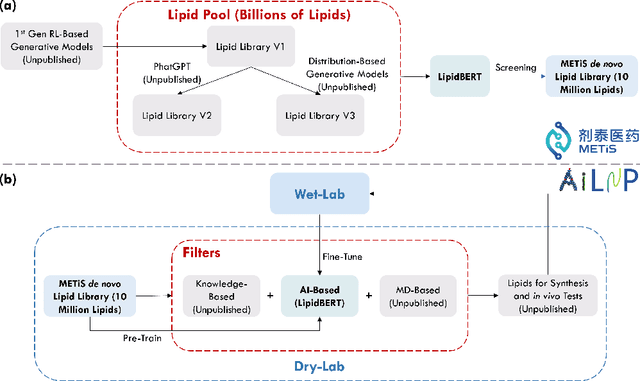
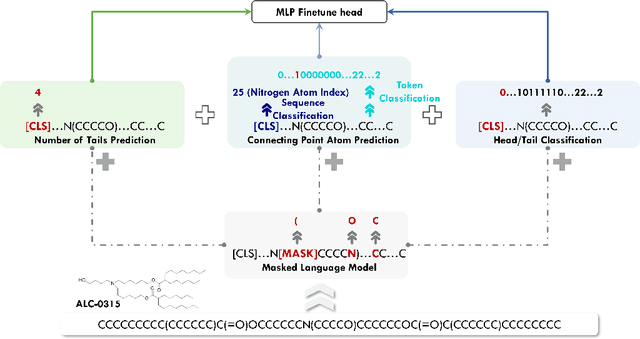
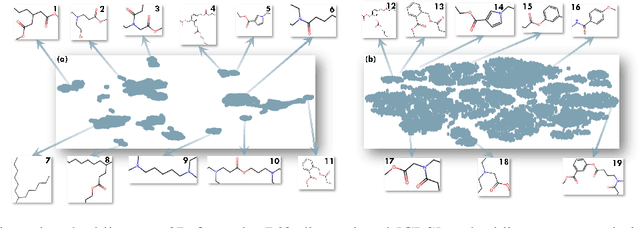
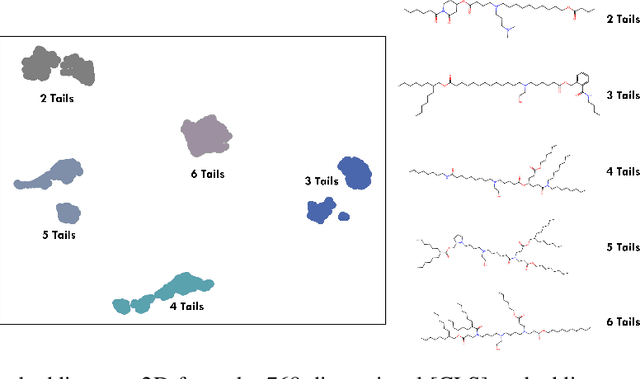
In this study, we generate and maintain a database of 10 million virtual lipids through METiS's in-house de novo lipid generation algorithms and lipid virtual screening techniques. These virtual lipids serve as a corpus for pre-training, lipid representation learning, and downstream task knowledge transfer, culminating in state-of-the-art LNP property prediction performance. We propose LipidBERT, a BERT-like model pre-trained with the Masked Language Model (MLM) and various secondary tasks. Additionally, we compare the performance of embeddings generated by LipidBERT and PhatGPT, our GPT-like lipid generation model, on downstream tasks. The proposed bilingual LipidBERT model operates in two languages: the language of ionizable lipid pre-training, using in-house dry-lab lipid structures, and the language of LNP fine-tuning, utilizing in-house LNP wet-lab data. This dual capability positions LipidBERT as a key AI-based filter for future screening tasks, including new versions of METiS de novo lipid libraries and, more importantly, candidates for in vivo testing for orgran-targeting LNPs. To the best of our knowledge, this is the first successful demonstration of the capability of a pre-trained language model on virtual lipids and its effectiveness in downstream tasks using web-lab data. This work showcases the clever utilization of METiS's in-house de novo lipid library as well as the power of dry-wet lab integration.